
Singapore’s EV charging prices remain stable, but an April increase looms

Observers say climbing natural gas prices and a bump in electricity tariffs could make charging more expensive from next month

Summarise
Derryn Wong
Published Fri, Mar 13, 2026 · 05:16 PM
    • Industry observers say that electric vehicles would still retain a cost advantage over petrol-powered ones even if charging prices go up.
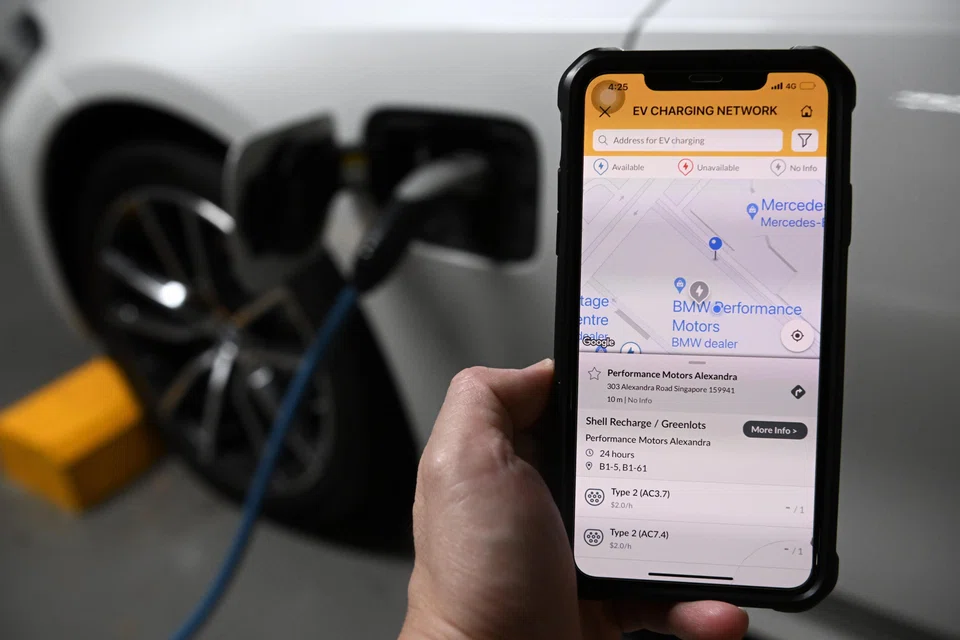
    • Industry observers say that electric vehicles would still retain a cost advantage over petrol-powered ones even if charging prices go up. PHOTO: BT FILE

    [SINGAPORE] Unlike petrol, charging rates for electric vehicles (EVs) have not spiked as a result of recent conflict in the Middle East – but observers say that could soon change as electricity prices are expected to rise in April on mounting energy costs.

    A senior manager at a major charging point operator (CPO) told The Business Times: “We are watching energy prices closely, and it is quite clear that the electricity tariff is likely to increase – the question is how much.”

    “If it is a small increase, we may be able to absorb some of the cost, but if it’s a large increase, then we may have no choice but to revise charging rates upward,” he added.

    Public EV charging rates in Singapore are typically set by CPOs based on several factors, with the price of electricity the dominant cost driver, noted Jimmy Peng, an associate professor at the National University of Singapore.

    “Because Singapore’s regulated electricity tariff is reviewed only once a quarter, any impact is not instantaneous. The current spike (in energy prices) will be reflected mainly in upcoming quarters rather than immediately,” he added.

    Petrol and diesel prices have climbed in recent weeks due to the war in the Middle East. As at Friday (Mar 13), the cost of a litre of 95-octane petrol was up 16 per cent at S$3.35, from S$2.88 in mid-February. Diesel prices climbed 27.1 per cent to S$3.38 a litre over the same period.

    While the majority of Singapore’s vehicle population still uses internal combustion engines (ICE), EV adoption has grown rapidly, and there is now a sizeable EV population of mostly passenger cars and light commercial vehicles.

    Based on Land Transport Authority data, there were 62,179 EVs in Singapore, making up 6.3 per cent of the total vehicle population of 984,131 as at February. In contrast, EVs accounted for less than 1 per cent of the total in 2022.

    Not jolting yet

    Public charging rates for EVs have remained stable.

    “So far, I have not seen broad‑based, immediate increases in EV charging tariffs directly attributed to the conflict,” Prof Peng said.

    “Individual operators may make small adjustments from time to time, but there has not yet been a clear, across‑the‑board, war‑driven jump.”

    The current rates for Singapore’s national public charging network range from around S$0.50 to S$0.80 per kilowatt hour, depending on the speed of the charger. These rates are largely unchanged from the costs before the conflict.

    The network is operated by five major CPOs: Charge+, ComfortDelGro Engie (CDG Engie), Shell, SP Mobility and Volt. Charge+ and CDG Engie said they have not raised charging prices.

    A spokesperson for CDG Engie said that numerous factors determine EV charging rates, including the cost of electricity, infrastructure investment, charger maintenance, site operating costs and network management. The company’s prices have remained the same since 2025.

    “At this time, our priority is to maintain stable and reliable charging services for EV drivers. As with any energy-related service, pricing may be reviewed periodically in response to changes in electricity costs and operating conditions,” the spokesperson added.

    BT has contacted Volt, Shell and SP Mobility for comment.

    Parth Pandit, a senior analyst at intelligence firm Rystad Energy, noted that the prices at which CPOs are receiving electricity under the commercial tariff are fixed until the end of March.

    Singapore’s electricity tariff is regulated by the Energy Market Authority and reviewed each quarter.

    Charges to charge

    The electricity tariff is expected to increase next quarter as the Gulf conflict has led to a blockade of the Strait of Hormuz, a key global channel for oil and liquefied natural gas (LNG), driving up the prices for those commodities.

    Ninety-five per cent of Singapore’s electricity is generated from natural gas imported from different parts of the world, of which 43 per cent was piped gas from Malaysia and Indonesia in 2025.

    LNG made up the remainder. According to Rystad Energy, 42.5 per cent of Singapore’s LNG last year originated from Qatar.

    Spot LNG prices in Asia are now about 80 per cent higher than before the conflict at around US$18 per million British thermal units.

    Minister-in-charge of Energy and Science and Technology Tan See Leng on Thursday said that while Singapore has multiple measures to ensure a stable energy supply, he nonetheless expects electricity prices to climb.

    “While these measures are in place to ensure Singapore has enough energy for our needs, global gas prices are indeed rising due to the conflict… We must therefore expect electricity prices to increase in the coming months,” he said.

    Higher electricity prices are likely to result in increased EV charging rates as well.

    “The expectation is that upward pressure on fuel costs, if sustained, will feed into higher electricity tariffs at future quarterly reviews,” Prof Peng said.

    But observers noted that EV charging prices may not track the electricity tariff closely, and differences among operators could also mean difficulty in predicting when and how much charging costs could rise.

    Both Prof Peng and Pandit said that CPOs would have to choose between passing the increase in tariffs to consumers, or absorbing them by reducing profit margins.

    If the tariff were to rise by 10 to 20 per cent, public charging tariffs might follow, said Prof Peng. However, the pass‑through is unlikely to be identical across operators due to competitive pressure and differing cost structures.

    Pandit added that some CPOs may have existing renewable energy contracts to source power, and could be insulated from these price hikes – allowing them to maintain stable prices or implement smaller increases in EV charging rates compared with their peers relying solely on the grid.

    EVs retain edge

    Yet, even if EV charging costs rise, they would still retain a substantial edge in running costs over ICE vehicles.

    “EVs generally retain a substantial running‑cost advantage over petrol vehicles in Singapore, because petrol prices at the pump react quickly to crude oil spikes and have already risen,” Prof Peng said.

    “For most drivers, the cost per kilometre for energy is still significantly lower for an EV than for an equivalent ICE car, especially if a portion of charging is done at home or at slower (alternating-current) chargers, where tariffs tend to be lower.”



