Singapore’s factory output beats forecast with 2.9% rise in May

Economists polled by Bloomberg are expecting a median expansion of 1.4 per cent

Tessa Oh
Published Wed, Jun 26, 2024 · 01:00 PM — Updated Wed, Jun 26, 2024 · 07:18 PM
    • Excluding the volatile biomedical sector, output increased 10.1 per cent year on year in May.
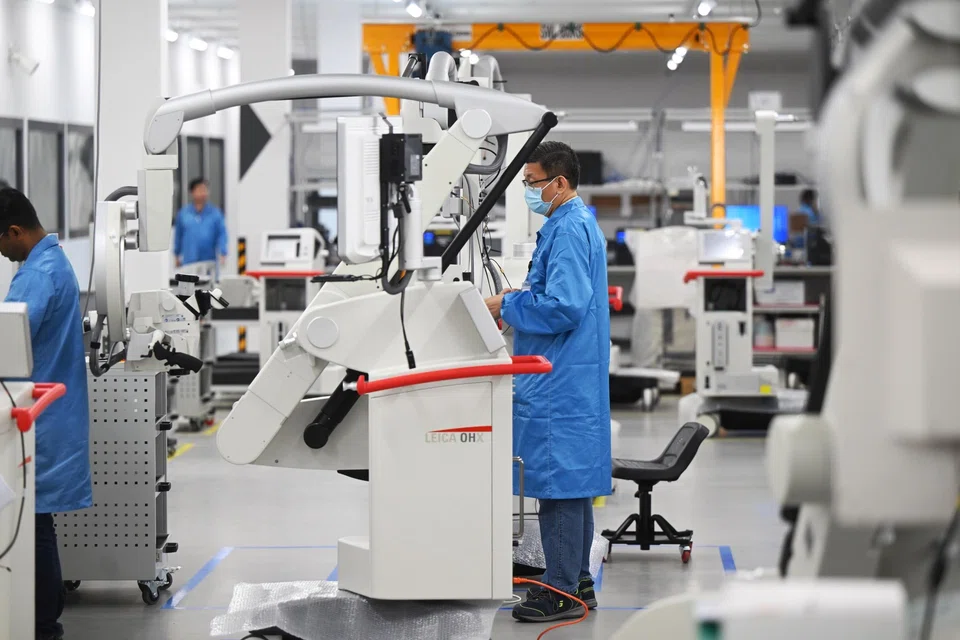
    • Excluding the volatile biomedical sector, output increased 10.1 per cent year on year in May. PHOTO: BT FILE

    SINGAPORE’S factory output grew 2.9 per cent year on year in May, as output in the key electronics sector rebounded from the previous month’s contraction, data from the Economic Development Board showed on Wednesday (Jun 26).

    This was better than the forecast given by private-sector economists, who predicted a 1.4 per cent expansion in a Bloomberg poll. It was also a turnaround from the previous month’s revised 1.2 per cent contraction.

    Excluding the volatile biomedical sector, output increased 10.1 per cent year on year in May, accelerating from April’s revised 1.9 per cent growth.

    DBS economist Chua Han Teng said: “The lift in Singapore’s factory output to expansion reflects an ongoing improvement from March’s sharp drop, and we continue to expect a gradual and fragile recovery in 2024.”

    Standard Chartered’s chief economist for Asean and South Asia Edward Lee said that May’s headline figures “pretty much sum up the growth so far – better but not roaring, which is in line with our expectations so far”.

    The month’s good performance was largely driven by an acceleration in electronics production, which expanded at the fastest rate since mid-2022, noted Chua.

    Output in the linchpin electronics cluster rose 20.1 per cent year on year in May, from a 1.1 per cent contraction recorded in the previous month. All segments recorded gains, with semiconductors recording a 20.6 per cent rise.

    The cluster’s performance will be key to Singapore’s manufacturing output recovery this year, said Chua.

    “It will be key to watch for sustained positive momentum, amid the ongoing global tech cycle upturn,” he said, adding that it will likely be underpinned by the replacement of smartphones and PCs, as well as the broadening use of artificial intelligence applications.

    But Chua cautioned to keep an eye on ongoing global uncertainties which could keep Singapore’s manufacturing improvement fragile.

    This includes ongoing geopolitical conflicts that could disrupt supply chains, a persistent US-China rivalry, as well as uncertainty surrounding the timing and extent of potential interest rate cuts by the US Federal Reserve.

    Cluster performance

    Biomedical manufacturing was the worst-performing cluster in May, deepening its slide with a contraction of 42.6 per cent year on year, extending April’s 27.7 per cent decline. Gains in the medical technology segment were offset by declines in pharmaceuticals.

    Other clusters which also recorded falls were precision engineering (-8.3 per cent) and general manufacturing (-4.4 per cent).

    In contrast, production in the remaining clusters grew on the year:

    • Chemicals (7.9 per cent)
    • Transport engineering (7.8 per cent)

    On a seasonally adjusted, monthly basis, manufacturing output grew 1.1 per cent, extending April’s revised 7.5 per cent expansion.

    Excluding biomedical manufacturing, output expanded 7.7 per cent, accelerating from the previous month’s 4.4 per cent growth.