Economists cut Singapore growth forecast after factory output dives 12.1% in August

SINGAPORE’S factory output fell a surprising 12.1 per cent year on year in August, contracting at a faster rate than in July, as the sector was dragged down by a plunge in electronics output.
Excluding the biomedical sector, which is typically volatile, factory output slipped 13.3 per cent, data from the Singapore Economic Development Board showed on Tuesday (Sep 26).
Singapore’s factory output has stayed in contraction territory for the past 11 months, with August being the weakest year-on-year reading since November 2019.
August’s performance was worse than July’s revised 1.1 per cent contraction, and much weaker than the 3.1 per cent dip that private-sector economists polled by Bloomberg were expecting.
Worse-than-expected print
Private-sector economists have downgraded their forecasts for the Republic’s industrial production as well as economic growth this year, following the worse-than-expected print for August.
RHB senior economist Barnabas Gan lowered his forecast for manufacturing output growth in 2023 to a 4 per cent contraction, from 0 per cent previously. With this, he also revised his full-year growth forecast to 1.5 per cent, from 2 per cent, with risks tilted to the downside.
UOB economists Alvin Liew and Jester Koh slashed their full-year estimate for industrial production growth to a 7 per cent contraction, from their earlier projection of a 5.4 per cent decline.
At the same time, the economists lowered their 2023 growth forecast to 0.4 per cent, from 0.7 per cent previously. The revised estimate is now below the lower end of the Ministry of Trade and Industry’s official 2023 growth projection of between 0.5 per cent and 1.5 per cent.
Nevertheless, economists were mixed on their near-term outlook for Singapore’s manufacturing recovery.
UOB’s Liew and Koh said the weak performance reaffirmed that the electronics downcycle – and more broadly, the trade downcycle – has yet to find a bottom.
August’s manufacturing performance continues to mirror the weak showing of non-oil domestic exports, which have also been contracting for 11 straight months.
“With external demand likely to weaken further amid an elevated interest rate environment and tighter global financial conditions, we expect the weakness in manufacturing activity to persist for the rest of the year,” they said, adding that any signs of recovery are likely to emerge only in the first quarter of next year at the earliest.
In contrast, RHB’s Gan was more optimistic, believing the deeper-than-expected contraction to probably be just a blip. “We see few indications that a decline of such magnitude in sequential numbers could persist in the fourth quarter.”
Signs are pointing towards an uptick in the electronics trade cycle, led by a potential bottoming of global semiconductor sales, he added, while high-frequency global economic data also suggests a continued improvement in the momentum of externally-facing activities.
DBS economist Chua Han Teng noted that the three-month moving average data shows the electronics slump has likely bottomed.
Nevertheless, August’s weak print suggests that the manufacturing sector’s recovery in the second half of the year is likely to be “gradual and fragile”, with the electronics turnaround yet to find a firm footing. Risks from lingering geopolitical disruptions could still disrupt supply chains.
This persistent weakness suggests that overall real gross domestic product expansion is likely to be soft in 2023, even as the services segments continue to benefit from the recovery in international tourism and large-scale events, added Chua.
On a seasonally adjusted month-on-month basis, manufacturing output decreased 10.5 per cent, reversing the previous month’s 3.7 per cent growth. Excluding biomedical manufacturing, factory output fell 16.6 per cent month on month.
Cluster performance
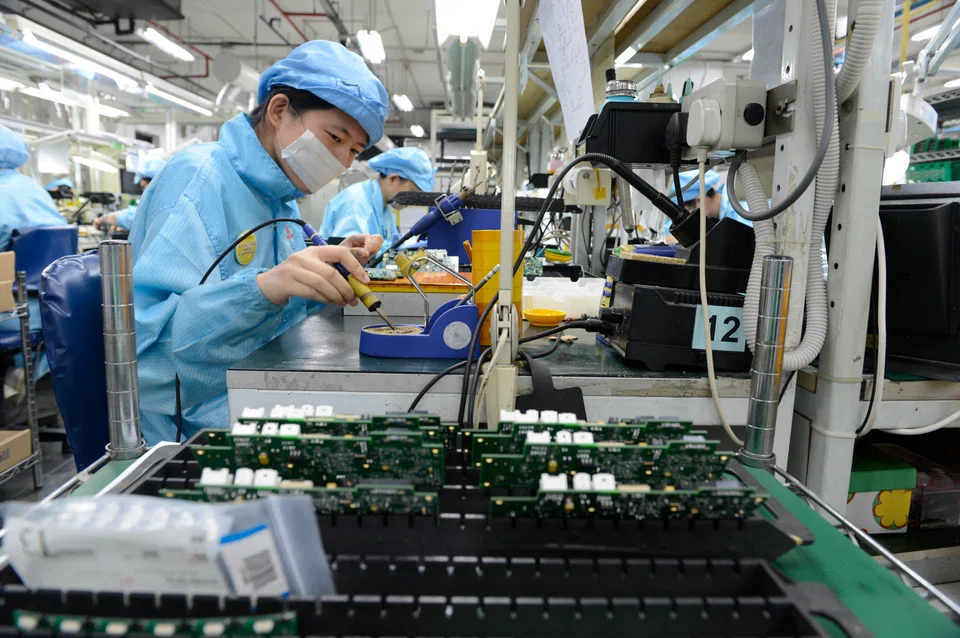
Output from the linchpin electronics cluster tumbled 20 per cent year on year in August, reversing the 5.1 per cent growth recorded in the previous month. It was the worst-performing cluster of the month.
The cluster was dragged down mainly by semiconductors, the output of which fell 23.7 per cent. Declines in computer peripherals and data storage, as well as other electronic modules and components, also contributed to the drop.
Other clusters that also recorded declines in August are:
- Biomedical manufacturing (-1.8 per cent)
- Chemicals (-5.9 per cent)
- Precision engineering (-14.4 per cent)
- General manufacturing industries (-6.1 per cent)
Transport engineering remained the only bright spot, growing at 16.2 per cent year on year – extending the previous month’s double-digit expansion.
The cluster’s good performance was driven by strong year-on-year readings in the marine and offshore engineering segment, which grew 29.4 per cent in August, against 28.1 per cent in the previous month.
The aerospace segment, which clocked double-digit growth of 15.2 per cent, also contributed to the cluster’s continued strong performance.