

Singapore’s factory output returns to growth with 1.8% rise in July, as electronics sector improves
Only the volatile biomedical manufacturing cluster falls

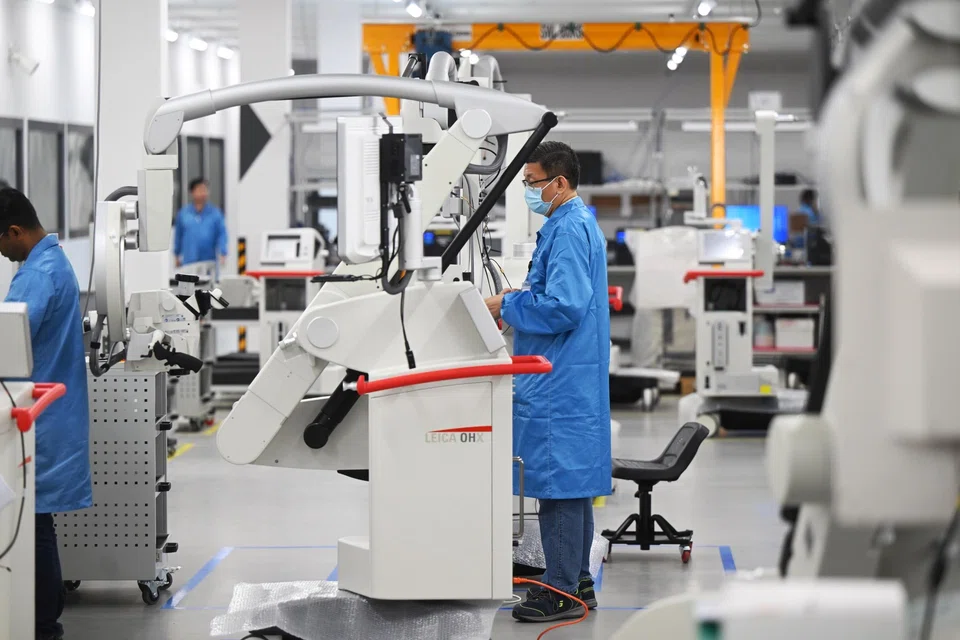
SINGAPORE’S factory output grew 1.8 per cent year on year in July, reversing from June’s revised 4.3 per cent decline, going by Economic Development Board (EDB) data on Monday (Aug 26).
The latest reading surpassed private-sector economists’ median forecast of 0.2 per cent growth in a Bloomberg poll.
Excluding the volatile biomedical sector, industrial production (IP) gained 3.4 per cent on year last month, in an about-turn from the 2.2 per cent contraction in June.
The headline figures indicate “better but not roaring” manufacturing recovery, in line with Standard Chartered’s expectations, said Edward Lee, chief economist and Head of FX for Asean and South Asia. (* see amendment note below)
Barclays senior regional economist Brian Tan said that while IP prints have been admittedly volatile, the July figure, following the 1.2 per cent year-on-year fall in Q2, “suggests some manufacturing lift could be at hand to offset an unfavourable base effect that will (optically) weigh on headline gross domestic product growth in Q3”.
Factory output in the key electronics sector rose 2.8 per cent from the year-ago period in July, reversing from June’s 6.7 per cent year-on-year slide.
The improved performance was led by the computer peripherals and data storage segment, which was up 34.9 per cent. Other electronics modules and components (6.1 per cent) and semiconductors (1.9 per cent) were also up, but the infocomms and consumer electronics segment (-6.6 per cent) contracted.
Electronics was the most optimistic cluster within the manufacturing sector for H2, based on EDB’s latest quarterly business expectations survey, said DBS economist Chua Han Teng.
“We continue to expect Singapore’s electronics firms to capitalise on the global technology upcycle, driven by the replacement of smartphones and PCs, as well as the broadening adoption of artificial intelligence applications,” he said.
The latest electronics data is also in line with Barclays’ view that the tech upcycle is broadening out of North Asia, especially into Malaysia and Singapore.
Transport engineering, with output up 13.3 per cent, was the other key support for recovery, particularly boosted by the aerospace segment.
Also recording growth were:
- Chemicals (1.7 per cent)
- Precision engineering (0.7 per cent) and
- General manufacturing (7.3 per cent)
Biomedical manufacturing was again the worst-performing cluster for the month; it was the only cluster in which production shrank. The July figure marked the fifth consecutive month of decline, noted Chua. Output fell 17.4 per cent year on year, narrowing from June’s 22.3 per cent decline.
EDB said: “The medical technology segment declined 1.6 per cent on the back of lower export demand for medical devices, while the pharmaceuticals segment contracted 27.4 per cent on account of a different mix of active pharmaceutical ingredients being produced compared to a year ago.”
On a seasonally adjusted, monthly basis, manufacturing output jumped 10.1 per cent in July, turning around from June’s revised 4.3 per cent drop. Excluding biomedical manufacturing, production climbed 4.1 per cent on the month, seasonally adjusted, reversing from the 6.9 per cent decline charted in the preceding month.
RHB acting group chief economist Barnabas Gan and associate research analyst Laalitha Raveenthar expect continuous year-on-year manufacturing improvement for the rest of the year.
“Today’s upside surprise has translated into a year-to-date IP contraction of 1 per cent, from H1 2024’s contraction of 1.4 per cent,” said the duo.
Expansion in several sectors reflects ongoing recovery in major economies such as the US and China, and Singapore’s IP growth momentum is anticipated to recover in H2 on the back of the improved global backdrop, they said.
IP’s return to growth at the start of Q3 aligns with DBS’ expectation of a gradual recovery in the second half of this year, after Q2’s choppy performance, though Chua warned that uncertainties such as further intensification of geopolitical conflicts could weigh on global trade and manufacturing activity.
* Amendment note: An earlier version of this story referred to Edward Lee as chief economist for Asean and South-east Asia at Standard Chartered. He is in fact chief economist and Head of FX for Asean and South Asia.
TRENDING NOW

Once staunchly pro-China, Malaysian Chinese businesses are now distancing themselves from Beijing

Looking beyond looming CEO succession, should UOB potentially pursue a transformative merger?

Could stablecoins be the future of money?

Grab CEO’s wife Chloe Tong on life with Anthony Tan and finding her purpose

