

Singapore’s factory output contracts at slower pace in June, beating expectations

Tessa Oh
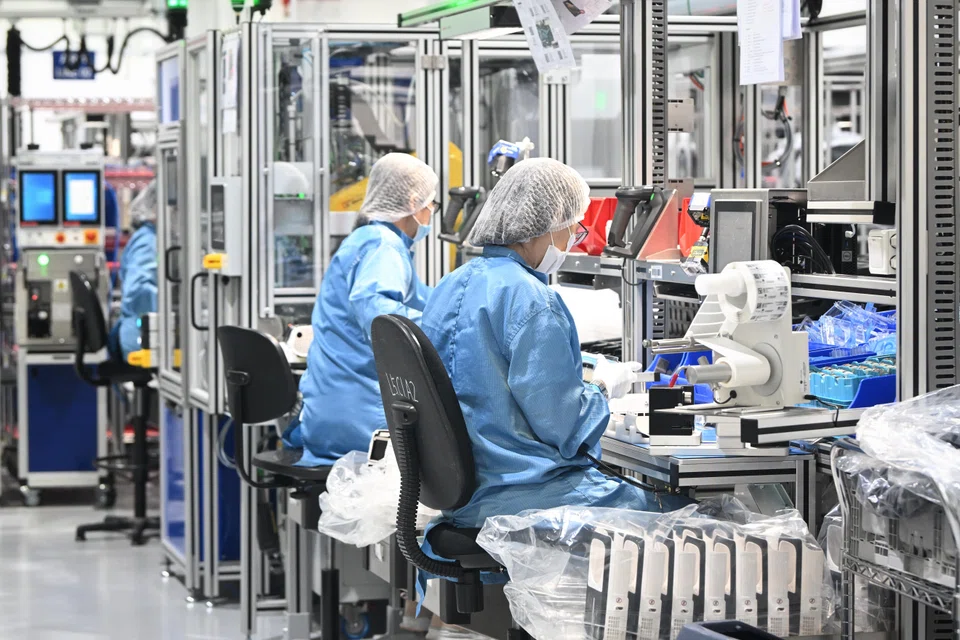
SINGAPORE’S factory output fell 4.9 per cent year on year in June, contracting at a slower rate than a month ago as the electronics segment recorded a smaller decline, data from the Singapore Economic Development Board (EDB) showed on Wednesday (Jul 26).
Excluding the biomedical cluster, which is typically volatile, factory output fell 5.2 per cent year on year in June.
While June’s output data marked nine straight months of contraction, it was still lower than May’s revised figure of a 10.5 per cent decline, and better than the 6 per cent contraction that private-sector economists polled by Bloomberg were expecting.
The better-than-expected print suggests that the worst of the manufacturing downturn could be over and the sector could start to see improvements in the second half of the year, said economists.
“A modest export boost from China’s reopening and possible stabilisation in global electronics demand could provide some support in the second half, driving a modest manufacturing recovery with small positive growth in the fourth quarter,” said Maybank economists Chua Hak Bin and Brian Lee.
RHB senior economist Barnabas Gan noted that sequential growth has moved “decidedly higher” year to date, in line with the positive data from the rest of the region. “These green shoots will turn into trees in the next two months, with the recovery of global trade and manufacturing momentum to persist in the second half of 2023.”
OCBC chief economist Selena Ling estimated that manufacturing output could contract by a smaller 1.9 per cent year on year, and record a 4.4 per cent contraction for the full year. For the first six months of the year, manufacturing output shrank 6.3 per cent, according to EDB.
As for how the latest data could affect Singapore’s final second-quarter growth print, Gan said he believes it will “likely do little to move the needle”, and there is a marginal risk of a downward revision.
In contrast, UOB senior economist Alvin Liew was more optimistic, believing that there could be a small upward revision to second-quarter growth, assuming no significant changes to the growth of services and construction.
On a seasonally adjusted month-on-month basis, manufacturing output grew 5 per cent, reversing the previous month’s 3.6 per cent contraction. Excluding biomedical manufacturing, factory output was up 6.6 per cent month on month.
Barclays senior regional economist Brian Tan noted that the main driver of the sequential rebound was electronics output, which grew 13.7 per cent month on month in June, reversing the 10.9 per cent plunge the month before.
Even so, he cautioned about being overly optimistic on the sector as electronics output has been volatile, though not to the same extent as the biomedical segment.
June’s manufacturing performance continues to mirror the weak showing of non-oil domestic exports, which has also been contracting for nine straight months.
Cluster performance
Output from the linchpin electronics cluster continued to shrink year on year in June, falling 2.9 per cent.
The biggest drag on growth were the computer peripherals and data storage, as well as infocomms and consumer electronics segments, which declined 25.8 per cent and 17.7 per cent respectively. In contrast, the other electronic modules and components, and semiconductors segments grew 7.5 per cent and 3.1 per cent respectively.
Precision engineering was the worst-performing cluster in June, clocking an overall contraction of 11.5 per cent year on year, extending May’s 10.5 per cent decline.
Other clusters which also saw declines in June were:
- Biomedical manufacturing (-1.8 per cent)
- Chemicals (-8.6 per cent)
- General manufacturing industries (-7.5 per cent)
Transport engineering was the only bright spot, recording year-on-year growth of 10.8 per cent.
This was led by the aerospace segment, which expanded 16.7 per cent due to higher demand for aircraft parts, as well as more maintenance, repair and overhaul jobs from commercial airlines, given the recovery of global air traffic post-Covid-19.
TRENDING NOW

Once staunchly pro-China, Malaysian Chinese businesses are now distancing themselves from Beijing

Grab CEO’s wife Chloe Tong on life with Anthony Tan and finding her purpose

Could stablecoins be the future of money?
ST Engineering opens tech-focused aircraft maintenance facility in Changi; to create over 500 jobs

