

Economists expect Singapore’s key exports to continue recovery after April’s 9.3% slide eases from March
But some are less optimistic about the recovery, with OCBC noting the risk of falling short of official full-year estimates and UOB downgrading its forecast

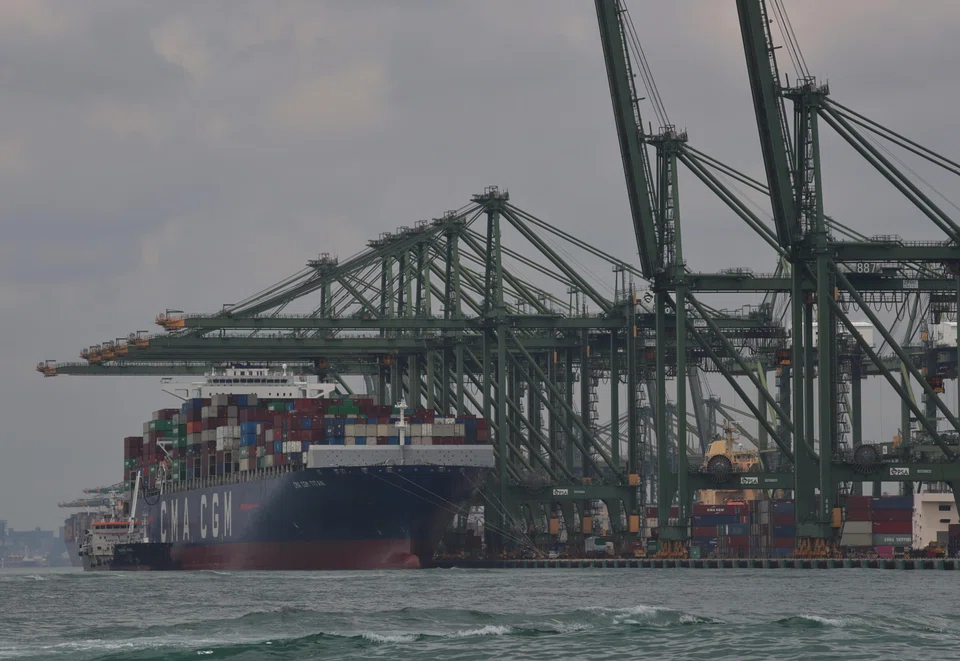
SINGAPORE’S non-oil domestic exports (NODX) slid 9.3 per cent from the year-ago high base in April, dragged down by a decrease in the non-electronics sector, particularly in volatile products.
This was a gentler contraction than the revised 20.8 per cent tumble charted in March, but slightly worse than the median 8.9 per cent drop forecast by private-sector economists in a Bloomberg poll.
Year on year, non-electronics exports decreased, while electronics exports resumed growth, data from Enterprise Singapore (EnterpriseSG) showed on Friday (May 17).
On a seasonally adjusted, monthly basis, NODX climbed 7.6 per cent in April, reversing from March’s 8.5 per cent fall. Both non-electronics and electronics exports increased.
Key exports’ value hit S$14 billion last month, seasonally adjusted, up from S$13 billion in the preceding month. But it was lower than the 2023 average of S$14.5 billion, and the year-ago period’s S$16 billion.
Better electronics showing
Non-electronics shipments last month slid 12.3 per cent from the year-ago period, easing from the 23.2 per cent contraction reported in March. Contributing most to the drop were pharmaceuticals (-73.3 per cent), non-electric engines and motors (-64 per cent) and food preparation (-12.9 per cent).
OCBC chief economist Selena Ling said: “Given the volatility of pharmaceuticals production and, in turn, exports, it is likely that the underperformance may sustain for a while longer.”
Excluding volatile pharmaceuticals, DBS estimates better non-electronics NODX performance in April, DBS economist Chua Han Teng said – a rebound to 8.6 per cent growth from March’s 11.1 per cent decline.
Meanwhile, electronics NODX gained 3.3 per cent on year in April, in an about-turn from the previous month’s 9.5 per cent fall. PCs (73.3 per cent), disk media products (39.6 per cent) and other computer peripherals (782.6 per cent) led the expansion.
“Integrated circuits shipments, which account for roughly half of electronics NODX, fell slightly by 3.6 per cent year on year in April 2024, but were well off the double-digit contractions seen for most of 2023,” noted Chua.
Accounting for NODX’s inherent volatility, electronics exports continued to exhibit incrementally narrower contractions from May 2023’s weakest reading, said UOB associate economist Jester Koh.
Weaker recovery?
Economists expect NODX to pick up in the coming months, noting encouraging Purchasing Managers’ Index data, more favourable base effects and the continued electronics cycle upturn – but some warned that it may be weaker than anticipated.
Base effects remain favourable for May to August, “while underlying end-demand fundamentals are intact, driven by the structural boost from generative AI-related applications, which have positive spillovers to the consumer segment”, Koh said.
The NODX prognosis should gradually improve in H2 2024 on the back of electronics improvement, said OCBC’s Ling in agreement; she also noted the potential stabilisation of China’s gross domestic product growth as a driver of recovery.
“AI (artificial intelligence) hype continues to provide a tailwind to the global chip industry by driving demand for high-performance memory chips,” she said.
But geopolitics increasingly weighs on investment decisions, she added, raising the example of the Biden administration’s multi-billion dollar awards for chip plants to be built in the US to ramp up domestic production of semiconductors.
Maybank economists Chua Hak Bin and Brian Lee added: “Singapore’s semiconductor sector is not as leveraged to the ongoing boom in advanced chips for AI servers, compared to peers like Taiwan and South Korea.”
Ling also noted that while some global chipmakers are still guiding for worldwide recovery in H2, demand in China may be mixed. It may depend on whether the chips are for Apple or Android phones, and China’s Semiconductor Manufacturing International Corporation warned of a fiercer price war for less advanced chips domestically.
EnterpriseSG in February upgraded its full-year forecast for NODX to growth of 4 to 6 per cent on year.
The lower end of the official full-year forecast may appear to be somewhat at risk at this juncture, said Ling, noting that the first four months’ NODX performance is “already at a weaker-than-expected -4.9 per cent year on year”.
UOB downgraded its full-year NODX growth forecast to 4.5 per cent from 6 per cent, to reflect this weaker year-to-date performance, even as it expects “a more meaningful recovery in the latter half of the year”.
DBS’ Chua continues to anticipate exports recovery to be “gradual and fragile” this year, highlighting global uncertainties, including supply-chain disruptions from geopolitical conflicts, persistent US-China rivalry and economic policy uncertainty.
Mixed performance across markets
NODX to Singapore’s top markets as a whole shrank in April, mainly due to the US (-40.6 per cent), European Union (-55.1 per cent) and South Korea (-23.8 per cent).
But NODX to half of the top 10 markets – China, Malaysia, Hong Kong, Indonesia and Japan – expanded, marking an improvement from March, when growth was recorded in only three markets, noted OCBC’s Ling.
Said UOB’s Koh: “Singapore’s NODX by key markets somewhat reflects the asynchronous growth path between advanced economies (namely the US and eurozone) versus China.”
Overall, total trade grew 15.7 per cent in April, reversing from the 1.9 per cent decline in March. Total exports last month rose 13.3 per cent, while total imports were up 18.3 per cent. In March, total exports contracted 3.4 per cent, while total imports decreased 0.1 per cent.
On a seasonally adjusted monthly basis, total trade was up 4 per cent last month, following March’s 2.2 per cent growth. On a seasonally adjusted basis, the level of total trade reached S$111.1 billion, more than the preceding month’s S$106.9 billion. Total exports expanded 3.7 per cent, and imports grew 4.3 per cent.
TRENDING NOW
‘Wasting money, spending tokens’: Companies still in search of AI use cases with worthwhile ROI, says Broadcom’s Hock Tan

Malaysian king buys stake in Singapore-listed mining firm expanding into rare earths

Once staunchly pro-China, Malaysian Chinese businesses are now distancing themselves from Beijing
Singapore’s wealth management success should extend to everyday families

