

Economists expect tech upcycle to lift Singapore’s key exports in H2 after better-than-expected 0.1% slide in May
But downside risks, including geopolitical conflicts and supply chain disruptions, may dampen recovery

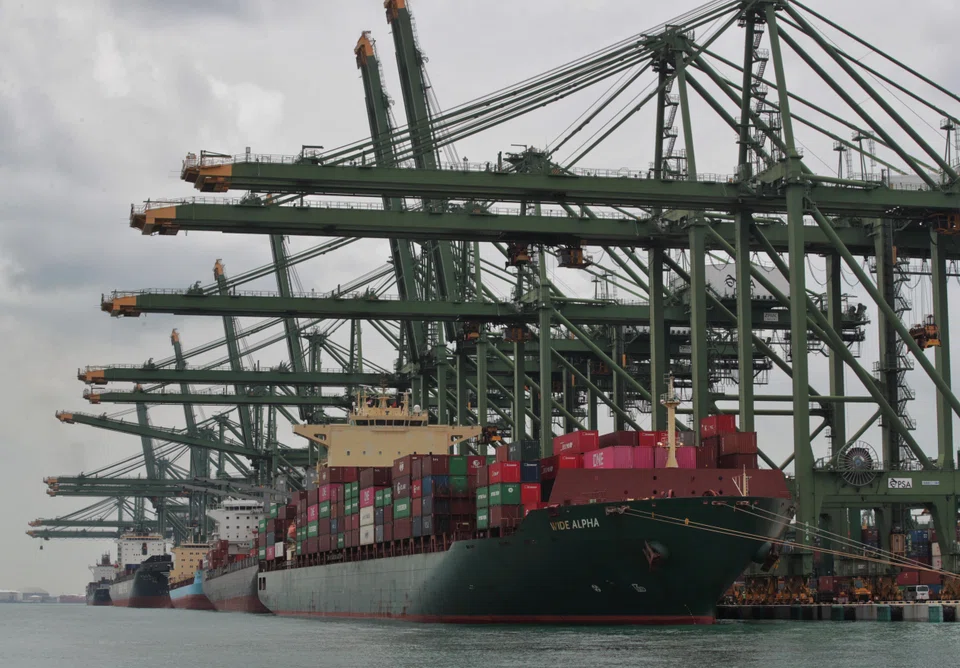
SINGAPORE’S non-oil domestic exports (NODX) beat analyst expectations to shrink 0.1 per cent year on year (yoy) in May, as electronics shipments continued to recover on the back of the global tech upswing.
May’s print moderated from the previous month’s revised 9.6 per cent contraction and marked the mildest decline in 20 months, data from Enterprise Singapore (EnterpriseSG) showed on Tuesday (Jun 18). It was also better than the 1.1 per cent decline private-sector economists predicted in a Bloomberg poll.
On a seasonally adjusted monthly basis, NODX declined 0.1 per cent in May, reversing from April’s revised 7.3 per cent expansion. While non-electronics decreased, electronics grew.
“While the recovery in the trade cycle offers optimism to Asian exporters, the trend appears to have not yet been reflected in Singapore’s NODX data,” said HSBC Asean economist Yun Liu.
In May, Singapore’s key exports continued to be dragged by falling non-electronics shipments. Non-electronics exports slid 6 per cent from the year-ago period, extending the previous month’s 12.6 per cent contraction. Declines in non-monetary gold (-47.2 per cent), pharmaceuticals (-37.5 per cent) and electrical circuit apparatus (-21.8 per cent) contributed most to the fall.
Electronics recovery
But, the global tech upcycle is expected to continue lifting electronics shipments in the coming months, which will in turn aid Singapore’s NODX recovery in the second half of 2024, said economists.
Additionally, the decline in pharmaceuticals – which has been a drag on growth – may not sustain, given the inherent volatility of the cluster, they noted.
“We anticipate a recovery in Singapore’s NODX growth momentum in H2 2024, driven by an improved global backdrop,” said RHB acting chief economist Barnabas Gan and associate research analyst Laalitha Raveenthar, who kept to their full-year NODX forecast of 0.5 per cent.
In particular, there is “strong growth potential” for Singapore’s electronics sector in the second half of the year, said the analysts. “This sector is expected to benefit from the ongoing upswing in the global tech cycle, which will support electronic production in the coming quarters.”
Electronics exports grew 21.9 per cent, extending the previous month’s 3.3 per cent increase and marking the first double-digit growth in almost two years. Growth in integrated circuit (35.8 per cent), disk media product (92 per cent) and PC (27.2 per cent) exports contributed the most to May’s expansion.
“The sharp improvement is thanks to both rising NAND prices and higher production volumes, reflecting global demand for artificial intelligence-powered chips,” said HSBC’s Liu. “The momentum continues to fuel optimism that a rebound in the tech cycle will be a main driver of growth this year.”
RHB’s Gan and Raveenthar noted that the growth of these segments reflected the ongoing recovery in key economies such as the United States and China.
Yet, there is a need to keep an eye on ongoing global uncertainties that could keep Singapore’s manufacturing improvement fragile, said DBS economist Chua Han Teng. “Global uncertainties include ongoing geopolitical conflicts that could still disrupt supply chains and persistent US-China rivalry, as well as economic policy uncertainty, such as the timing and extent of potential US interest-rate cuts.”
Maybank economists Chua Hak Bin and Brian Lee identified supply chain disruptions due to port congestion as another risk that may dampen manufacturing recovery, due to delays in supplies of imported components, longer export fulfilment times and higher freight rates.
Nevertheless, they kept to their full-year NODX forecast of between 7 and 9 per cent. “The encouraging May print, alongside robust growth in IC (integrated circuits) shipments, is in line with our view that tech demand shows tentative signs of broadening.”
NODX to top markets
Key exports’ value hit S$13.9 billion in May, seasonally adjusted, the same as the previous month, but lower than the 2023 average of S$14.5 billion and the year-ago period’s S$14 billion.
NODX to Singapore’s top markets as a whole grew in May, mainly due to Hong Kong (73.4 per cent), Malaysia (23.6 per cent) and the US (12.1 per cent). In contrast, NODX to China, Taiwan, the EU27, Japan and Thailand declined.
Overall, total trade grew 14.2 per cent last month, extending the revised 15.6 per cent growth recorded in April. Total exports rose 12.6 per cent, while total imports were up by 16 per cent.
But on a seasonally adjusted monthly basis, total trade fell 2.4 per cent in May, reversing from the 3.9 per cent expansion recorded the preceding month.
On a seasonally adjusted basis, the level of total trade reached S$108.3 billion, less than the previous month’s S$111 billion. Total exports fell 2.3 per cent, and imports declined 2.6 per cent.
In May, EnterpriseSG cautioned that NODX could come at the lower range of the 4 to 6 per cent forecast, given the worse-than-expected trade performance in the first quarter. This came just three months after authorities upgraded their full-year exports outlook.
In Q1, NODX fell 3.4 per cent yoy, a deeper contraction than the 1.4 per cent decrease in the final quarter of 2023.
TRENDING NOW

Grab CEO’s wife Chloe Tong on life with Anthony Tan and finding her purpose
Jacqueline Loh to step down as MAS deputy MD in senior leadership reshuffle

Why 1 in 2 young Singaporeans who said ‘no kids’ now say ‘yes please’: new study
Private home prices accelerate with 1.4% rise while HDB resale values dip further in Q3: flash data

