

Singapore’s Parf rebate cut may favour China EV brands as ownership and borrowing costs rise
Industry players say the move will have far-reaching consequences across the automotive value chain

[SINGAPORE] The cut in Preferential Additional Registration Fee (Parf) rebates marks one of the most consequential policy shifts for Singapore’s car market in years.
The implications extend beyond car sales and Certificate of Entitlement (COE) premiums to every aspect of the industry.
The full impact is unlikely to be immediate. As the changes apply to cars registered from Friday (Feb 20) onwards, the effects will take time to filter through the market.
The Business Times spoke to many players across the automotive sector, including car dealers, private-hire car (PHC) rental companies, and consultants. Most expressed concern over the wide-ranging nature of the change, with knock-on effects that are likely to reverberate across the entire ecosystem.
Here are some possible consequences.
The move could further boost Chinese electric vehicle (EV) brands, accelerate industry consolidation and hamstring legacy players.
It may ease COE premiums for large cars in the near term, but could also raise the cost of car loans and the operating costs for taxis and ride-hailing services. Insurance premiums may also come under upward pressure.
Accelerate change
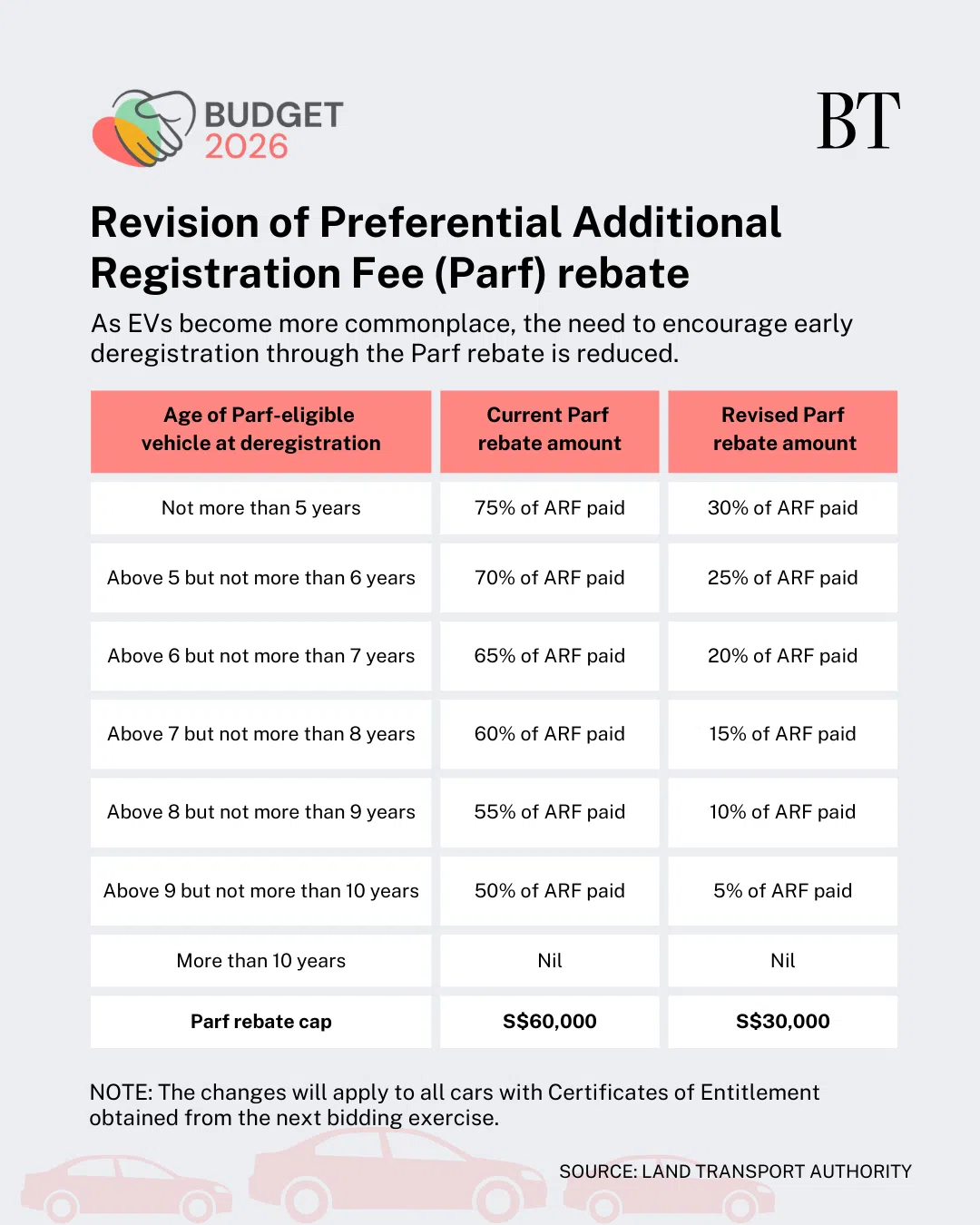
Last week, Prime Minister and Finance Minister Lawrence Wong announced during Budget 2026 that the Parf rebate for all cars would be reduced by 45 percentage points, and capped at a maximum of S$30,000, down from S$60,000.
The move reflects the view that as less-pollutive EVs become more prevalent, there is less need to incentivise early deregistration, noted PM Wong.
The Parf rebate was originally designed to encourage motorists to deregister petrol-powered cars before the end of their 10-year COE lifespan, with higher rebates paid for earlier deregistration.
The change will hasten the ascent of China brands and the consolidation of the car industry. Some brands, likely smaller legacy players, may exit the market entirely.
China’s carmakers are a direct beneficiary of the move, which applies to all cars registered from the next round of COE bidding, which ends on Feb 20.
The Parf rebate is calculated based on the Additional Registration Fee (ARF). ARF is a tiered tax on cars – the more expensive a car is, the more tax it attracts. The ARF is based on the open market value (OMV) of a car, which is its price when it lands in Singapore, before any major taxes are applied.
Because the rebate’s cap has been halved to S$30,000, cheaper cars will retain a higher proportion of their value.
This means that their depreciation – the yearly reduction in residual value calculated using the Parf rebate and remaining amount of COE – is less than that of more expensive cars, both in absolute and percentage terms.
The cars with less depreciation will be those with a lower OMV. While manufacturers all strive to keep OMV, and hence tax, low, Chinese carmakers are more able to deliver this now with their massive economies of scale at home and hunger for overseas expansion and market share – and that is before EV rebates apply.
An example is BYD’s eye-catching ascent to become Singapore’s best-selling car brand in just a few years, fuelled by a willingness to deliver extremely competitive pricing to grow market share.
More EVs are a good thing: They will reduce pollution and improve emissions performance. The flip side is that brands with more non-EVs and more expensive models face decreasing competitiveness, and this includes major Japanese and European brands, especially luxury ones.
Arguably, this is something that is already happening in mainstream cars, but the Parf changes will accelerate this to include luxury cars – the area where China is not strong yet.
The introduction of a new Parf rebate cap of S$60,000 in 2023, coupled with increased ARF, saw sales in the ultra-luxury car sector slump by as much as 80 per cent for some brands in 2024. They have still not recovered to pre-2023 levels.
Those brands are still present here, but some have had to lay off staff and scale down their operations. While the ultra-luxury sector is unique, similar effects might be seen in the wider car market with the change as the industry enters a new and uncertain phase.
Near-term COE dip?
There is the possible near-term effect that COE premiums for Category B, for larger or premium cars, could go down.
With the depreciation of more expensive cars set to be much higher, the sales of luxury or premium models could be affected. This would cause Category B demand to dip, along with its COE premium.
At the same time, the one reliable thing that spurs higher COE demand is a lower premium. Since the premium difference between categories A and B was just S$4,570 as at February’s first round of bidding, we could end up with a rare situation where Category B’s premium is lower than that of A.
If that happens, buyers would simply switch to Category B models. This would benefit more expensive cars once again, but how long that would last is the question.
Yet, it is more likely that higher depreciation of more car models will drive motoring costs up across the board: ride-hailing trips, interest rates and insurance premiums for non-EVs.
Both taxis and private-hire cars pay ARF and have Parf rebates. Rental rates for these cars are calculated based on the cost of maintaining the car and its depreciation per month.
Smaller Parf rebates would mean higher rental costs, which would be passed on to consumers. This would increase the price of ride-hail and taxi trips.
It could also increase interest rates for car loans, a move that would affect both consumers and PHC rental companies.
The calculation for car loan interest rates includes Parf rebates, since higher Parf rebates mean more money recovered in case of a default, reducing risk. The opposite would mean that lenders need to build more risk coverage by raising interest rates.
Insurance premiums may also rise, because of a wider gap between the on-paper value and market value of cars. This would likely be funded by increases in insurance premiums.
Other significant changes may also emerge, some potentially positive, with the full effects only becoming clear when the first batch of affected cars reaches the end of its COE lifespan a decade from now.
This includes a general reduction in used-car prices, fewer deregistrations in the future, and a more stable COE supply in the long term.
Calls for greater engagement
Among the roughly 10 industry players to whom BT spoke, the overarching response – beyond about the uncertainty created by the changes – was that there appears to have been limited prior consultation with the industry before such a significant policy shift.
While there was acknowledgement that the changes are market-moving and that it would have been difficult to signal or share details in advance, industry players said that the scale of the adjustment and the resulting uncertainty are significant.
Some further suggested that a more gradual implementation could have been considered.
TRENDING NOW

Good Class Bungalow market activity picks up pace on ‘realistic’ pricing

Indonesia imposes US$116 million in fines over manipulation of Sinar Mas, Prajogo-linked stocks

Singapore identifies 7 firms responsible for haze fires, notices issued urging action: Grace Fu

Once staunchly pro-China, Malaysian Chinese businesses are now distancing themselves from Beijing

