

Singapore’s PMI edges up to 51.3 in June on AI-related tailwinds
Regional manufacturing performance is mixed in June

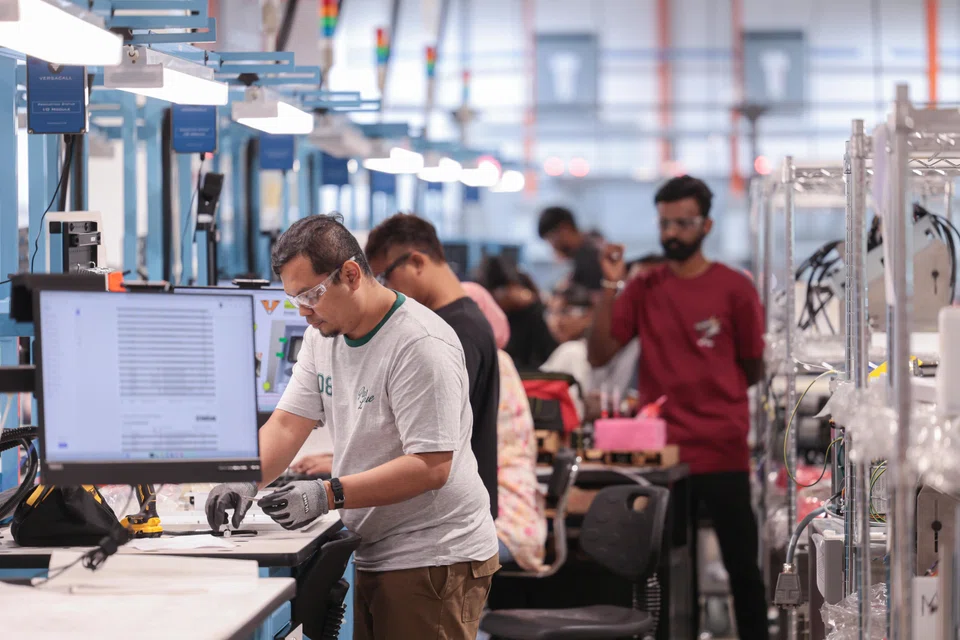
[SINGAPORE] The Republic’s factory activity expanded at a faster pace in June, remaining supported by artificial intelligence-related tailwinds amid continued – but potentially easing – challenges posed by the ongoing Middle East conflict.
The purchasing managers’ index (PMI) edged up 0.3 point to 51.3, data from the Singapore Institute of Purchasing and Materials Management (SIPMM) showed on Thursday (Jul 2). This marked 11 consecutive months of growth and the highest reading since November 2018.
A reading above 50 indicates expansion, while one below 50 indicates decline.
Within manufacturing, the PMI for the lynchpin electronics sector also increased 0.3 point to 52.2, marking the 13th straight month of growth.
The “AI-driven semiconductor super-cycle” is supporting robust production, strong order inflows and rising order backlogs” in Singapore’s manufacturing sector, while reducing finished goods inventories, said SIPMM executive director Stephen Poh.
UOB senior economist Alvin Liew said that the movements in the order backlog and finished goods inventories sub-indices “reflect inventory drawdown in response to order demand, suggesting that electronics production is still not keeping pace with demand”.
He maintained that the greater scope to enhance capacity utilisation should bode well for electronics manufacturing activity in the coming months, with businesses likely to continue drawing down inventories. Orders-to-inventories ratios continued to rise in June, Liew pointed out.
The strong AI-related demand comes as hyperscalers ramp up their AI infrastructure, said DBS senior economist Chua Han Teng.
Poh noted that ongoing geopolitical tensions in the Middle East are still disrupting global supply chains, causing slower supplier deliveries and longer lead times.


However, Chua said that the interim peace deal between the US and Iran – which was reached in mid-June – has reduced the risks of escalating input cost pressures, persistent severe supply chain disruptions, and significantly weakened external demand.
Liew highlighted that the input prices sub-index within the overall PMI eased in June, likely reflecting easing in energy and fuel-related costs and other input costs, due to “some level of de-escalation” achieved.
Chua said that chemicals manufacturing in particular will get relief from improved availability of imported energy and commodity inputs. This will enable a potential rebound in output and business sentiment in the months ahead, he said.
Still, Chua added, confidence in transiting through the Strait of Hormuz and the normalisation of critical input supplies from the Middle East will take time to recover.
Regional PMI performance
Manufacturing performance was mixed among regional economies.
Japan’s PMI, at 54.8 in June, picked up from 54.5 in May and rounded off the best quarterly performance since the first quarter of 2014.
Malaysia’s PMI rose to 50.7 in June, after it had slipped into contraction at 49.9 in May.
China’s official PMI rose to 50.3 in June from 50 in May.
But the private RatingDog China PMI recorded a marginally slower expansion at 51.7 in June, against 51.8 in May.
In Vietnam, the PMI was 51.8, down from 52.8 in May. South Korea’s PMI growth, at 52.1, fell from May’s 54.8.
Indonesia’s PMI marked the strongest rate of deterioration in a year and crossed into contraction territory at 46.9, from its no-change 50 reading in May.
Decoding Asia newsletter: your guide to navigating Asia in a new global order. Sign up here to get Decoding Asia newsletter. Delivered to your inbox. Free.
Copyright SPH Media. All rights reserved.
TRENDING NOW

Once staunchly pro-China, Malaysian Chinese businesses are now distancing themselves from Beijing

Looking beyond looming CEO succession, should UOB potentially pursue a transformative merger?

Could stablecoins be the future of money?

Grab CEO’s wife Chloe Tong on life with Anthony Tan and finding her purpose

