

Singapore’s rich warm to ultra-luxe hybrid electric vehicles – as they still have traditional engines
Bugatti unveils its first plug-in hybrid hypercar here; such models attract customers where pure EVs might not

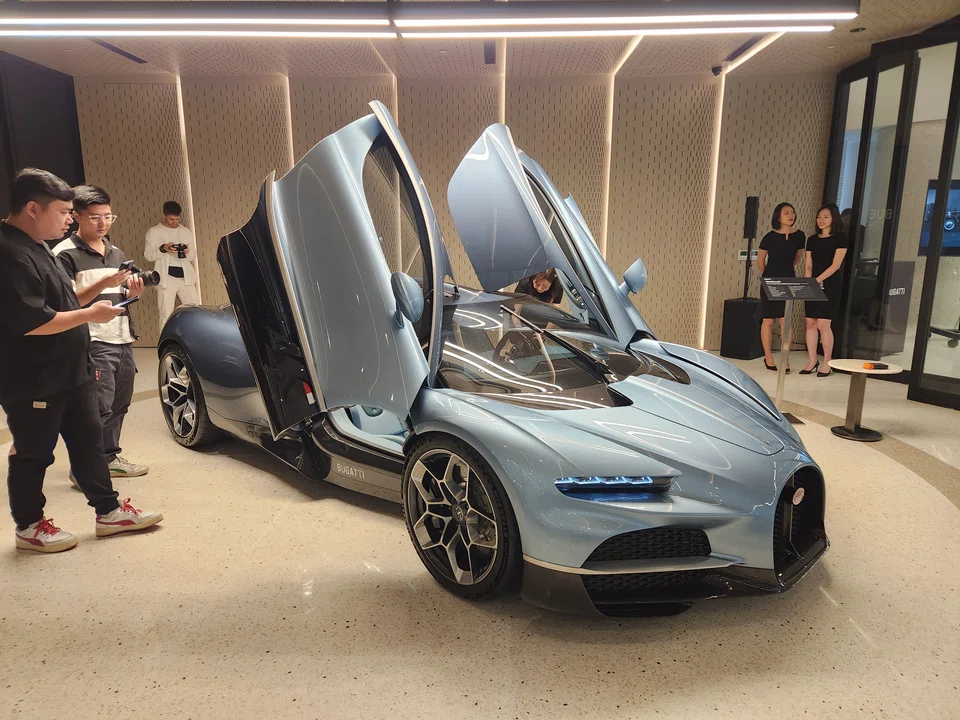
ON TUESDAY (Nov 26), French ultra-luxury carmaker Bugatti previewed a new hypercar in Singapore, notable not just for its top speed of 445 kilometres per hour or multimillion-euro price tag, but also for being the company’s first plug-in hybrid electric vehicle (PHEV).
Such hybrids are over-represented in Singapore’s ultra-luxury car market – where full EVs are under-represented instead.
While full EVs are a growing share of the overall car population, buyers of ultra-luxury cars are unconvinced by how silent and relatively undramatic they are, said industry observers.
Instead, such buyers are drawn by the brand and emotional appeal of engine-equipped ultra-luxury models. PHEVs, which can run on electric power but retain traditional internal combustion engines (ICEs), fit the bill.
Plug up
Ultra-luxury cars are generally defined as those from brands such as Bentley, Ferrari, Lamborghini and McLaren, and cost at least S$1 million each.
Bugatti’s new Tourbillon is one of the world’s fastest and costliest cars, with a price tag of 3.8 million euros (S$5.4 million) before taxes, customisations or add-on options. Only 250 units will be produced and all have been sold.
It follows two other Singapore launches of ultra-luxury PHEV versions of past mainstays: Bentley with its S$1.4 million Continental GT coupe on Nov 20, and Lamborghini with its S$1.2 million Urus SE sport utility vehicle on Sep 24.
Elsewhere, Ferrari and McLaren both announced new limited-edition PHEV versions of flagship sports cars – the Ferrari F80 and McLaren W1 – in October.
Notably, none of these brands have pure EV offerings.
In Singapore, PHEVs formed 12 per cent of the ultra-luxury new passenger car registrations for the first 10 months of 2024. This compares with 19 per cent in 2023, and 4.6 per cent in 2022.
Industry observers say that the 2024 number could have been even higher, if not for the hike in luxury-car taxes that came into effect in May 2023.
“The market has not recovered from the big increase in luxury-car taxes in 2023. Everyone rushed to register before the deadline of May 2023, so the numbers of both normal and plug-in cars in 2024 are comparatively lower,” said Chow Yi Ling, general manager for Bentley Singapore.
Still, PHEVs are starkly over-represented in the ultra-luxury segment. In the overall car market, PHEVs made up just 0.5 per cent of registrations in the first 10 months of 2024 – down from 0.9 per cent in 2023, and 1.3 per cent in 2022.
In contrast, in the same period, EVs formed 12.6 per cent of ultra-luxury registrations, compared with 32.8 per cent of the overall market. All 13 of the ultra-luxury registrations came from one model, the Rolls-Royce Spectre – as that is the only ultra-luxury full EV in Singapore.
Automotive consultant Say Kwee Neng said, “Rolls-Royces are large, heavy and refined, so their engineering brief can accommodate an electric drivetrain, which typically adds weight and is very quiet. But for high-performance brands, a quiet source of power that weighs a tonne is actually a problem, as the lack of EV sales has shown.”
Costly objects, cost no object
It is not that ultra-luxury car buyers are necessarily after PHEVs, but rather that they do not mind the price, said industry players. In Singapore, PHEVs are typically pricier than both conventional cars and full EVs.
Chow noted: “When customers come (to the showroom) they ask for a specific Bentley model, but they do not come to buy a PHEV or an ICE car. They are mostly focused on the image, luxuriousness and brand appeal. If the car happens to be a PHEV, they don’t mind.”
Two dealers of ultra-luxury cars told The Business Times that while PHEVs do not enjoy the same emissions-related rebates as full EVs, this does not deter luxury shoppers.
PHEVs tend to be pricier due to having both a sizeable battery and a conventional petrol drivetrain. But having an ICE is precisely what endears PHEVs to ultra-luxury buyers.
Dr Victor Kwan, senior lecturer at the Singapore University of Social Sciences, said: “(Ultra-luxury car) purchases are driven by emotion, and you need the exciting sound and feel of an engine to capitalise on them.”
He added: “Ultra-luxury and supercar makers are now saying that full-EVs do not work for their segment; so PHEVs are a good in-between because there is a sustainability angle and customers will still accept them.”
Francesco Scardaoni, region director for Automobili Lamborghini Asia-Pacific, said that “the majority” of the brand’s customers still ask for an ICE for its sound and appeal.
This preference is borne out by the experience of EV maker Rimac Group, which owns Bugatti.
While the Tourbillon was announced in June and is sold out, Rimac’s own S$2.9 million electric-only supercar, the Nevera, has sold only around 50 of its planned 150 units as at May 2024, after being on sale since 2019.
Wearnes Automotive, the dealer for both brands in Asean, has sold a single-digit quantity of Rimacs.
“(For EV adoption) you need to make sustainability sexy and emotional,” noted Dr Kwan. “And you can’t do that with a quiet EV.”
Keep calm and plug on
Having previously set EV-related targets, ultra-luxury carmakers are now pushing these back in favour of PHEVs.
Bentley previously aimed to sell only electric vehicles by 2030. It has since pushed this to 2035 at the earliest, saying that customers and governments are not embracing EV tech as quickly as expected.
Aston Martin and Ferrari’s first EVs are expected in 2026, and Lamborghini’s in 2028. McLaren has not specified when its first EV goes on sale. In the meantime, all have PHEVs or plan to launch models soon.
Given that carmakers are focusing on PHEVs and buyers have yet to warm to ultra-luxe EVs, observers expect PHEVs to continue increasing in popularity.
Bentley’s Chow noted: “Interest in the Continental GT PHEV is high, so I expect customer acceptance of the technology to go up as more PHEVs enter the market in future.”
Andy Goh, executive director of EuroSports Auto – the authorised dealer for Lamborghini in Singapore – expects ultra-luxury PHEV adoption to rise as more models are launched.
For example, Lamborghini will launch the Temerario coupe in 2026 as a replacement for its popular Huracan model, bringing its number of PHEV models to three.
TRENDING NOW

Once staunchly pro-China, Malaysian Chinese businesses are now distancing themselves from Beijing

Stocks to watch: HPL, Aims Apac Reit, Zico, Advanced Systems Automation, ComfortDelGro

‘How many will survive?’: Bubble fears arise as China’s humanoid robotics face reality check

Smaller board lots can’t fix a market run by three banks

