

Singapore’s tourism receipts could set record in 2026, despite slower arrivals growth
STB’s arrivals forecast is more conservative for this year, after tourist volumes missed estimates in 2025

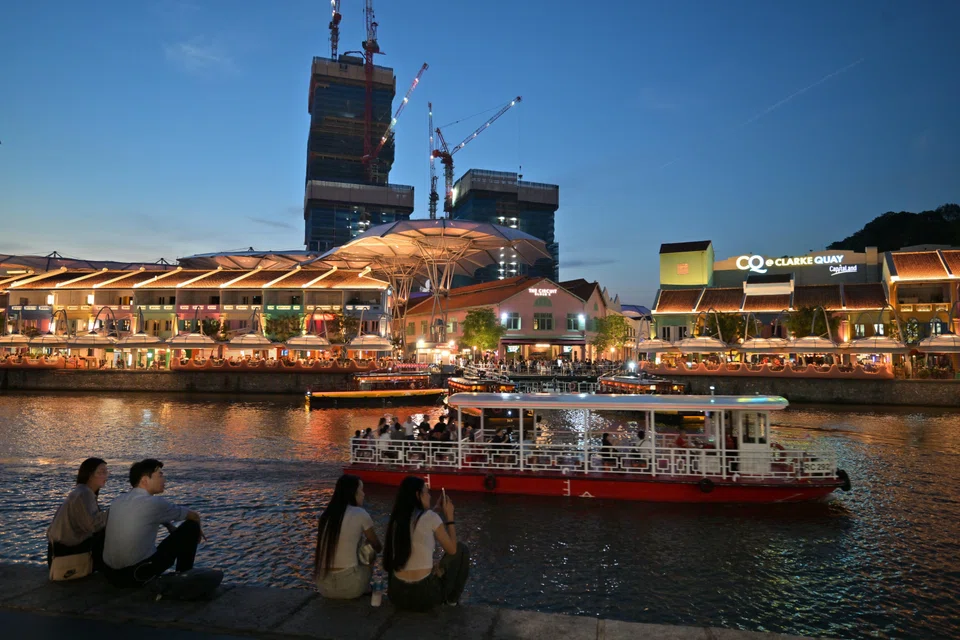
[SINGAPORE] The Singapore Tourism Board (STB) has set a higher prediction for tourism receipts in 2026, even as it lowered its forecast for the total number of international visitor arrivals.
This comes as tourist spending for 2025 looks poised to outperform, but full-year arrivals fell slightly short of the statutory board’s projection.
In its year-in-review on Tuesday (Feb 3), STB said that it expects 17 million to 18 million international visitor arrivals this year, slightly below the 2025 forecast of 17 million to 18.5 million arrivals. Singapore recorded 16.9 million arrivals in 2025.
But the agency also anticipates that tourism receipts will reach somewhere between S$31 billion and S$32.5 billion in 2026, which could set a new record.
This is up from the S$29 billion to S$30.5 billion forecast for 2025 – which Singapore is “on track to exceed”, based on the record S$23.9 billion in tourism receipts collected in the first three quarters.
The 2025 full-year tourism spending will be announced in the second quarter of this year.
STB said: “The 2026 projections take a measured approach given global economic uncertainty and political instability affecting travel patterns globally.”
Realisitic projections
Noting that in 2025, tourism receipts are surpassing pre-Covid values even as tourist arrivals continue to fall short of the 19.1 million visitors recorded in 2019, DBS senior economist Chua Han Teng said: “Singapore’s strategy of attracting higher-spending visitors is paying off.”
Ken Foong, equity research analyst at Bloomberg Intelligence, attributed the slower visitor growth in 2025 to the return to normal travel-demand seasonality, post-pandemic. For the same reason, he expects “a low single-digit percentage growth in visitor arrivals” for 2026, in line with official estimates.
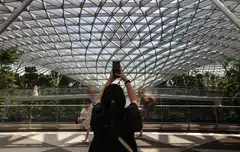
Watchers agreed that 2026’s more modest arrivals projection, coupled with the higher tourism receipts expectation, point to Singapore’s quality tourism strategy.
Dr Samer El Hajjar, senior lecturer of marketing at NUS Business School, said: “Singapore is moving into a more mature phase of recovery.”
Dr Guy Llewellyn, academic director and assistant professor, EHL Singapore, said: “Given current hotel occupancy levels, modest room supply growth, and a packed 2026 events pipeline, a 17 million to 18 million estimate appears realistic rather than conservative.”
He said arrivals and receipts are “related but not linearly linked”, with “what ultimately matters” being the spend per visitor, length of stay and types of experiences consumed.
Singapore’s offerings as a premier destination, and its value-led strategy, translate into higher per-visitor spend, he argued. “Visitors are staying longer around events, spending more on food and beverage, retail, and curated experiences.”
Benjamin Cassim, senior lecturer at Temasek Polytechnic’s School of Business, said that while Singapore’s diverse range of offerings come at a “somewhat higher” price point than in neighbouring destinations, they “resonate with our key visitor markets”, which supports the projected increase in visitor expenditure.
Dr El Hajjar believes it is a “healthy sign” that Singapore is not trying to “win” tourism by simply packing more people in, but by sustainably “refining what it wants tourism to do for the economy, for jobs and for the visitor experience”.
“A slightly more conservative arrivals forecast can reflect realism, not weakness,” he added.
Observers also highlighted that STB’s value-led strategy is in line with its Tourism 2040 goals.
Under its Tourism 2040 road map, the agency aims to drive tourism growth while navigating rising global competition, shifting demographics and increasing resource constraints. It projects that tourism receipts will reach between S$47 billion and S$50 billion by 2040.
STB chief executive Melissa Ow said that as the agency works towards its Tourism 2040 goals and a sustainable tourism sector, it will continue seeking opportunities to reach new markets, and support tourism businesses and workers to “develop differentiated products and experiences”.
“New experiences” on the cards
“New experiences will debut in 2026,” STB said, naming “innovative entertainment concepts” such as immersive dining experiences from AndSoForth and the return of Kooza by Cirque du Soleil to Singapore as examples.
K-pop group BTS will perform four nights in Singapore this December as part of their world tour, marking their longest stop in Asia outside of South Korea and Japan, it noted. The city-state also serves as the Disney Cruise Line’s first Asia homeport, with the Disney Adventure set for its maiden voyage in March after a three-month delay.
Other highlights include the new sprint race at the 2026 Formula 1 Grand Prix in October and the opening of the Grange Road Events Space by Live Nation by end-2026.
As for the meetings, incentives, conferences and exhibitions (Mice) industry, the Association for the Advancement of Artificial Intelligence held its annual conference here in January, the first time this event was held outside the US in its 40-year history.
Singapore will also host Herbalife Extravaganza in June, which is expected to be the Republic’s largest meeting and incentive travel event, with 25,000 visitors anticipated.
Chua and Cassim said Mice visitors have deep wallets and a propensity for higher spending.
Singapore’s events-led strategy creates meaningful upside, said Dr Llewellyn. He acknowledged that global macroeconomic uncertainty remains a variable.
Prolonged economic slowdown or currency weakness in key source markets, particularly in price-sensitive segments, could weigh on short-haul leisure arrivals, he said.
But the professor added that, as planned events attract tourists of all ages and from a wide range of countries, Singapore will not be vulnerable if one source market experiences a downturn.
Cassim noted that geopolitics has resulted in “holidays centred around shorter travel distances” and maximising the value of each holiday, adding: “Singapore, being central to the Asia-Pacific, is well-placed to capitalise on this important sentiment.”
Decoding Asia newsletter: your guide to navigating Asia in a new global order. Sign up here to get Decoding Asia newsletter. Delivered to your inbox. Free.
Copyright SPH Media. All rights reserved.
TRENDING NOW

Once staunchly pro-China, Malaysian Chinese businesses are now distancing themselves from Beijing

Looking beyond looming CEO succession, should UOB potentially pursue a transformative merger?

Could stablecoins be the future of money?

Grab CEO’s wife Chloe Tong on life with Anthony Tan and finding her purpose

