Singapore’s trade slump likely to persist till year-end as key exports fall a surprising 20.1% in August

Tessa Oh
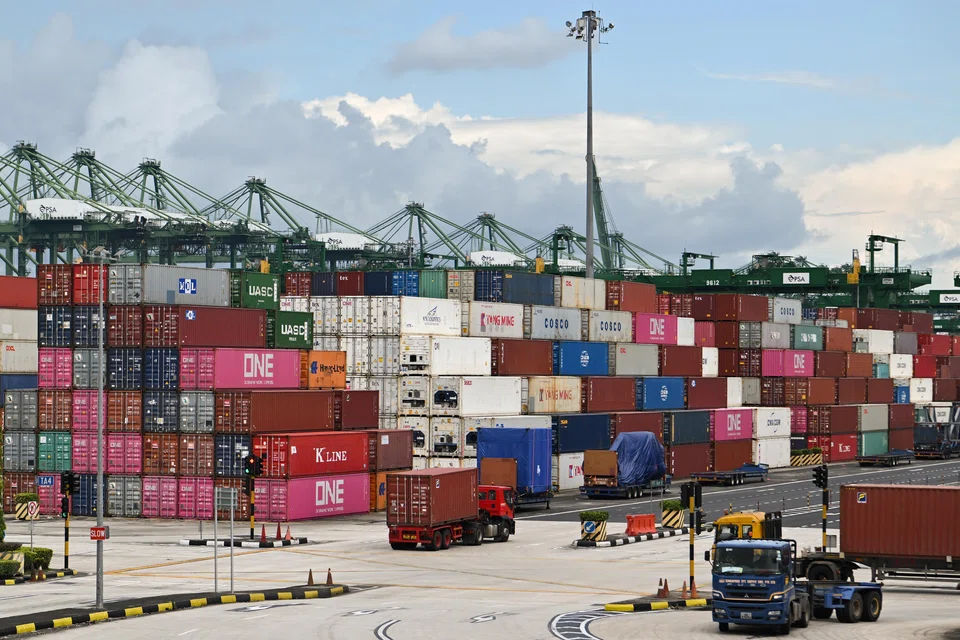
SINGAPORE’S non-oil domestic exports (NODX) slid a surprising 20.1 per cent in August, dragged down by electronics shipments that continued to contract for the 13th consecutive month, data from Enterprise Singapore (EnterpriseSG) showed on Monday (Sep 18).
August’s print extended the previous month’s revised 20.3 per cent decline, and surpassed the median 17.1 per cent drop which private-sector economists were expecting, according to a Bloomberg poll. Both electronics and non-electronics exports continued to decline on a year-on-year basis.
The latest data suggests that the electronics slump has yet to bottom out, said private-sector economists, who believe external demand will remain weak and patchy until the end of the year.
“Our earlier guarded enthusiasm due to the surprise back-to-back rebound in semiconductors output in June and July is now curbed by the latest August trade report, which still reflects the persistent dowturn in NODX,” said UOB senior economist Alvin Liew, who is expecting more year-on-year contractions in the coming months.
He slashed his full-year NODX forecast to a deeper contraction of 15 per cent in 2023, from 10 per cent previously.
This is at the lower end of the official forecast range of a 9 per cent to 10 per cent contraction.
Nevertheless, Singapore is not expected to enter a technical recession in the second half of the year, said OCBC chief economist Selena Ling, though she noted that the soft patch in external demand conditions imply some downside risks to third-quarter NODX and manufacturing performance.
Given that NODX has contracted 16.2 per cent year on year in the first eight months of 2023, full-year NODX is likely to contract “at least 11 per cent year on year” even with a gradual improvement for the remaining months. “If this materialises, this would potentially mark the worst annual NODX performance since 2001,” she added.
DBS economist Chua Han Teng said “forward-looking indicators point to a gradual and fragile exports recovery”. The latest manufacturing purchasing managers index data shows that new export orders have shrunk at a slower rate, while manufacturers indicated that they were cautiously optimistic in the latest business expectations survey by the Economic Development Board. Base effects will also become more favourable towards the year-end.
With export data still showing no signs of a turnaround, the Monetary Authority of Singapore (MAS) is likely to leave monetary policy settings unchanged during its upcoming policy review in October, said Barclays economist Brian Tan in a research note.
Tan believes the risks are tilted towards easing, in the form of a slope reduction of the Singapore dollar nominal effective exchange rate (S$NEER) policy band, than further tightening.
In contrast, Maybank economists Chua Hak Bin and Brian Lee expect MAS to maintain its current appreciation stance during the next policy meeting. “Even with subdued growth, it remains too early for MAS to ease policy, given that core inflation remains sticky and well above comfort levels,” they said.
On a seasonally adjusted monthly basis, NODX dropped 3.8 per cent in August, extending the preceding month’s 3.5 per cent contraction. Both electronics and non-electronics shipments declined month on month.
Key exports’ value reached S$13.5 billion last month, seasonally adjusted, down from S$14 billion in July. It also remained lower than the year-ago period’s S$17 billion and 2022’s average of S$16.6 billion.
Electronics exports shed 21.1 per cent in August, compared with July’s 26.1 per cent contraction. Integrated circuits (-28.5 per cent), disk media products (-30.6 per cent) and PCs (-25.6 per cent) contributed the most to the fall.
Non-electronics shipments also contracted by 19.9 per cent in August, accelerating from the 18.5 per cent decline in the preceding month. Contributing the most to the drop were structures of ships and boats (-97.7 per cent), pharmaceuticals (-37.7 per cent) and specialised machinery (-25.5 per cent).
Total trade fell 15.2 per cent on the year in August, extending July’s 20.9 per cent contraction. Total exports declined 14.7 per cent, while total imports fell by 15.6 per cent.
But on a seasonally adjusted monthly basis, total trade was up 1.6 per cent in August, following July’s 1 per cent increase.
The level of total trade reached S$100 billion in August on a seasonally adjusted basis, higher than the S$98.5 billion clocked in the preceding month.