


Accurate and affordable medical diagnostics for women
Inex Innovate focuses on tests related to women’s and fetal health
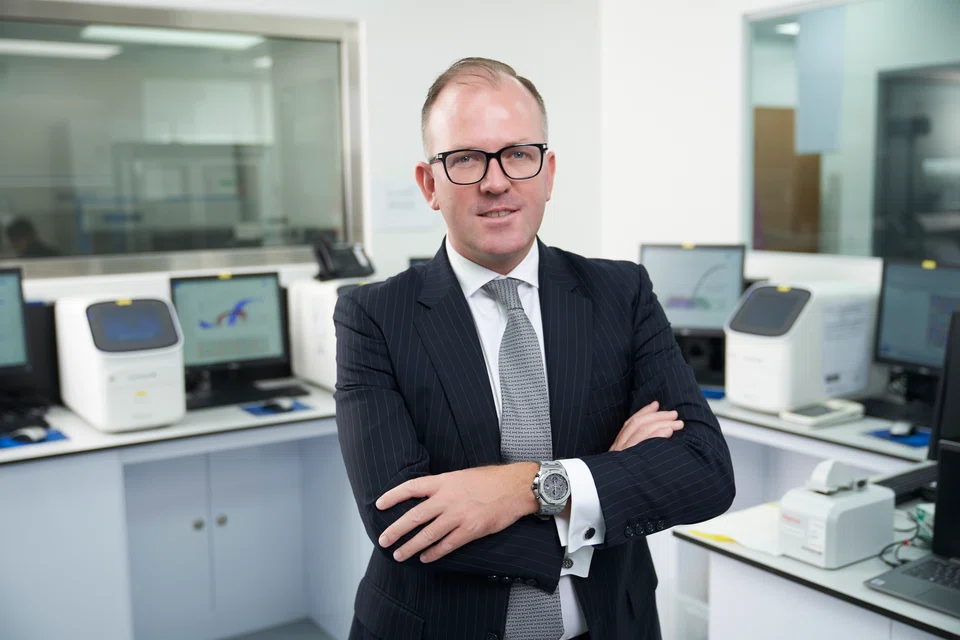
MEDICAL technology firm Inex Innovate aims to offer three things to women who need tests: accuracy, affordability and accessibility.
“If you don’t have the right diagnosis, you don’t have treatment,” said chief executive officer Kane Black.
Spun off from the National University of Singapore in 2006, Inex uses molecular diagnostics technology to develop medical tests, focusing on addressing unmet needs in women’s and fetal health.
Inex itself conducts research and development, while its subsidiary iGene Laboratory provides genetic testing services, clinical molecular testing, and immunology and serology tests.
To date, Inex has developed and launched five diagnostics tests and services, as well as seven different laboratory workflows. It has processed more than 500,000 patient samples from countries across South-east Asia.
In 2022, Inex made it onto the Financial Times’ ranking of 500 of Asia-Pacific’s fastest-growing companies, and also clinched an Enterprise 50 Award.
Chromosomes, cancer and Covid
Inex’s two focus areas are prenatal screenings and diagnostic tests for ovarian cancers. The former include several blood-based non-invasive prenatal tests, which analyse fetal DNA in the mother’s plasma.
Two of these detect common chromosomal abnormalities. The Essential Screen test can be done in the first trimester and detects three kinds of chromosomal abnormalities, including Down syndrome.
The iGene test can be done from the 10th week of gestation, and screens for a wider range of conditions.


Another test is used to determine the RhD status of the fetus, which indicates whether the mother’s blood will be compatible with that of the fetus.
Inex’s other focus, ovarian cancer, is the seventh most prevalent cancer among women worldwide, and the fifth-highest cause of cancer-related deaths among women.
The company has developed two diagnostic tests for this. OvaCis detects epithelial ovarian cancer by testing for haptoglobin – a kind of protein found in high levels in such patients – in ovarian cyst fluid, providing an accurate diagnosis within 15 minutes.
The other test, epiHERA, detects endometrial cancer by picking out biomarkers for indications of gene repression from malignancy. It provides results in two days.
When Covid-19 hit Singapore in early 2000, however, Inex’s laboratories were diverted to help with pandemic testing instead. The sentiment then, as Black put it, was: “The country needs more testing, and so let’s step up and do this!”
At the start of the pandemic, the public healthcare system began to require support from private laboratories. Inex stepped up, becoming one of the first few private laboratories in Singapore to engage in Covid-19 testing.
In partnership with Temasek, Inex could run Covid-19 tests for up to 5,000 patient samples daily.
However, this diversion of bandwidth to Covid-19 testing – along with pandemic-era restrictions – resulted in Inex’s pipeline of new diagnostic technologies being pushed back by two years.
Looking further ahead
Having pulled through the pandemic, Inex is now focused on growing both organically through new technology product launches as well as through acquisitions.
New launches include Xena, a non-invasive blood-based ovarian test that aims at early detection. This will enable early treatment, increasing the five-year survival rate for patients.
Going beyond ovarian cancer, another new product is epiDx, a blood-based test for early detection of breast cancer.
This provides an alternative to the prevailing method of detection, mammography. Mammography can be painful – leading to low participation rates in screening – and less accurate in women with dense breast tissue.
Noting the increasing prevalence of breast cancer among Asian women in their early to mid-30s, Inex seeks to increase screening participation rates in Asia, identifying breast cancer early for better treatment.
In the fourth quarter of 2024, Inex also intends to launch Lexi, a non-invasive prenatal test that aims to provide definitive results instead of just probabilities.
Lexi will be able to detect over 7,000 fetal genetic conditions through direct biological measurements, without requiring invasive procedures.
As for acquisition plans, Inex is acquiring a medical laboratory in North Asia. This will aid its entry into regional markets such as Hong Kong, Japan, Korea and Taiwan.
Closer to home, Inex is looking at potential acquisitions in Indonesia and Malaysia. It also intends to venture further into Cambodia, where it is currently building a next-generation sequencing laboratory in the rapidly growing capital, Phnom Penh.
This series is part of the Enterprise 50 Educational Project between the E50 partners and the NUS Business School. Inex Innovate was among the winners in 2022. The annual E50 ranking is co-organised by The Business Times and KPMG, sponsored by OCBC Bank, and supported by Enterprise Singapore, Singapore Exchange and Singapore Business Federation.
Decoding Asia newsletter: your guide to navigating Asia in a new global order. Sign up here to get Decoding Asia newsletter. Delivered to your inbox. Free.
Share with us your feedback on BT's products and services
TRENDING NOW

Stocks to watch: CapitaLand Ascott Trust, Keppel Infrastructure Trust, iFast, ESR Reit, First Sponsor

Indonesia says gas export cuts to Singapore remain within contract terms

If Europe goes to war, the fallout will be felt in East Asia

Government to bring forward raising of retirement age, give employers more financial support to create flexi-load jobs

