


Adaptation is key for Singapore brands entering the US


SINGAPORE brands are making inroads into the American consumer market, but supply-chain issues and the need to adapt to local tastes are significant hurdles that take improvisation and determination to overcome.
Take Irvins, for example. In July 2022, when the salted-egg chips brand decided to supply mainstream grocery chains in the United States, it secured Albertsons as a customer. But it struggled with getting its products to the grocery chain’s more than 1,400 stores.
Alex Uoo, senior vice-president for North America at Irvins, said: “That was a major issue. We were supposed to receive six to seven containers in the US in January, but we couldn’t supply that amount of salted-egg salmon skins in time, and Albertsons was really upset with us.”
Supply issues are just one of the many challenges that Singapore lifestyle brands face when entering the US market. Adapting to American consumers’ tastes poses another.
Irvins tailored its approach by selling salmon skin chips, rather than its regular potato chips.
“Everything about the product is keto-friendly, and this is what the Americans want,” said Uoo. The keto – short for ketogenic – diet involves replacing the bulk of carbohydrates with fat in one’s daily intake.
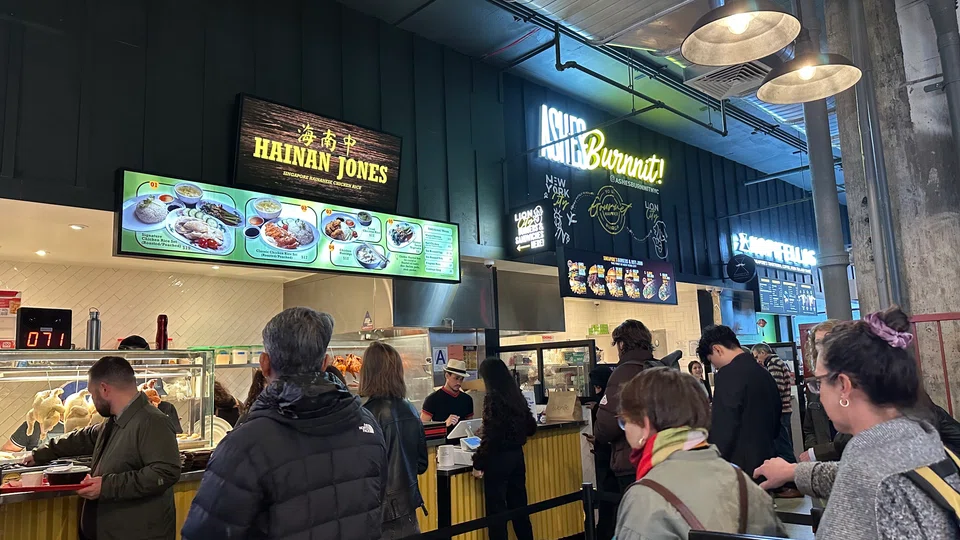
Other brands, such as Hainan Jones, had to adapt to the lack of ingredients typically available in Singapore. For instance, the chicken rice stall at the Urban Hawker food court in New York could not procure its usual Thai hom mali jasmine rice. The grains it got instead were a little younger, starchier and wetter when cooked.
Hainan Jones manager Lim Wee Keat said that the brand therefore cut the amount of water in its American recipe.
Its chilli sauce, too, had to be reformulated from herbs and spices available in the US. Chickens were also different from those available in Singapore. Lim noted that the chicken breast in the US is more flavourful than those found in Singapore, and this affected the stock produced.
“We try our best to do what we can to achieve the closest end-product (to what) one can get in Singapore,” he added.
For the first three months after its launch, crowds flocked to Hainan Jones, creating queues that snaked out the food court’s doors at one point. “I was panicking because there weren’t enough chickens to sell,” shared Lim.
Clarence Hoe, executive director for the Americas and Europe at Enterprise Singapore (EnterpriseSG), said that the number of Singapore companies seeking help from EnterpriseSG to enter the US market has grown since the Covid-19 pandemic started. In 2019, the statutory board supported around 130 companies in such endeavours; that figure jumped to 190 last year.
During the pandemic, many companies looked into entering markets beyond Singapore. More now recognise the US as a viable option to expand into, Hoe noted.
“We know for a fact that companies are willing to try… they do apply for the Market Readiness Assistance Grant,” he added, referring to an EnterpriseSG scheme that provides support for companies venturing overseas.
With the rising demand for support in entering the US, EnterpriseSG has been playing a role in helping Singapore brands crack that market. The agency advises companies on a range of matters from possible challenges to information on domestic competitors.
According to Hoe, brands could stand out by highlighting the unique aspects of their brand, for instance by emphasising their ingredients or processes. “If you put those markers, you put yourself in a different category and therefore reach out to a different sector, which differentiates you from your competitors.”
For fashion brand Love, Bonito, expanding to the US came on the back of rising interest from the American market, with order numbers picking up in 2021. It made its first hire in New York in June 2022, as it ramped up efforts to grow in the US. Now, there are about six people in its US office.
Love, Bonito is now looking to replicate its existing omni-channel strategy – where shoppers can try in store and buy online – in the US. It is also planning to launch a pop-up store in SoHo, Manhattan in the middle of the year.
Stephanie Seow, US country head for the brand, said: “One of the challenges lies in helping our customers understand our fit, which is different. I think it’s about opening up a store (for them) to interact with our products, touch and feel and try them on, because it’s love at first try for our customers.”
A pop-up store also raises brand awareness. The company, despite having locations and a pronounced presence across Asia, has found it challenging to gain name recognition in the US.
Another pain point that many companies have raised is the higher costs of operating in the US. Labour costs in the country are substantially higher than in Singapore; in California, the minimum wage is US$15.50 an hour.
Products thus have to be repriced. A Love, Bonito T-shirt that retails for S$29 in Singapore is priced about 15 per cent higher, at US$25, in the US. Similarly, Hainan Jones sells a plate of chicken rice in its New York location for US$17, a huge leap from the usual sub-S$5 price in Singapore.
Despite the higher costs, the market opportunities have still been lucrative enough for Love, Bonito to plan for a distribution centre in the US, and for Hainan Jones to consider expanding beyond its current sole outlet.
But expanding is not easy, with both local and international brands concentrating their efforts in the US. Competition among lifestyle brands in the country is fierce, but EnterpriseSG’s Hoe believes that Singapore companies can pull their weight, aided by their experience competing in Asia.
“They’ve traditionally tended to compete on being different in our region, and in doing so, have made it very clear where their value proposition to the customer is.”
TRENDING NOW

Once staunchly pro-China, Malaysian Chinese businesses are now distancing themselves from Beijing

Britain’s mansion tax shows the difficulty of targeting wealth

Three hats, one goal: How Ng Kian Swan runs sustainability at NUHS

COE review: The gap between luxury and mass-market cars isn’t the only one worth bridging

