The art of collecting members and spaces
Collective Works CEO lifts the veil on the firm's swanky co-working space, a 50:50 venture between his company and CapitaLand.

Mindy Tan
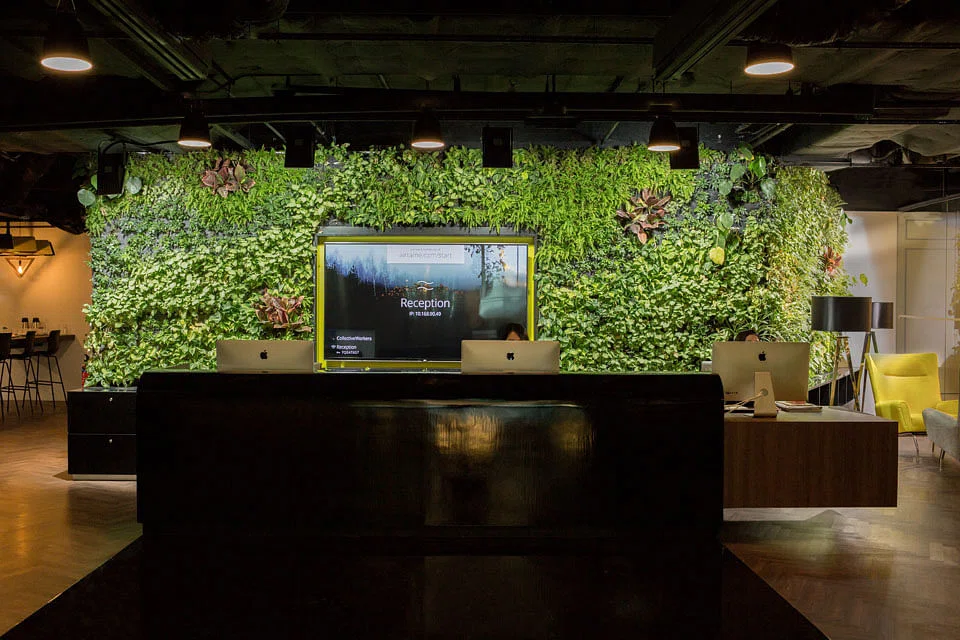
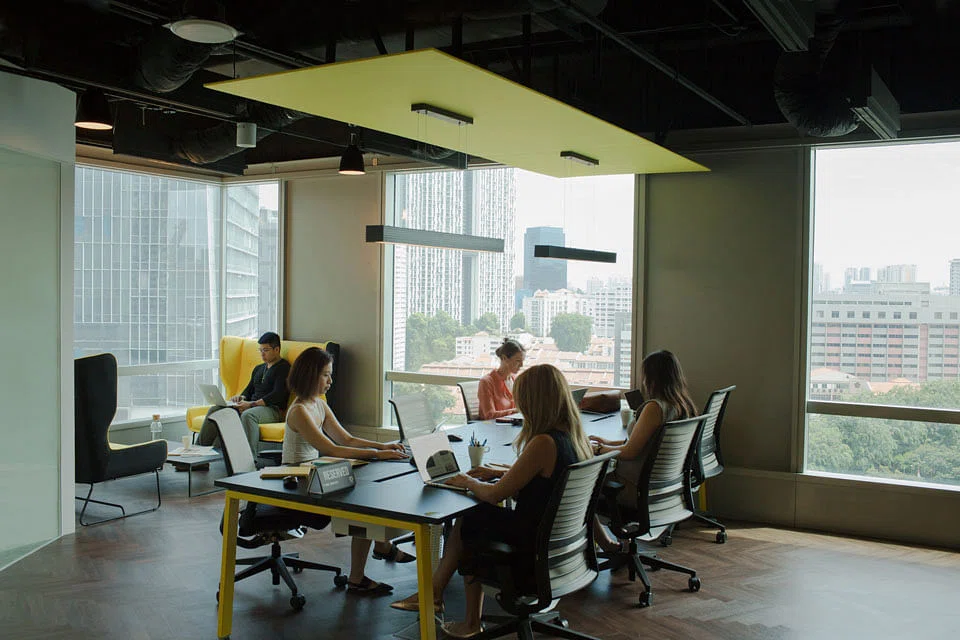
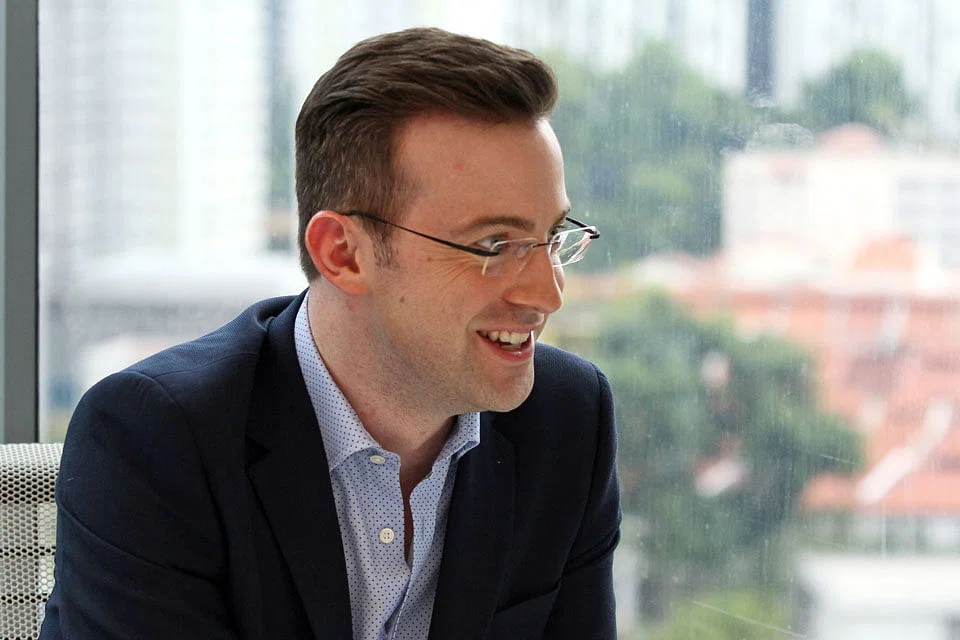
ON the 12th floor of Capital Tower in Singapore's central business district (CBD), a set of conventional glass doors separates you from a large green wall, in front of which is a reception desk. You could be walking into a swanky designer's office, or even a high-end restaurant's waiting area. It looks nothing like a typical office, an effect painstakingly curated and planned for by the founder and CEO of Collective Works, Jonathan O'Bryne.
Indeed, make your way past the reception and you are faced with a sprawling maze of enclosed offices of different sizes and configurations, meeting rooms, phone booths, huddle rooms and relaxation areas.
This is Collective Works' second and latest venture. Spanning 22,000 sq ft, it is a 50:50 venture between Collective Works and CapitaLand, and is the first Grade A building in the CBD to test out co-working.
Says Mr O'Bryne: "Collective Works grew organically over at The Globe where we first started. So we never really had an opportunity to master plan the space; we were only able to take space as it became available. This really is the first time that we have master planned a whole floor."
Indeed, one of the first things you notice once you get past the reception is the lack of corridors and that nothing is straight, so to speak. Instead, the glass walls that separate the offices and the tables are all arranged in odd angles and nothing is parallel with the grid on the floor.
This, says Mr O'Bryne, gives the space a "playful, asymmetrical layout".
"We did this for a couple of reasons - the first is we want to create open working zones between the offices. So it treats the open space as a semi-private space and it allows teams to separate out into different corners. But also it means that there is proximate work area for companies to expand out into as they get bigger."
Carte blanche
It is also filled with break-out spaces. Near the pantry, there is a brainstorming wall beside a bank of storage lockers. Such facilities - or a lack thereof - are one of the reasons why companies tend to get their own offices, says Mr O'Bryne.
There are in addition 10 meeting rooms and six phone booths and huddles, making it a grand total of 16 bookable rooms.
"Rooms like this are super important because they improve the quality of the working space out here - if anyone is making a sales call or a protracted phone call, that can get really disruptive," says Mr O'Bryne of these spaces, which are free to use.
"The provision of 16 bookable rooms is extremely high in terms of any kind of business centre. So we will have one of the highest shared and flexible spaces in the shared work space in Singapore; definitely the most of any of the co-working spaces."
It is a significant investment for the co-sharing space operator given that it is, after all, right smack in the middle of the CBD. Other "weird stipulations" they gave had was that members must be able to touch the windows.
"By taking some of what is essentially the most expensive real estate on the floor and making it into a social space, we're making a pretty strong statement about how important the well-being of the members within this space is to us, and it's more important than just tying this space up with an income-generating office," says Mr O'Bryne.
More than startups
According to Mr O'Bryne, co-working spaces appeal to a large range of companies. When we spoke in mid-May, they already had seven companies installed in the space (even as they were putting the finishing touches) with another 38 due to move in in stages. Companies that have registered interest in the space range from a social media marketing outfit, a computer programming startup, to a charitable foundation coming to Singapore from the United States.
"Four or five years ago, I could see there was a really big disconnect between the way people want to work and the way they are forced to work by the facilities available to them. We are not really talking about real estate, we are talking about the future of work and how people want to lead their lives. And I think there's been a real shift with the advent of the Gen Y workforce and also cloud technology and what people can actually achieve outside the office," says Mr O'Bryne.
According to his estimations, there was, in the last year, 150,000 sq ft of co-working space in Singapore. There will be another 150,000 sq ft opening by July this year, and yet another 150,000 sq ft opening by January the year after.
"I think what has really happened over the past few years is that the Gen Y workforce is starting to make buying decisions about where they want to work. But I also think that Singapore is a very unique real estate market with incredibly high asset values so there is always a lot of scrutiny in Singapore in how you get these assets to perform well. So there's two sides to it - you have a very dynamic real estate market and you also have a very dynamic workforce. So the two combined are fuelling the trend."
Far from being stressed by the competition however, Mr O'Bryne is confident that Collective Works is ahead of the game.
One of the ways he does this is by ensuring that the hardware available to members can cater to their requirements, even if they do not yet realise they need it. An example of this is a large room situated in the middle of the office space. It is, according to Mr O'Bryne, a multi-function room which can sit 16 as a boardroom, or a brainstorming space, with 270 degrees of white board. It is also, potentially, a recording studio, with sound-proofing behind the wall panels and ceiling.
"With more and more people blogging and vlogging, this room is designed for companies to do podcasts, vlogs, and create their own content. . . I think in the next five years, being able to vlog and record in your own office will be like having a photocopier in the 1970s," he says with a laugh.
"When we design co-working spaces we have to make sure they are relevant and enjoyable for the next five to10 years. So this was something that may not be critical now, although you should see the twinkle in a lot of our members' eyes when we tell them we built it, but it will be there if they do. We try to be very receptive to trends; you have to keep experimenting and playing."
Exclusive membership
It is not just in terms of hardware that the team at Collective Works caters to its members.
The other interesting detail about the space is that the music undulates depending on which part of the office you are in. In certain areas, a more dynamic colour tone is used for the furniture to match the music piped in through strategically located speakers. In others, the colour palette is more muted and you only get the wash from other areas around it. The former space is designed for the energetic, high-performing, entrepreneurial temperament while the latter is for calmer, less gregarious type of companies.
"I see ourselves as one of the market leaders in terms of segmentation. We really understand who our clients are - we screen and curate our communities much more strongly compared to other co-working spaces," says Mr O'Bryne.
According to Mr O'Bryne, in-depth interviews - to decide whether or not they want to take on a company as a member and to ascertain each company's working style - are some of the trademarks of Collective Works. In the four years of running Collective Works, one of the key takeaways for him is that companies interact with each other naturally and can impact each other if not zoned correctly.
"We are an interesting space in that you have to apply to join Collective Works and you go through a series of background checks before you can actually become a member. So we do things like background checks on the companies and directors to make sure they are in good standing.
"As part of the interview process, we have a very frank discussion about how the team works and their working styles; part of how we understand whether we put the in private space or open space is the same conversation that helps us understand (if they fit better in) noisy or quieter zones."
The interview is also a way for them to screen for competitors and is one of the ways the operator tackles a big bugbear industry: privacy. Through community curation, competing businesses in the same industry are not housed in the same building, although they can be on the other site. They also manage privacy in terms of how they place businesses within the centre.
"And, we do have spaces where you can be seated at an angle where your monitor is not facing into the main space. So some companies are more sensitive than others but we take care of it with different furniture layouts," says Mr O'Bryne.
But more than catering to the physical needs of companies, the co-working space also allows for networking.
"When you look at the networks people get the most value from - professional networks or alumni associations - they are all networks where people are of a similar background or calibre, or they are playing the same kind of game," says Mr O'Bryne.
"We (also) want to make sure we have members who are performing at a certain level. So our segmentation in Singapore is we exclusively look after high performers," he says. "That's why I say co-working is the new members club."