


Biological labs, robotic assistants
Two robots are important members of testing staff at Ugene Laboratory Services
Varun Karthik
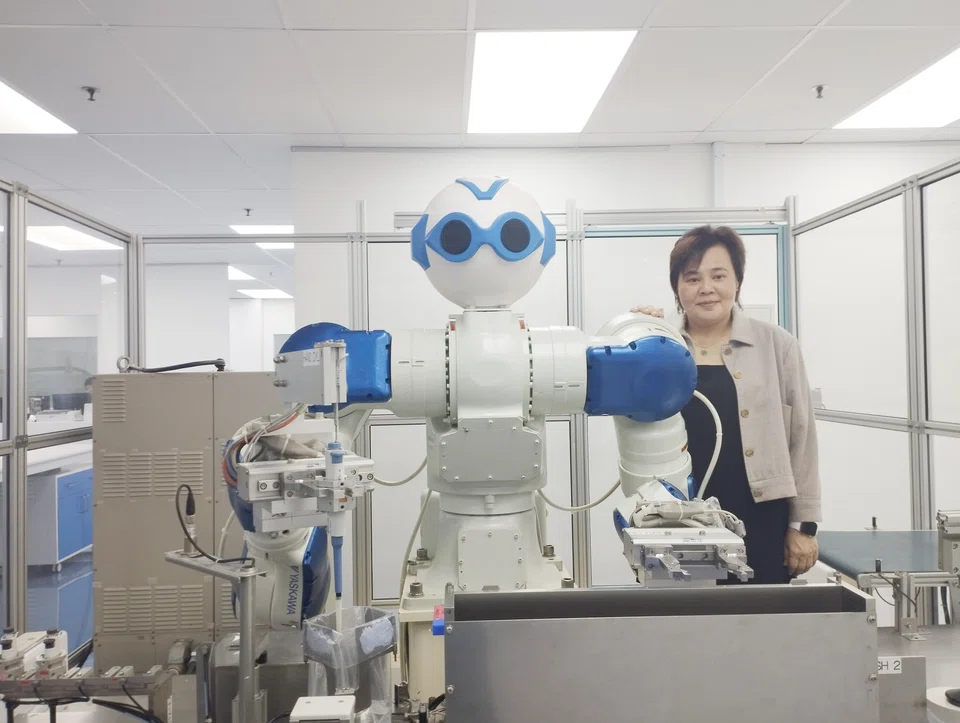
AT UGENE Laboratory Services, some microbiological tests are carried out by non-biological workers that do not need MCs or lunch breaks, just good upkeep. Two robots, named Ms and Mr Ugene, have become so indispensable that founder and technical director Eunice Ng considers them part of the company’s headcount of around 30.
Ugene Labs’ core business is microbiological testing, which “helps save lives” by ensuring that manufactured food is fit for human consumption, said Ng.
This takes place in a facility that spans nearly 8,000 square feet, which she reckons is the largest in Singapore. Many of the company’s top 20 clients are multinational corporations.
In the area of food safety, Ugene Labs also conducts hygiene audits of their clients’ factories, ensuring that the surfaces and air are clean. Such audits are crucial when seeking certification to export products.
Since its founding in 1997, the company has branched out to areas such as chemical tests that help manufacturers devise nutritional labels for their products. Its client base has expanded beyond food manufacturing, to makers of cosmetics and animal feed.
This year, the company has entered into vegan testing – using molecular biology to test for the presence of meat in products that are meant to be vegan. It is also considering an entry into “speciation” – helping to confirm, for instance, if a beef product is truly 100 per cent beef.
Difficult beginnings
Though Ng has spent over 30 years in microbiology, she entered the field by chance. Her initial plans to become a doctor were dropped when she learnt that a medical degree in the US would take eight years – too long, given that she had to finance her own studies.
When she asked a professor what was the closest to being a doctor, the professor recommended that she become a microbiologist instead.
Taking the advice, Ng graduated with a degree in microbiology from Washington State University and worked in the US for a few years before returning to Singapore. After some years at a clinical lab here, she decided to blend her passion for science and business by starting a company with two friends in 1997.
But both friends decided to leave a couple of months later, leaving her alone with just S$500 in the bank, in what she recalls as the most challenging period for the business.
Hurdles had to be overcome in Ugene Labs’ automation journey, too. When Ng first suggested bringing a robot into the lab, her staff were fearful that they would be made obsolete.
At the same time, naysayers told her that if automation were possible, bigger players would have already done it. Some scoffed at her idea for a two-arm robot which would help conduct microbiological tests.
Yet Ng persisted. Over repeated engagements, Ugene Labs’ management convinced employees that robots would not replace them, but instead free them up to do higher-value work and grow the business.
The company worked with engineers from Japan to custom-build a robot. Staff were involved in this process, further helping them get on board with the idea.
The first robot, Ms Ugene, joined the staff in 2014. In 2022, the company acquired a second robot, Mr Ugene.
Lending a robotic hand
Automation is crucial to Ugene Labs for multiple reasons, said Ng. First, it ensures that the lab can handle any sudden surge in samples for testing, which might be required if a manufacturer has an outbreak at their facility.
Second, it ensures consistency in how tests are conducted. Third, robots aid in digital record-keeping and thus improve traceability, with customers able to track down samples from as long as seven years ago.
Automation – which does not pose any HR problems, quipped Ng – is particularly important given the industry’s manpower woes.
“We have a hard time trying to nurture people who are interested in testing, inspection and certification,” Ng said, calling it her biggest challenge.
“A lot of youngsters want to dress nicely and go out to see people; they do not want to be in the lab looking at machines and talking to bacteria.”
While many of her scientists have been with the lab for more than five years, it is much harder to retain diploma graduates in more entry-level positions such as lab technicians, she added.
“They realise that laboratory work is not what they see it to be, and so they change trade; or their parents say having a diploma is not good enough, and so you (should work for) two years and then go get a degree.”
This was among the reasons she invested in Mr and Ms Ugene: to take care of more repetitive tasks so that staff can take on higher-end tasks that are “more interesting”.
Serving customers
Ugene Labs has never had a dedicated sales team, business development team or marketing team – but continues to grow thanks to good customer service, Ng said: “We treat our customer’s samples as if it is our own brand.”
“Recently when I went to a tradeshow, it was so heartwarming when a customer who has been supporting us for the past 26 years brought their successor to come and see us,” she added.
In retaining customers, going above and beyond is key, said Ng. This could mean, for instance, explaining the results of tests and guiding them through contamination incidents instead of merely providing a report.
Solving problems for clients has proved to be a key driver of growth. Many services were first offered by Ugene Labs at the urging of existing clients, said Ng: “A lot of our new product development, besides being about quality and traceability, is also to fulfil our customer’s requirements.”
For further growth, regional expansion is in the pipeline. “For us to bring a lab like (this) to another country is pretty easy,” said Ng. Vietnam is one possibility, with many customers having moved production there due to lower costs.






