


From black gold to green goals

Renald Yeo
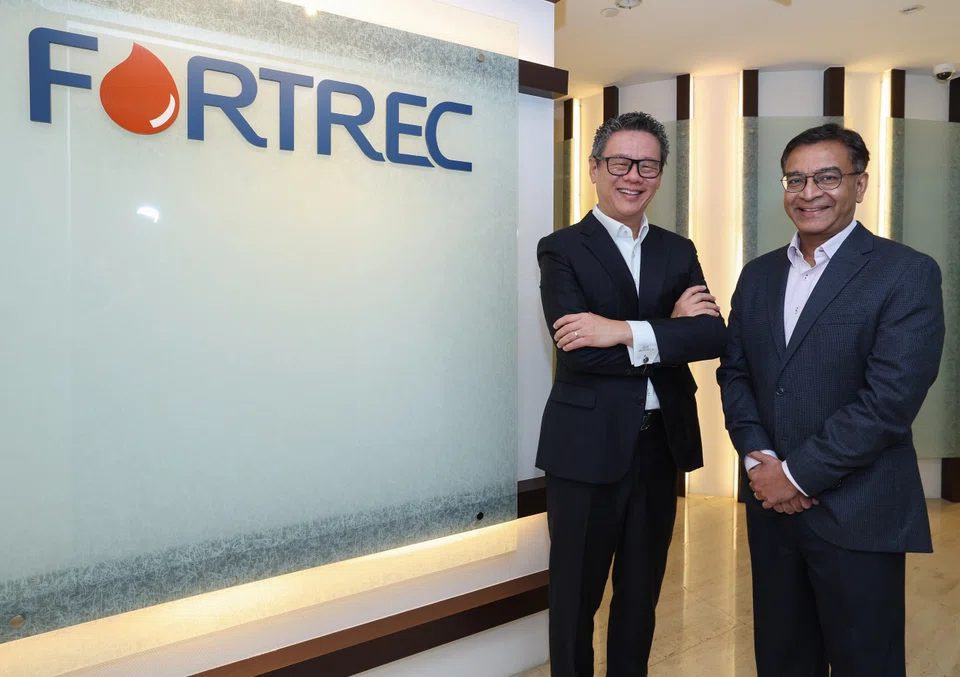
WITH the global green transition, the petroleum industry’s days could be numbered – but in the meantime, local petrochemical company Fortrec Group is helping refineries shrink their carbon footprint, and gunning for a topline of US$300 million by 2026.
Since 2005, the company has used a proprietary process to distil “refinery bottoms” – one of the by-products of oil refining – into industrial solvents. Now, it can also precisely calculate the carbon emission savings from doing so.
“Science and mathematics have reached a level where we can now quantify the carbon emission reduction,” group chairman Wilson Chew told The Business Times. Being able to put a firm number to this has resulted in more interest from refineries seeking to report such reductions, he added.
Crude oil refineries typically incinerate the refinery bottoms – a sort of sludge – left over from the refining process. But this presents two problems. First, incineration leaves behind a sticky residue that can clog up the system. Second, it produces additional carbon emissions, adding to greenhouse gases already emitted during refining.
In Fortrec’s proprietary distillation process, the refinery bottoms instead serve as feedstock for the production of solvents, which are then used in products such as adhesives, paints, and pesticides.
Ajay Bhattacharya, Fortrec’s co-founder and managing director, recalled: “When we first started, the demand was because of the dirty, sticky (residue)… it was not about the carbon emissions. In the past, that was not important.”
But with countries and companies now seeking to cut their carbon emissions on the way to net zero, the industry’s focus has shifted accordingly.
“Right now (the process) sells by itself – people are coming to us,” said Bhattacharya.
For every tonne of feedstock that Fortrec diverts from incineration, about 3.3 tonnes of carbon emissions are saved, Dr Chew added. “This is meaningful data, because we deal in the hundreds of thousands of tonnes.”
Keeping it local
To further reduce carbon emissions, Fortrec is redesigning its business model to keep production local.
Currently, Fortrec buys feedstock from refineries in Asia and the Middle East, and ships these to third-party facilities in Europe and India, which use the company’s process to produce solvents. But the transportation means both carbon emissions and additional costs.
To mitigate both issues, Fortrec is setting up local joint venture (JV) operations with refineries and solvent manufacturers, starting this year, to process each refinery’s bottoms into solvents.
“We want to concentrate the activity as close as possible to within the jurisdiction of our supply source,” said Dr Chew. By running short pipelines instead of ships and trucks, carbon emissions from transportation and much of the shipping-related costs will be eliminated, he added.
Apart from sharing the costs of building and operating the facilities with its JV partners, Fortrec will provide its intellectual property and distillation know-how. Meanwhile, its partners on the ground will help with navigating local rules and regulations.
Shaking off pandemic blues
In the early days of the Covid-19 pandemic, demand for petroleum-based products fell sharply, with oil prices even plunging below zero in April 2020. Crude oil refining volumes fell in tandem, meaning that there were low levels of refinery bottoms that Fortrec could use as feedstock.
As a result, the company’s revenue fell from a peak of US$220 million in 2019, on about 230,000 tonnes of processed feedstock, to US$67 million in 2020. But it has since recovered to US$80 million in 2022.
Beyond the post-pandemic rebound in crude oil demand, Fortrec’s bullishness about revenue growth stems from the fact that it has crossed the US$200 million mark before, said Dr Chew.
He added that the company “has never recorded a loss”, even during the worst of the pandemic.
He also pointed out that the market for the solvents it produces is “enormous”, due to sustained demand from agriculture, paint and pharmaceutical players in Europe and Asia.
Fortrec’s current customers are pushing the company’s production levels to reach a critical mass, so that they can supply more than the current “small quantities”, Dr Chew said.
In his estimation, that critical mass only starts at the US$300 million mark – hence the 2026 target.
“There is an urgency for us to some extent to scale to that number, because then (we’ll) break the minimum threshold of the market by procurement,” he said.
“On the supply side, we have a solution. On the buyer side, we have a growing demand. Our job is to perfect what we do, and it’s really an inflection point (for) us.”
While Fortrec has no current plans to go public, that might be “possible in the future” after it exceeds its US$300 million target, he added.
TRENDING NOW

Malaysian king buys stake in Singapore-listed mining firm expanding into rare earths

Grab CEO’s wife Chloe Tong on life with Anthony Tan and finding her purpose

Once staunchly pro-China, Malaysian Chinese businesses are now distancing themselves from Beijing

Longer wait times expected as S’pore healthcare institutions report system disruptions

