Career conversion programmes ease PMETs into SMEs

Renald Yeo
DESPITE previously working for a multinational corporation (MNC), Lim Keng Kian jumped at the chance to join a small and medium-sized enterprise (SME) when he received a job offer in late 2021.
Becoming a purchasing assistant at food manufacturing SME Ha Li Fa was a no-brainer, he told The Business Times: “Looking for a procurement role during the pandemic was not that easy, but it happened that Ha Li Fa offered the opportunity to me.”
As a PMET – someone in a professional, manager, executive or technician role – who worked in procurement at an MNC for five years before a career break in 2019, he was no stranger to what the job entailed. What was challenging, instead, was adapting to the work culture and practices at an SME.
He faced a steep learning curve because he was exposed to a much wider range of work than would have been typical in an MNC. This was due in part to a leaner workforce, and job descriptions that were broader and less structured.
“In an MNC, you might have someone whose only job is to purchase stationery,” Lim said. “In an SME, we have a wider job scope.”
To help employees adjust to the SME working environment, Ha Li Fa sent Lim and three other new hires for the Career Conversion Programme (CCP) for SME Executives in 2022.
Funded by Workforce Singapore (WSG), the programme provides employers with salary support of up to 70 per cent of participating employees’ monthly salary during the three-month programme, capped at S$4,000 per month.
Enhanced salary support of up to 90 per cent, capped at S$6,000 monthly, applies for participants aged 40 and above, or those who have been unemployed and actively seeking employment for six months or more.
During the programme, which included a three-day workshop and structured on-the-job training, trainees were taught how to improve processes at the workplace, said Lim. “It helped us in understanding the work culture in the company, (and) how, using technology, we can help the company perform better, to ease the workflow for everyone.”
Growing ranks
WSG offers close to 100 CCPs across some 30 sectors. In 2022, more than 90 per cent – or about 1,400 – of the companies that took part in CCPs were SMEs.
The CCP for SME Executives was by far the most popular among SMEs, with 921 employees from 629 SMEs participating in 2022.
This was followed by the sector-specific CCP for Early Preschool Educators, with 166 trainees from 87 SMEs; and the more general CCP for Professional Executives, with 89 employees from 53 SMEs.
Together, these top three programmes accounted for 46 per cent of the workers that WSG helped to place with SMEs in 2022.
“CCPs help companies, including SMEs, to meet their manpower needs by hiring and reskilling mid-career individuals to take on new job roles,” said Jason Tay, director of WSG’s enterprise programmes division.
“This is especially so in a tight labour market where companies may face challenges securing candidates with the right fit.”
One highlight for Lim was a joint training session between trainees and their work supervisors, as it encouraged interaction and alignment of work expectations. Beyond helping him build rapport with his supervisor, the session allowed for an exchange of ideas that eventually led to improved processes at Ha Li Fa.
For instance, Lim applied what he learnt when he pitched for the company to digitalise its handling of purchase orders. By automating the sending of purchase orders, which was previously done manually through e-mail, productivity was improved.
Casting a wider net
Aside from helping employees acclimatise to working at SMEs, the CCPs allowed the company to engage a wider talent pool, said Phil Chern, human resources manager at Ha Li Fa.
The company can cast a wider net because even if new hires lack some of the necessary skills for their role, they can be sent for training through the CCPs. Ha Li Fa has about 250 employees.
“It’s complementary training to what we provide internally,” said Chern. “We will collaborate with the government to see what other programmes we can (tap), because we can’t cover everything on our own.”
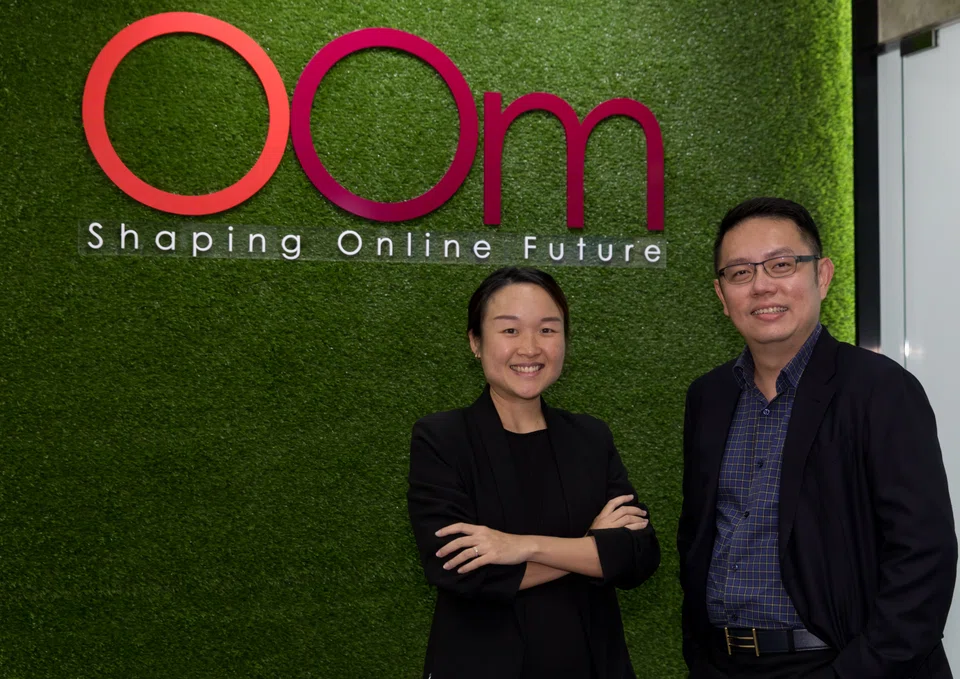
Digital marketing agency Oom has similarly found that CCPs allow for hiring from a larger pool, said chief executive and co-founder Cheow Yu Yuan.
As companies scrambled to go online during Covid-19, there was a boom in demand for digital marketing services – and Oom urgently needed new hires to sustain growth. Pandemic-era hiring has brought it up to 110 employees, from about 50 in the fourth quarter of 2019.
By tapping the CCP for Professional Executives, Oom was able to hire mid-career switchers to help fill its ranks, Cheow said. “We were able to look at other candidates from other industries that might not have the relevant experience, and a direct benefit was that it allowed us to fill up (the) roles on time to meet the demand.”
One such hire was Ng Jia Min, who has an engineering background and previously worked at a shipyard and a laboratory for six years after graduation.
In 2021, she pivoted to digital marketing and joined Oom as an account manager, despite having no prior experience in a client-facing role.
The CCP allowed her to pick up the relevant skills through classroom and on-the-job training, said Ng, who is now team lead of search engine optimisation at Oom.
“Most of the courses were centred on ways to handle service challenges better, to manage relationships with customers, and also effective communication with other stakeholders,” she added.
Workers looking to pursue a mid-career switch – like she did – should first gather as much information as they can on the target sector, Ng said.
Beyond that, all that remains is to take the plunge, she added: “Just go and do it. No matter what happens, you can still fall back on what you were doing previously.”