


Charting a new course with lighter, greener vessels
Pinnacle Marine’s new shipyard lets it scale up shipbuilding and provide new services to customers

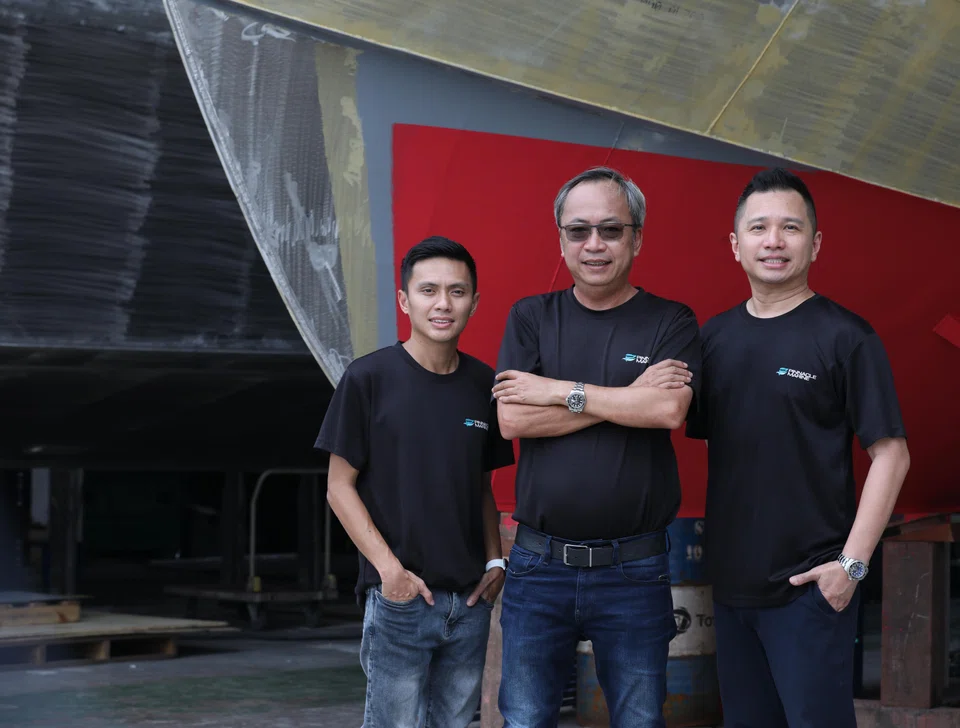
FROM supplying ships with provisions, Pinnacle Marine now builds its own. The home-grown maritime group’s S$6 million acquisition of a shipyard has given a boost to its dream of being Singapore’s fastest aluminium shipbuilder.
The shipyard allows Pinnacle Marine to serve as a “one-stop” integrated services provider, with everything – from shipbuilding and repairs to custom fabrication – carried out there, said chief executive Fabian Lim.
“Initially, we did not even have a shipyard to call our own; now everything is under one roof,” he explained.
“This allows us to scale up in our shipbuilding business and work on improving the quality of our boats, while providing additional services to boat operators.”
The group has been diversifying since its early days. Pinnacle Marine began in 2009 as a ship chandler, using rented boats and trucks to supply anchored vessels with provisions and equipment.
But, it soon saw the benefit of acquiring its own vehicles, which could both serve its own operations and be hired out to clients, such as ship chandlers and freight forwarders.
In 2011, it set up subsidiary Prestige Ocean for that purpose, and acquired a fleet of trucks and fibreglass boats.
Then in 2012, the group started providing shipping agency services: assisting ships calling at Singapore’s ports with operational and procedural requirements. In 2019, it expanded these services to regional ports.
Its most important revenue stream, however, has been shipbuilding, said chairman Laurence Chua.
Since 2018, it has built more than 40 vessels for clients such as Equatorial Marine Fuel Management Services and Bolsen Marine Systems. It has also carried out repair and maintenance works for boats owned by harbour and terminal towage operator PSA Marine and Singapore’s Police Coast Guard.
Today, shipbuilding, repair and maintenance works collectively account for half of the group’s top line, up from 30 per cent in 2022, before it acquired its shipyard.
The rest is split evenly between two areas: sea and land transportation services, and shipping agency services.
Its revenue hit S$41 million in the 2024 financial year, up from S$38 million the year before.
Banking on lighter vessels
Chua had the idea to venture into shipbuilding in 2016, when he noticed that aluminium vessels were becoming increasingly popular as an alternative to traditional fibreglass boats.
Besides being lighter and more compact, these vessels were recognised as having more stringent safety standards and better operating conditions for crew, he said. For instance, they had proper sewage systems, unlike fibreglass boats.
Specifically, these were aluminium vessels that met the standards of the world’s top ship-certification body, the International Association of Classification Societies (IACS).
Anticipating that shipowners would want aluminium vessels, Pinnacle Marine ordered two from a shipbuilder in Batam – then learnt that it would take at least 1.5 years for them to be built and delivered.
Said Chua: “We realised that if we built the vessels in Singapore ourselves, we would have more control over the lead time and quality of the work being rendered.”
So, in 2018, Pinnacle Marine set up a vessel-building unit and rented a 5,000-square-foot segment of a shipyard.
It took just four months to build its first IACS-classed aluminium vessel.
Yet, as vessel-building orders grew, the company was confined by a lack of space.
A 2019 application to acquire a shipyard was rejected by JTC, as the group still lacked a track record in vessel-building, said Chua.
In 2020, Pinnacle Marine moved to the eighth floor of a ramp-up rented factory to construct its vessels. But, there was only space to build two at a time.
Another challenge was that each vessel’s wheelhouse and hull had to be built separately, due to the factory’s ramp-height restrictions. The parts then had to be transported, reassembled and launched at a third-party shipyard.
A shipyard to call its own
In 2022, when a derelict waterfront shipyard in Pandan Loop was put up for sale, Pinnacle Marine jumped at the opportunity.
This time, its application to acquire the site was successful.
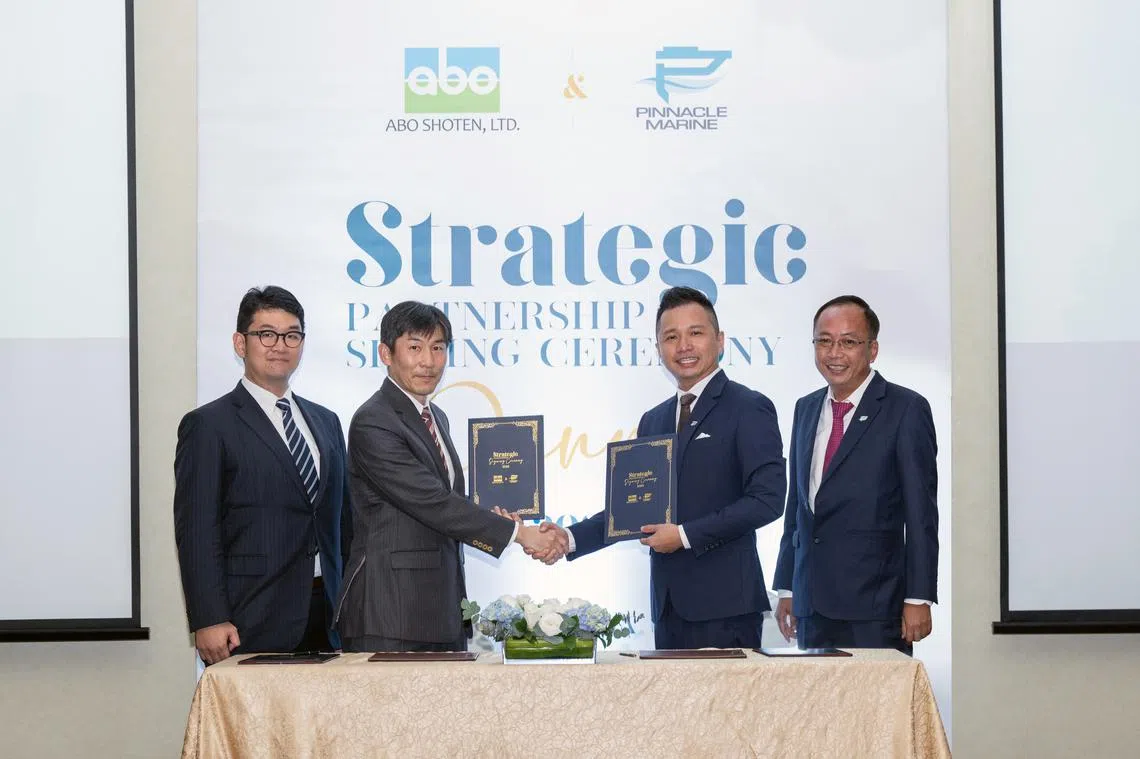
A timely capital injection came in February 2023, when Japanese shipowner Abo Shoten took a 7.7 per cent stake in Pinnacle Marine for S$5 million, in its first investment in a Singapore firm.
This supported Pinnacle Marine’s S$6 million acquisition of the shipyard in July 2023. The company shifted all its operations, including its office headquarters, to the new site.
Another S$4.4 million was spent to restore the premises, which span 125,798 sq ft.
Said Chua: “We want to build more boats, build them faster and build them bigger.”
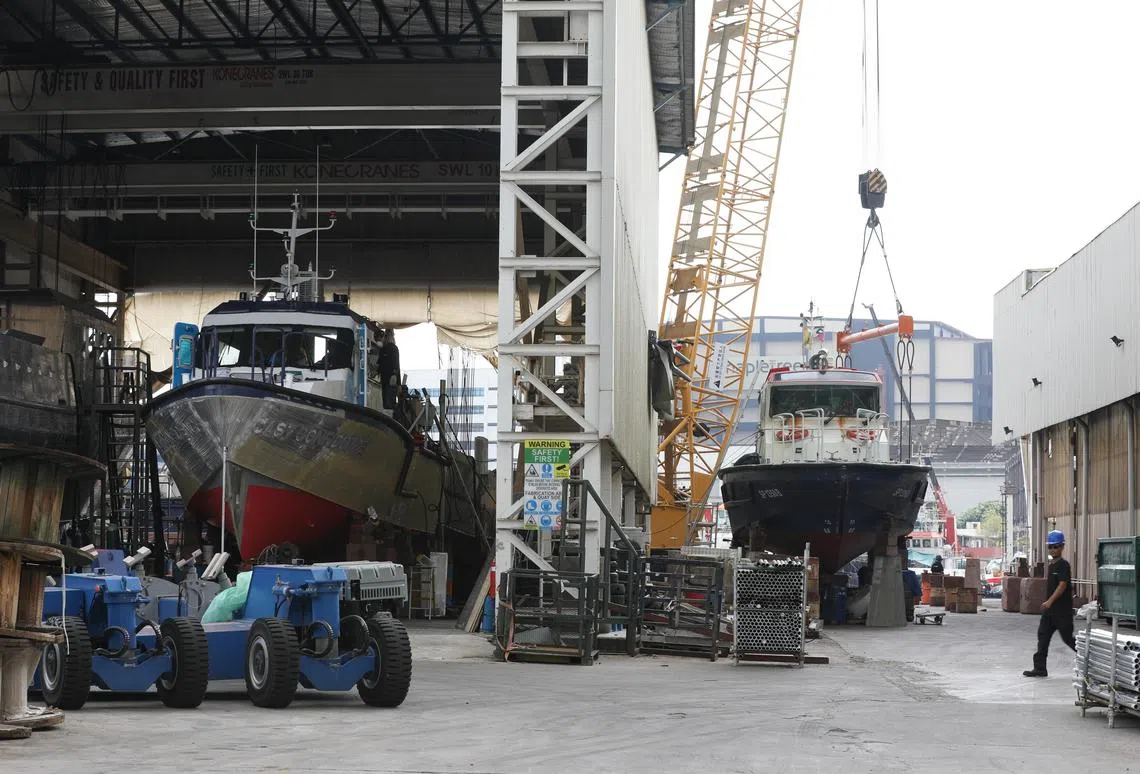
At its shipyard, the group can build four aluminium vessels concurrently, up from two previously. It can also build larger vessels of up to 20 m in length and 5.6 m in width, with each taking about two to three months.
Pinnacle Marine delivered a record nine vessels in 2024, up from an average of six a year previously. These included its first exports to a shipping agency and diving agency in the Middle East.
Apart from the space it provides to build more vessels, the shipyard has allowed the group to offer more services: repair and maintenance for commercial and government boats.
“In the past, we didn’t have enough manpower to send people out to service commercial boats, because these boats would be located across different third-party waterfronts,” said the group’s business development manager, Ken Lee.
“Today, boats can come straight to our shipyard, since we have all the parts readily available here.”
Other services, such as machining and more types of fabrication works, have also moved in-house.
These used to be outsourced, as there was no space for the necessary machinery. The group has since invested S$2.1 million in equipment, including a crawler crane.
On the back of these efforts, group revenue is expected to hit S$50 million in 2025. The company has already received 10 vessel orders this year, close to its target of 13.
Going green on the high seas
Pinnacle Marine is also leading the way in next-generation green vessels, as Singapore’s maritime industry decarbonises.
In end-2022, the group won a Maritime and Port Authority of Singapore tender to deliver three vessels that run on B20 fuel – the first such vessels in Singapore. B20 is a biofuel blend comprising up to 20 per cent biodiesel and 80 per cent petroleum diesel.
But, it has not stopped there. Last October, the group signed a research agreement with Nanyang Technological University, automobile and equipment manufacturer Weichai Singapore and the China Classification Society to build a first-of-its-kind harbour craft powered by pure biodiesel.
A 1,000-hour sea trial of the craft is set to be conducted within Singapore’s port waters in the second half of 2025.
The group’s green dreams are supported by its corporate ambitions. By 2030, Pinnacle Marine hopes to list regionally.
Said Chua: “By raising funds, we hope to convert more existing craft to green vessels. That’s how we can do our part for sustainability.”
TRENDING NOW

ComfortDelGro appoints two new independent directors

Once staunchly pro-China, Malaysian Chinese businesses are now distancing themselves from Beijing

NoonTalk needs continued financial support from CEO Dasmond Koh, auditors warn

DP Architects sets the benchmark for sustainability disclosure and design

