Cleaning and greening the planet from end to end
Blue Planet Environmental Solutions integrates the waste management value chain, from household bins to landfills

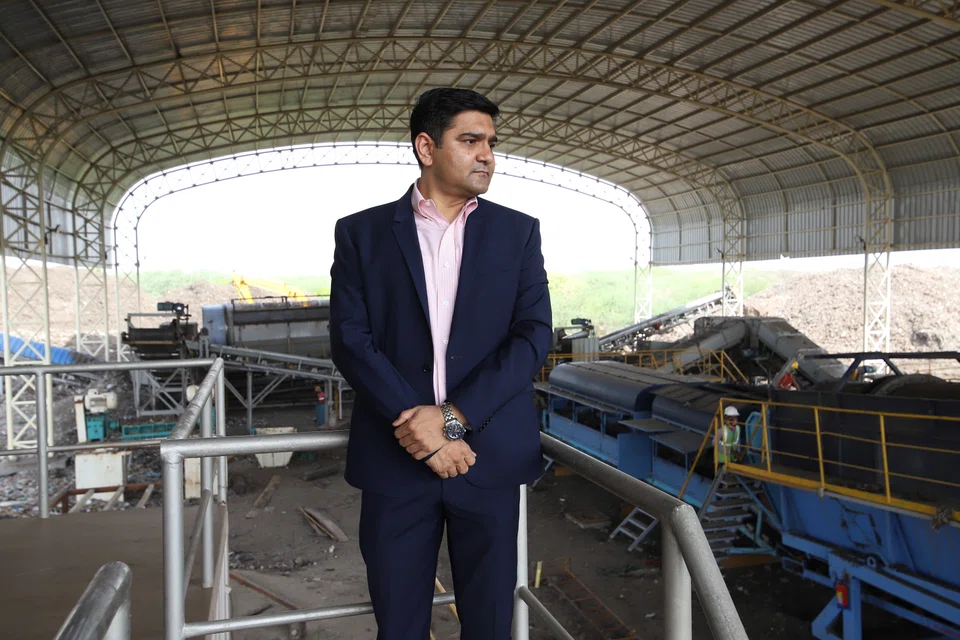
RUBBISH typically passes through many hands before reaching its final destination, be it a recycling plant or a landfill. But Singapore-headquartered Blue Planet Environmental Solutions aims to handle the entire journey.
“When half a dozen people own a solution to the problem, the problem never gets solved,” said Blue Planet co-founder and chief executive officer Prashant Singh.
In the highly fragmented waste management sector, he explained, different companies might be responsible for collecting waste from households; transporting it to waste transfer stations; processing it to recover recyclable materials; then disposing of the remainder in a landfill.
As an integrated waste management solutions provider, Blue Planet seeks oversight of the whole process – partly through acquiring companies and working with partners that handle different stages.
Newly acquired processing facilities are integrated into the company’s network in the most suitable manner, on a case-by-case basis. This could involve creating an in-house collection process, or engaging local partners.
Having control of the workflow means that Blue Planet can ensure that waste is segregated early in the process – which is more efficient – and maintain the quality of the recyclable components. An independent collector or transporter might have no incentive to do this, added Singh.
For example, at Blue Planet’s industrial waste processing facility and feedstock-collecting offices in Malaysia, waste is properly segregated so that high-quality plastic can be traded or converted into granules for recycling, while tin can be made into tin ingots to replace virgin tin, and so on.
For Blue Planet, waste is itself a resource. The company has a “zero-waste-to-landfill” goal – processing as much waste as possible, so that nothing ends up in landfills.
Currently, after filtering out organic waste, recyclables and other materials, about 10 to 20 per cent of waste that Blue Planet collects still goes to landfills, in forms such as silt and soil. Singh hopes to eventually bring this to zero.
Riding the wave
Blue Planet was set up in 2017, when its four founders saw “a lot of action” ahead for sustainability and climate change in the Asia-Pacific. Funding opportunities were on the rise, with growing interest from both governments and global private equity funds, Singh recalled.
Upon further research, the founders realised the great potential for integrated solutions in waste management.
“No one was looking at the entire value chain of waste management getting integrated, there were a lot of inefficiencies in the value chain, and there was no technology being brought up as far as processing and upcycling are concerned,” Singh said.
The company began with market research, meeting stakeholders and hiring experts to create a framework for an integrated solution. This informed its acquisition strategy, through which Blue Planet can gain capabilities directly, rather than building technologies from scratch.
With a big-picture view, economies of scale and shared access to capital, the acquired companies can worry less about those aspects, and instead focus on research and development and growing the business, he added.
Through a mixture of acquisitions – 13 so far – and building its own facilities, Blue Planet has acquired a processing capacity of more than 25,000 tonnes a day, with facilities in Singapore, Malaysia, India and the UK. Its electronic waste technologies are also applied in Switzerland, through a partner.
Most recently, this February, it acquired a majority stake in the waste-to-energy unit of Mahindra Group, one of India’s largest private entities. The unit specialises in converting municipal wet waste into refined biogas.
“(This has) given us significant momentum,” said Singh. “They have seven, eight plants across different states in India.” Expertise and technology from this unit can also be shared to improve processes and yields in other Blue Planet facilities.
This follows the 2023 acquisitions of UK recycling management company Recycle Force and Singapore’s Vac-Tech Engineering, which specialises in industrial services and hazardous waste.
Building its own
Acquisition is not the only way that Blue Planet builds capacity. The company plans to complete installation of a 9.9 megawatt waste-to-energy plant in Singapore later this year, which should be able to process almost 370 tonnes of waste per day.
Getting access to feedstock should be simple, said Singh, thanks to its portfolio company Wah & Hua, which handles commercial and industrial waste, and has a joint venture handling household waste from Jurong and Woodlands.
Blue Planet is also working towards getting the energy generated by this plant to be certified as green energy.
Elsewhere, Blue Planet is in the middle of installing “one of the largest landfill mining projects in the world” in Chennai, with an expected processing capacity of up to 10,000 tonnes of waste every day.
In landfill mining, unprocessed waste in landfills is segregated, treated and recycled, so as to free up the land.
In Kerala, it is also currently building another integrated waste processing facility.
Separately, Blue Planet has helped to develop more than 170 projects that were then handed over to clients in 15 different countries, including the US and Canada, and parts of Europe, Africa and the Asia-Pacific.
As the nature of waste varies by geography, Blue Planet’s strategy has been to consolidate expertise in-house, and potentially export its capabilities and technologies.
For instance, it is looking at how to export its petrochemical expertise developed in Singapore, in the cleaning of refinery equipment, transportation of sludge to processing facilities and consulting.
Separately, it is in “advanced talks” to expand in Singapore and Malaysia through contracts in more areas, as well as potential mergers and acquisitions (M&A).
In deciding which markets to enter, the company considers the opportunities to scale up, the presence of a suitable partner, which it may acquire, as well as government and regulatory support.
Singh continues to see “a good amount of growth” in the Asia-Pacific and is looking at projects in Vietnam, where the company now has a sales office. Further abroad, the Middle East could hold opportunities for Blue Planet’s landfill mining and organic waste processing services.
He estimates that the company has already developed or acquired “70, 80 per cent” of the technologies and capabilities that it desires. To close this final gap, its M&A strategy is focused on the recycling of lithium ion batteries, solar panels and tyres, as well as management of biomedical and electronic waste.
Though the business is certainly a capital-intensive one, Blue Planet has been “decently profitable” since its second year of operations. It funds its growth both internally and through fundraising, most recently receiving a US$35 million investment from a Danish developing countries-focused state-owned fund in December.
The company is “decently leveraged” this year, and will look to finance the next stage of its growth in another funding round after the next 18 months, said Singh.
But profits aside, the business remains purpose-driven, he stressed.
“Waste management becomes a means to an end, but not the end itself,” he said. “If waste management is creating a positive impact, that impact should be the reason why people should engage with us.”