


Climbing gyms reach new heights, but could hit a wall

Paige Lim
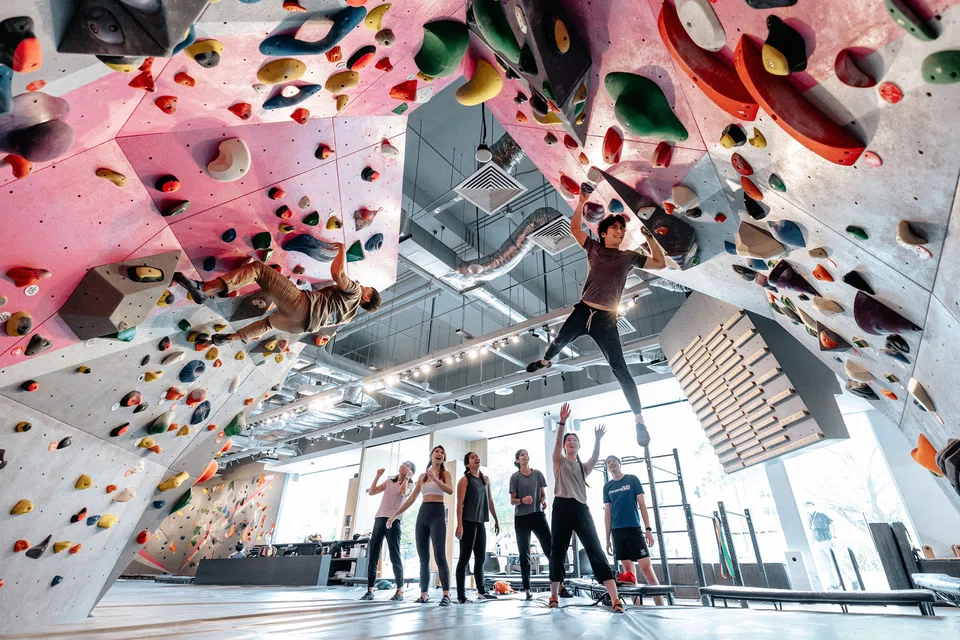
INDOOR rock-climbing has reached new heights of popularity in Singapore in the last 2 years, with a proliferation of homegrown gyms. There are an estimated 31 commercial climbing gyms in Singapore today, up from just 13 in 2018, industry players told The Business Times.
While climbing has been slower to take off here as compared to Europe and the United States, where climbing gyms are in abundance, the once niche sport has enjoyed a massive boost in exposure in Asia after making its official debut at the 2020 Summer Olympics in Tokyo last year, players said.
Another factor is the rising accessibility to climbing gyms in Singapore, with more businesses taking up leases in shopping malls – making it easier for novices to pick up the sport recreationally, they added.
One emerging trend is that of bouldering. Instead of top-rope climbing, where climbers are supported by a rope, bouldering involves climbing close to the ground without ropes or harnesses. At least 7 new bouldering gyms have sprouted up here since 2021, including 2 opened by existing chains.
Climbing chains that offer both bouldering and top rope climbing have also expanded. This year alone, BFF Climb opened a 2nd outlet in January; Climb Central opened its 4th outlet on 1 Apr; while Fitbloc opened its 2nd outlet on 8 Apr.
The climbing industry appears set to grow further this year, with players reporting brisk business and more expansion plans – particularly for bouldering.
All 4 of Boulder Movement’s gyms have been operating at 80 to 100 per cent capacity during weekday evenings and weekends since March 2022, and at a “healthy” 40 to 50 per cent capacity during off-peak hours, said co-founder Jansen Ko. Boulder Movement is currently the bouldering chain with the most outlets in Singapore, with a 5th gym set to open at Bugis+ in June.
Meanwhile, Boulder Planet hit its monthly visitorship target of 5,000 climbers just 6 months after opening in June 2021 – something that director Ben Toh had only expected to achieve after 2.5 years. A 2nd Boulder Planet outlet will be opening at Tai Seng in July.
Standing out from the pack
As the marketplace becomes increasingly crowded, it has become more important for climbing gyms to set themselves apart.
Toh cites location and space as crucial factors in a climbing gym’s ability to bring in the crowds. A central location helps: “With so many offerings right now, people are likely to go to a gym near them.”
Then there is size. According to Toh, most indoor bouldering gyms in Singapore average around 3,000 square feet (sq ft) - which is why he is banking on Boulder Planet’s relatively spacious floor area of 11,000 sq ft as a key value proposition, notwithstanding its Sembawang location.
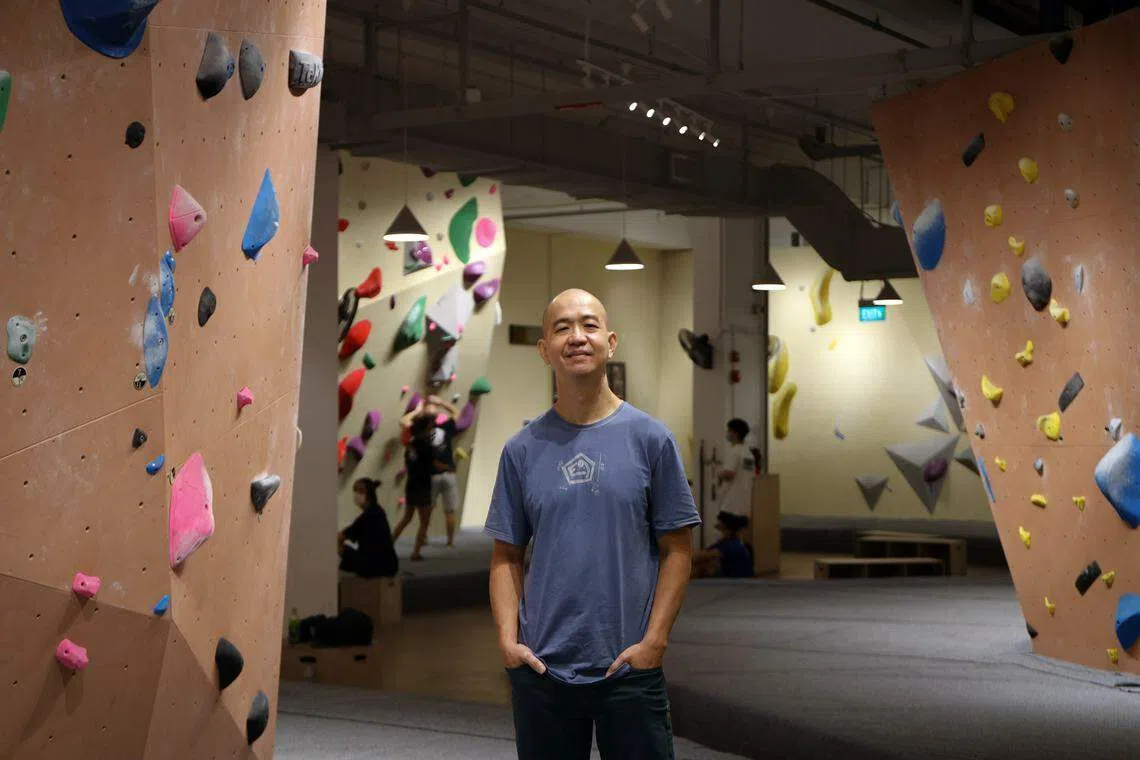
“Climbing is a social sport, and we’ve built our space to encourage interactions. If your gym is 3,000 sq ft and you try to pack in 50 people, it’s not going to be a very pleasant experience for anyone,” he said. He invested S$1.2 million to set up Boulder Planet.
The bigger floor area has allowed Boulder Planet to carve out a competition wall section, enabling it to host university bouldering competitions as an alternative revenue stream, Toh noted.
Size can also help a gym attract climbers even if it is in a less central location, Toh added. He cited competitor Boulder+ as an example: at over 23,000 sq ft, its second outlet at The Chevrons in Boon Lay is currently the largest bouldering gym by floor space in Singapore.
For Boulder+’s director Thomas Tan, another draw of his gym’s outlet at The Chevrons is its onsite cafe selling cakes, coffee and beer. Climbing gyms themselves are not eligible for food and beverage licences, but Boulder+ was able to obtain such a licence for its premises, which were previously occupied by a bowling alley with a food kiosk.
“It’s a common concept in US and European gyms, where people climb, chill and then have a beer. Having a cafe is complementary and makes it more appealing for climbers to hang out in the space,” said Tan. Boulder+ at The Chevrons opened in December 2021.
Smaller players feel the heat
Given the rapid proliferation of commercial climbing gyms since 2020, gyms which are smaller, older, or not yet well-established could face a tough road ahead growing their customer base, said industry players.
Some, such as bouldering gym Boruda Climbing, are already feeling the heat. Since opening near Mapletree Business City in September 2021, Boruda’s visitorship has been missing the mark, said managing director Iris Lee. The 7,000 sq ft gym has had a daily average of around 100 climbers – mostly young working professionals – or fewer, below its target of 120.
Competition in the vicinity is also stiff, with bouldering gym Lighthouse Climbing and rock climbing gym Fitbloc located just a stone’s throw away, Lee added.
To differentiate Boruda’s offerings, Lee is developing highly personalised bouldering programmes for corporate clients in the next few months, with the goal of converting some of these first-timer visitors into recurring gym-goers. She hopes these programmes can contribute to about 15 per cent of Boruda’s total monthly revenue, enabling the gym to break even within 2 years.
“There are a number of places that offer generic and standard programmes, where you come in to climb and that’s it – very touch and go,” Lee said. “But we want to curate activities for companies based on their specific needs, and create something of value that will compel people to return.”
On the side, Boruda will be producing limited-edition merchandise such as graphic t-shirts, socks and enamel pins to raise its profile.
Amid the bouldering boom, Ground Up Climbing chose to set itself apart by upgrading its top rope climbing facilities in March and re-positioning them as the gym’s core offering, instead of its bouldering walls.
The gym, which opened at Tessensohn Road in 2017, spent around S$100,000 to add more climbing lanes and features to its indoor high walls. It also resets its routes more frequently to attract climbers.
“Only a few places in Singapore offer high walls. Since the revamp, our gym has been full house almost every day, and we’ve seen a 30 per cent increase in first-time top rope climbers,” said Beatrix Chong, managing director of Ground Up Climbing.
But she plans to take a more conservative approach towards growing the business, for now.
“Everyone’s revenue is very diluted at the moment. I might think about expanding 5 years down the road when we have enough consumers, but right now there’s no rush – I don’t want to be scraping through every month.”
TRENDING NOW

He built the Vingroup empire. Now South-east Asia’s richest man is handing some key roles to his sons

Morgan Stanley investment-bank list leaked in email boo-boo

Could Grab CEO Anthony Tan’s US$30 million share purchase be aimed at reassuring investors?

From folding clothes to factory work: Why China is sending humanoid robots to school

