Commercial electric vehicles drive growth for battery-maker Durapower
The Singapore-based manufacturer has gone beyond the major market of China to find niches elsewhere

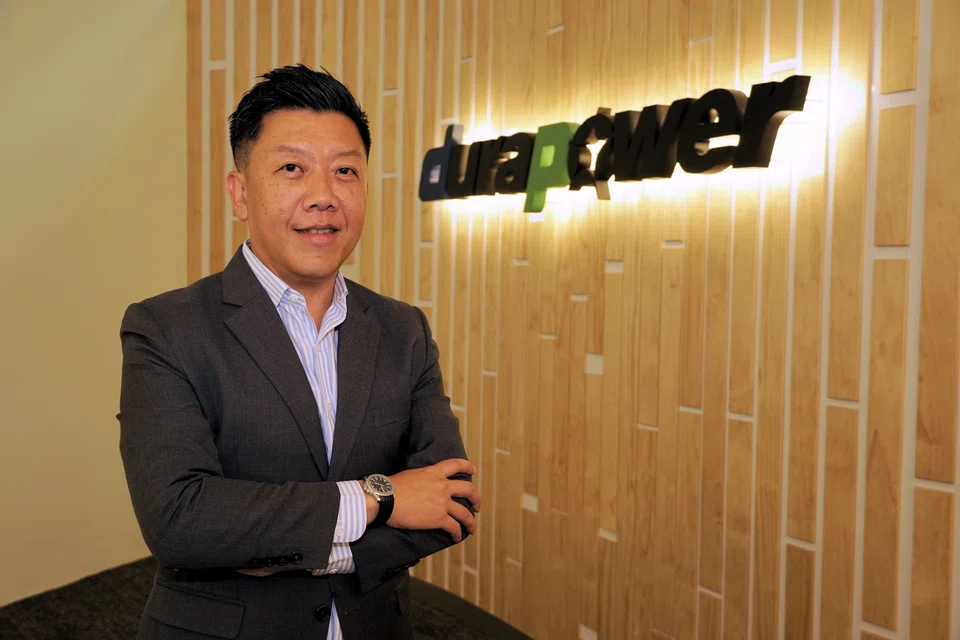
MORE than a decade ago, battery-maker Durapower was ahead of the curve in serving China’s electric vehicle (EV) market; within a few years, not content with riding the country’s EV boom, it headed to Europe too.
The Singapore-headquartered company makes high-performance batteries, although it does not focus on the more familiar passenger EVs, but on flexible battery systems that can handle tough conditions, in two main areas.
One is electrified road transport, where it has focused on electric commercial vehicles and buses. The other is its speciality segment, which includes autonomous guided vehicles (AGVs), forklifts and industrial machinery for port and harbour operations.
These two areas make up 70 per cent of its revenue, with the rest from battery applications in marine transport and “stationary energy” – that is, storage systems for solar and wind energy.
Founded in 2009, it received undisclosed Series A funding in 2014, then S$52.8 million of Series B funding from energy company Banpu in 2018.
Banpu, which is listed on the Stock Exchange of Thailand, also took a 47.7 per cent stake in the company.
In 2023, Banpu’s stake rose to 65.1 per cent after it invested another US$70 million.
Durapower’s combined revenue and order book has grown to a high of US$100 million in 2023, from a revenue of just US$2 million in 2014, said chief executive officer Kelvin Lim.
Europe contributes around half of its revenue, with another 20 per cent from China, 15 per cent from South-east Asia, and the rest spread across emerging markets in Asia-Pacific.
Growing against the flow
After spending time to develop its battery technology, establish partnerships and conduct market research, Durapower set up its first facility in China in 2010. By 2011, it was supplying batteries for commercial vehicles and buses.
At the time, the company faced questions regarding its focus on EVs, recalled Lim. “People said, ‘Why are you only focusing on EVs? It is way too early, right?’”
But Durapower’s commitment proved prescient. China was already gearing its automotive industry towards “new energy vehicles”, its term for hybrids and EVs. By 2013, the company had established itself as a supplier of hybrid commercial vehicles and buses there, differentiating itself with high-power, quick-charging batteries.
Lim then felt it was time for change. “Everyone was focused on China as a volume market, but I thought it was getting saturated, and (that) China was very much subsidy-dependent,” he recounted.
He wanted the company to be able to compete anywhere in the world, not just in a market where it benefited from subsidies.
“So we designed a product solution that is really justified only by performance and cost… and Europe was our first stop.”
Starting afresh in Europe was a challenge, but Enterprise Singapore helped by providing support and advice in areas such as laws, labour procedures and technical certification, he said.
Durapower entered Europe in 2013 with its Omniflex battery module, which is flatter, lighter and more compact than competing products, allowing for improved vehicle performance and capacity. The battery is now used in more than 1,000 electric buses globally.
New autonomy
Another new route that Durapower pursued was making batteries for AGVs: self-driving vehicles used in ports to move containers, or in manufacturing.
Mordor Intelligence estimates the global market for AGVs at US$5.5 billion in 2024, and expects it to grow to US$8.3 billion by 2029, with Asia-Pacific the fastest-growing market.
Lim is bullish on AGVs, pointing out that important ports such as Singapore and Rotterdam are leading the way in automation and electrification, with other regional ports – including in South Korea, Hong Kong and Thailand – also following the trend.
Durapower already powers the majority of PSA’s fleet of 200 AGVs. This August, it announced that it will also supply batteries to 60 AGVs for the port of Busan in South Korea.
With more than a decade’s experience in making batteries for AGVs – which are exposed to tough conditions such as high humidity, temperatures and salt – Durapower is well-placed to meet demand, said Lim.
“There are four big AGV manufacturers in the world, and we are qualified to supply to all of them,” he added.
Power diversity
Indeed, diversification is a driver of Durapower’s growth, said Lim. “If we had focused on just one market segment or geography, that would be a challenge.”
He expects most growth over the next three years to come from road transport and speciality applications for ports, with the geographical split of business to remain largely the same.
Durapower’s two smaller sectors – marine transport and stationary energy – should also contribute a growing share of revenue, though they are longer-term plays.
But Durapower has more diversity planned – for resilience.
“Our business model today has been built to anticipate geopolitical issues, even before the pandemic,” said Lim. Beyond its initial manufacturing base in China, it has an assembly facility in the Netherlands, and is opening a battery assembly plant in Thailand this year, to expand its engineering base and cut the cost of transporting goods.
One of its newest products is not even physical. In 2023, the company launched battery-monitoring software DP Pulse, which allows its batteries to be tracked in real time.
This means the owner of a Durapower battery-powered fleet, for instance, can track the batteries in all its vehicles.
Powered by machine-learning, the platform can predict battery performance and lifespan, as well as prevent safety incidents.
This not only benefits immediate users, but could also give other industries – such as the banks that provide loans and the insurers that provide coverage – more confidence in the reliability of battery systems.
All this could even help Durapower evolve from a company that sells batteries to one that sells energy services instead, as data can power such a business model.
“I believe, in the next few years to come, the battery industry will be transformed from one that is trade-based to a service-based one,” he said. “Like today, you have software-as-a-service. We could have energy-as-a-service, but that… cannot happen without data platforms.”