Commitment, capability and collaboration for the long haul
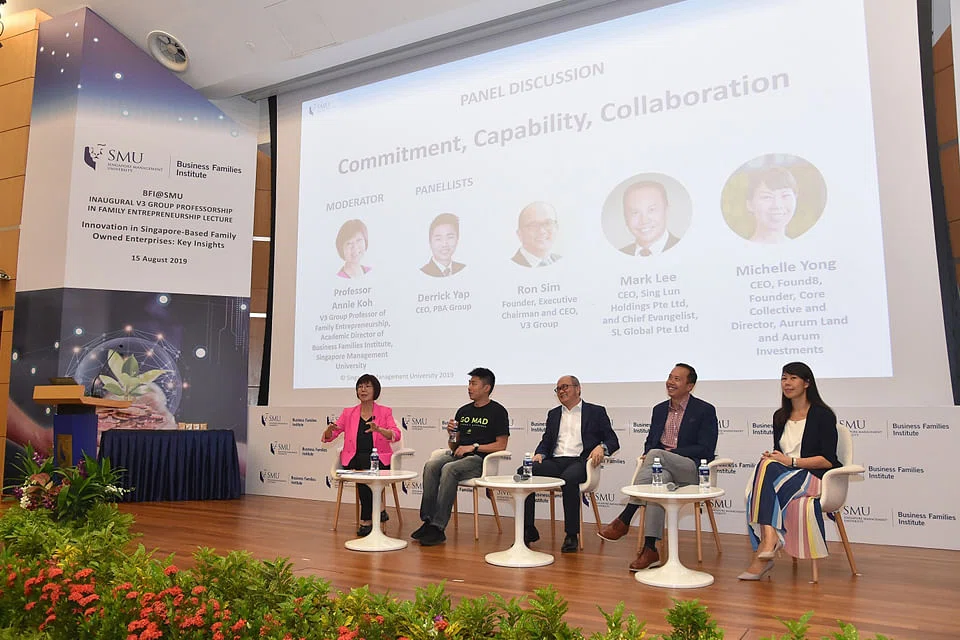
"INNOVATION is what sparks many success stories among sustainable family enterprises," said Singapore Management University's (SMU) Professor Annie Koh.
Prof Koh was sharing key findings of a study entitled "Innovation in Singapore-based Family-owned Enterprises" at the inaugural V3 Group Professorship in Family Entrepreneurship Lecture held at SMU last Thursday.
The six-month study, conducted by SMU's Business Families Institute (BFI@SMU) between December 2018 and May 2019, surveyed 86 Singapore-based family firms across a range of sectors, including food and beverage, manufacturing, as well as wholesale and retail trade.
Seventy-eight per cent of the respondents were small- and medium-sized enterprises (SMEs) with an annual turnover of up to S$100 million, with the remaining being large corporations with an annual turnover above S$100 million.
One key finding from the survey was that the majority of respondents had not collaborated with education institutions (56 per cent) or government institutions (62 per cent).
Collaboration was one of "the 3Cs" of innovation that Prof Koh mentioned were key to building a sustainable family-owned enterprise, the other two being capability and commitment.
Commitment formed the foundation, as families needed the dedication to understand the different types of innovation, which according to Prof Koh are product and service innovation, process innovation and organisational innovation.
Product and service innovation involves improvements to a certain product or service, while process innovation revolves around the upgrading of production or delivery methods. Organisational innovation means a new organisational approach in areas such as business practices.
Capability, meanwhile, centred on the interplay between internal and external catalysts to drive innovation. Internal catalysts can include company culture while governmental support is one such external catalyst.
Finally, collaboration can take the form of partnerships between family-owned enterprises themselves and other parties such as government institutions, educational institutes and other private firms.
Dovetailing with Prof Koh's lecture, a panel discussion on the same topic of innovation was conducted shortly after.
The panellists included Ron Sim, founder, executive chairman and CEO, V3 Group, whose brands include OSIM and TWG Tea; Michelle Yong, who is the founder of Core Collective, a fitness and wellness co-working centre; Mark Lee, CEO of apparel manufacturer Sing Lun Holdings; and Derrick Yap, CEO of automation company PBA Group. Prof Koh served as the moderator for the discussion.
A key item discussed by the panel was the issue of convincing more traditional-minded shareholders to innovate. "Traditional folks need to be able to see that it works before trying it, but that's the irony as innovation means that there is a higher chance of failure, before succeeding," said Mr Yap.
Chiming in, Mr Sim said: "We actually derive a lot of success from failure. You learn a lot more from failure than success." At the same event, BFI@SMU also announced a new research partnership with Bangkok University through a Memorandum of Understanding signed between ProfKoh and associate professor Dr Veerapong Malai, Vice President for Innovation and Creative Entrepreneurship Development of Bangkok University.
Under the agreement, Bangkok University will collaborate with SMU to collect data to uncover insights into innovation in Thailand-based family-owned enterprises.
The findings of this study are expected to be ready by the end of 2020.