


Construction tech SMEs lay groundwork for smarter, safer building
From video analytics to defect-spotting, their digital solutions reduce manual labour on work sites

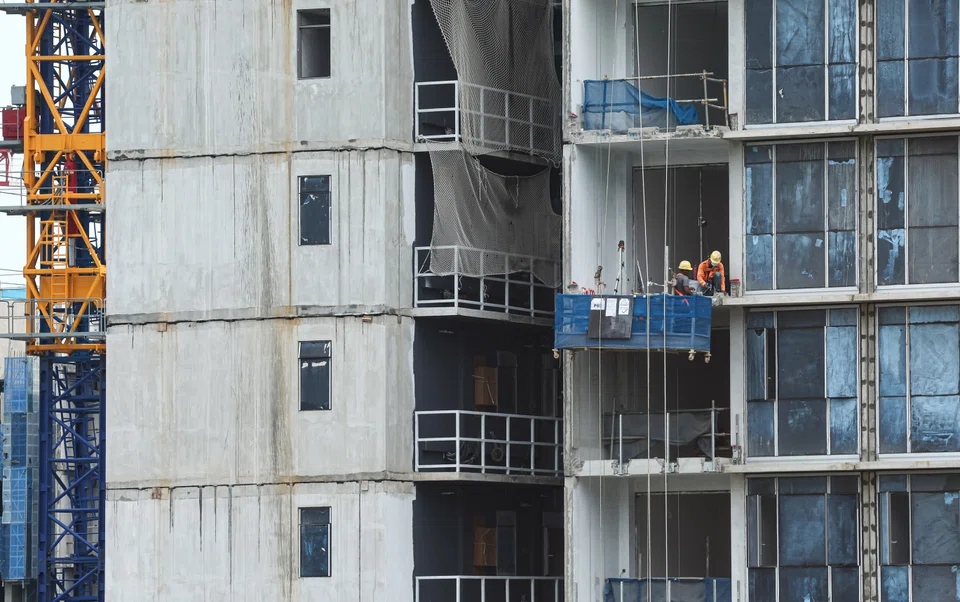
MANY small and medium-sized enterprises (SMEs) in Singapore’s construction sector may have yet to build the confidence to adopt new technologies.
“Most built environment firms tend to be caught up with their projects’ day-to-day matters and may not have the capacity to keep a lookout for the latest innovations,” a Building and Construction Authority (BCA) spokesperson told The Business Times.
Even when companies do notice innovations, they might hold off on investing because of the initial cost – particularly when the return on investment is uncertain, the spokesperson said.
Government support can help to narrow the field and fund these decisions. The Productivity Solutions Grant, for instance, co-funds SMEs in acquiring pre-approved digital tools such as 3D modelling, quantity surveying and facilities management automation. More than 900 SMEs in the built environment sector have tapped it since April 2020.
Even as SME customers may be reluctant, however, local construction technology firms are pressing ahead.
From scanning concrete for hidden dangers to automating labour-intensive tasks, these companies’ solutions help worksites get safer, smarter and more efficient.
Ailytics: Replacing human surveillance with all-seeing AI
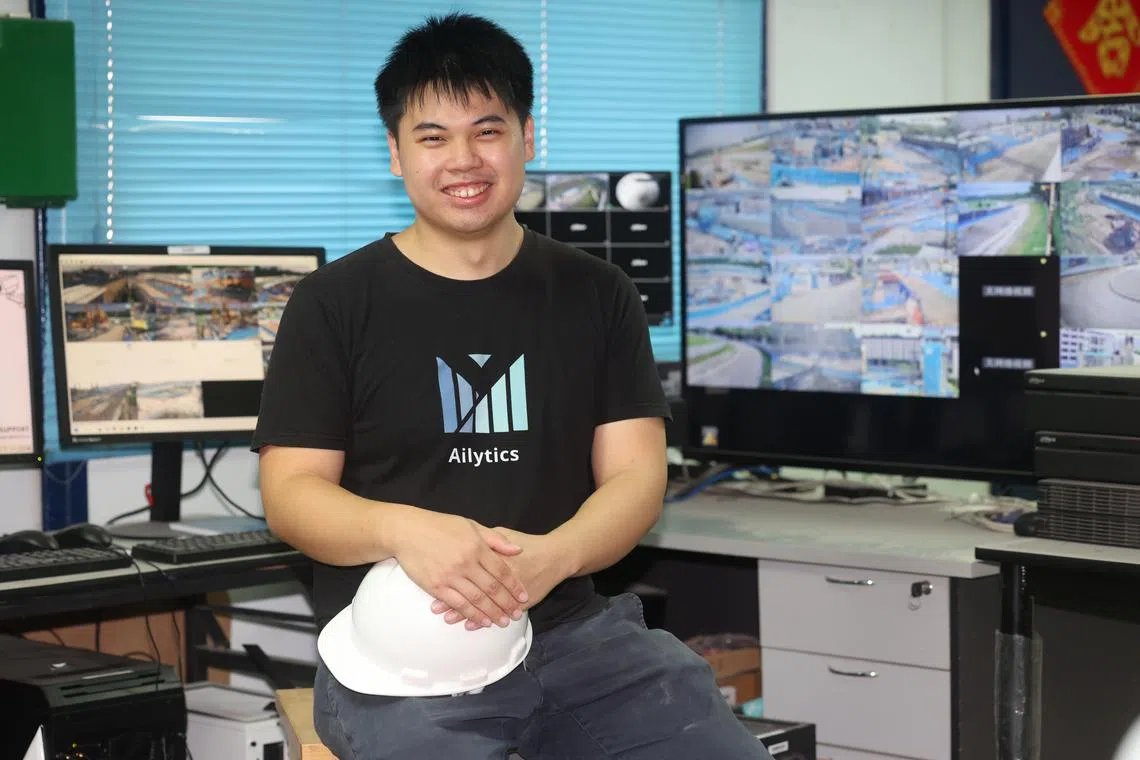
On most construction sites, safety teams have to look out for ever-present risks, especially where heavy machinery or work from heights are involved. But now, artificial intelligence is helping to spot safety violations.
Traditionally, construction firms rely on safety teams who manually inspect sites for breaches or on workers who monitor camera feeds, said Ailytics chief executive officer Lenard Tan.
Both methods, however, are prone to human error, operator fatigue and inefficiencies.
“If we go on a site walk, and we see someone without a face shield, and ask him to put it on – we are 90 per cent sure that after we walk away, he will take it off again,” Tan said.
AI video analytics tools, such as Ailytics’ software, solves these problems by providing continuous monitoring without the need for constant human involvement.
The company’s visual-recognition AI software analyses video footage to detect and flag hazards in real time, alerting safety teams to missing protective gear, for instance, or unsafe practices such as workers standing under suspended crane loads.
By using the software, construction sites can reduce the frequency of manual inspections by up to 50 per cent.
In 2023, Ailytics’ software detected over 32,000 potential hazards across more than 80 job sites, Tan said.
So far this year, the system has been rolled out across at least 122 job sites in six markets: Singapore, Hong Kong, Malaysia, Indonesia, Abu Dhabi, and Israel.
In April, the company secured US$2.7 million in a pre-Series A funding round, led by venture capital firm Tin Men Capital.
But getting to this point was not easy. When the company was founded in 2021, convincing construction bosses to adopt cutting-edge technology was a challenge, said Tan.
Many firms hesitated to invest in AI when its value was yet to be proven, he recalled. “They would say: ‘Who are you young punks who (have) never even worked in construction before?’ These were typical remarks, and we had to prove ourselves.”
Since then, however, acceptance of AI has grown – and recent regulatory changes in Singapore have also shifted the landscape in AI’s favour.
Since Jun 1, it has been mandatory for construction worksites worth S$5 million and above to install video surveillance systems in higher-risk zones.
These include areas where work involves lifting operations, excavations and potential falls from heights over 2 metres.
With the new mandate, all such sites now have camera systems – into which AI video analytics can be integrated. Ailytics has seen a rise in demand for such integration, said Tan.
“Now, the infrastructure cost for the cameras is already (baked) in,” he explained. “In the past, if they wanted our solutions, but they didn’t have the cameras, the infrastructure cost could be too high, especially for short projects.”
Ailytics is also gaining traction overseas. Singapore now accounts for 70 per cent of revenue, but this share is expected to shrink over the next few years as the company expands its international footprint.
In the next three to five years, Tan projects that Singapore’s contribution to its revenue will decrease to around 20 per cent, as the company expands into regions such as Europe and the Middle East.
Azimuth Technologies: Taking a production-line approach to construction
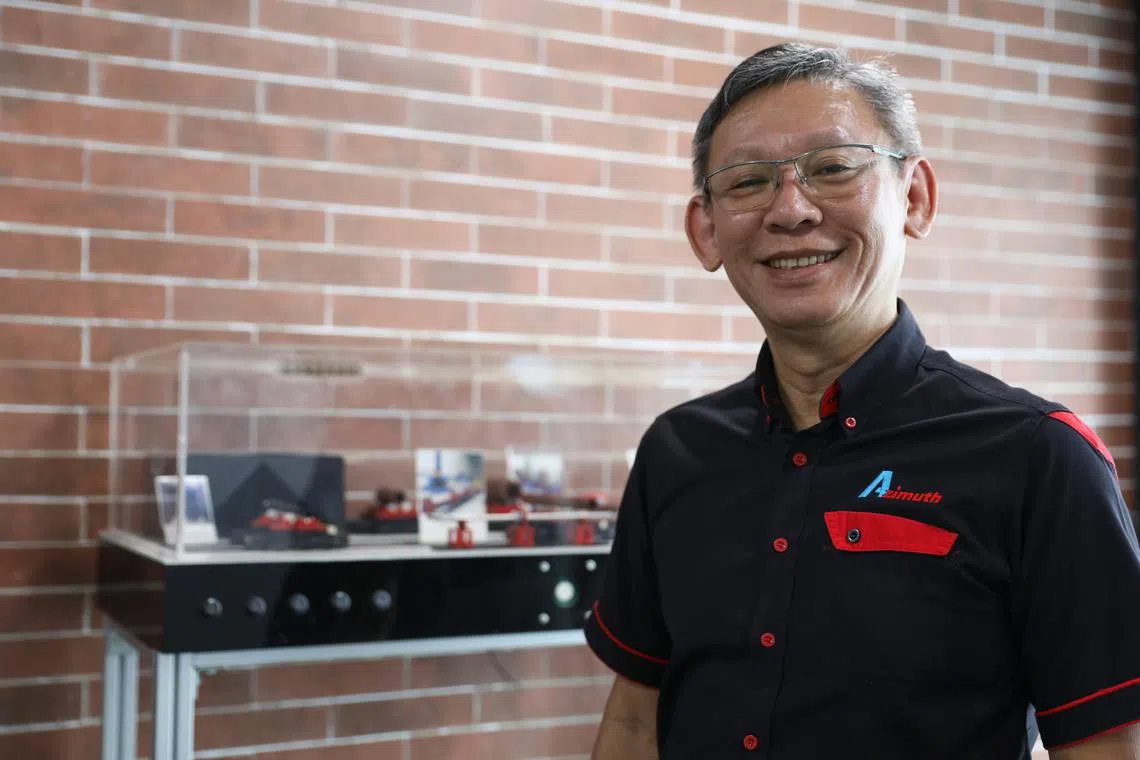
Azimuth Technologies is taking its automation expertise out of the factory and into construction sites. Its goal: applying robotics to tasks that have long relied on manual labour, said director Francis Tan.
The company had nearly two decades of experience in automating the movement and handling of heavy equipment in the semiconductor and oil and gas industries.
Then in 2017, a Swedish manufacturer approached it for help with a prefabricated housing project. This was the beginning of Azimuth’s foray into construction automation. Prefab housing consists of self-contained housing units – each one basically a single flat – which are then assembled into full apartment blocks. The project was to manufacture these units at a site in Malaysia, to be shipped overseas for assembly.
Azimuth designed a conveyor system for building these container-sized housing modules, similar to the assembly lines used in car manufacturing.
As a module moves through the line, robots at each station perform a specific task: for instance, welding structural joints. With this system, a completed module could be produced every 90 minutes, Tan said.
Since then, Azimuth has continued to explore automation opportunities in construction.
In 2022, it started working with Chuan Lim Construction to develop a robotic system to install noise barriers along Singapore’s roads, under the government’s multi-agency Built Environment Accelerate to Market Programme. Part of the research and development was funded by the government.
Traditionally, workers have to plant poles in the ground and then install sound-absorbing panels. Azimuth adapted and programmed a third-party robot to handle the panels.
Mounted on a mobile trolley, the robot moves along the route of the pre-installed poles, precisely positioning each panel accordingly.
“With this robot, the productivity has improved significantly,” said Tan. What used to take 30 minutes with a team of six workers can now be completed in just five minutes with a team of two with the robot.
In addition to boosting productivity, the robot improves safety. Its robotic arm can reach the highest point of the noise barriers, allowing it to perform tasks that previously required workers to operate at heights of up to 5 m.
Another benefit is the robot’s built-in “eye” or laser sensor – also developed and installed by Azimuth. As it is not affected by changes in lighting, it can operate effectively in various environments, including low-light conditions. Indeed, some customers plan to take advantage of this capability by scheduling work to be carried out during cooler night-time hours to reduce the risk of heat stress for workers, Tan said.
One major client is Singapore’s Land Transport Authority. Early next year, Azimuth’s robotic system will be deployed to install noise barriers along the Jurong Region Line.
As Azimuth’s construction business grows, the company has formalised its commitment to the sector with a dedicated subsidiary, Tan said.
This new entity deals exclusively with automation solutions for the construction industry, allowing Azimuth to separate this from its oil and gas operations.
Currently, 90 per cent of Azimuth’s revenue comes from oil and gas, but the company expects this to change over the next three to five years.
By 2028, the company projects that construction will account for half of its business on a group level, driven by an increasing demand for automation in building projects across Singapore. “We are still focused on Singapore, until we are more mature and (our) people are more confident,” Tan added.
WaveScan: Scanners that can peer through concrete
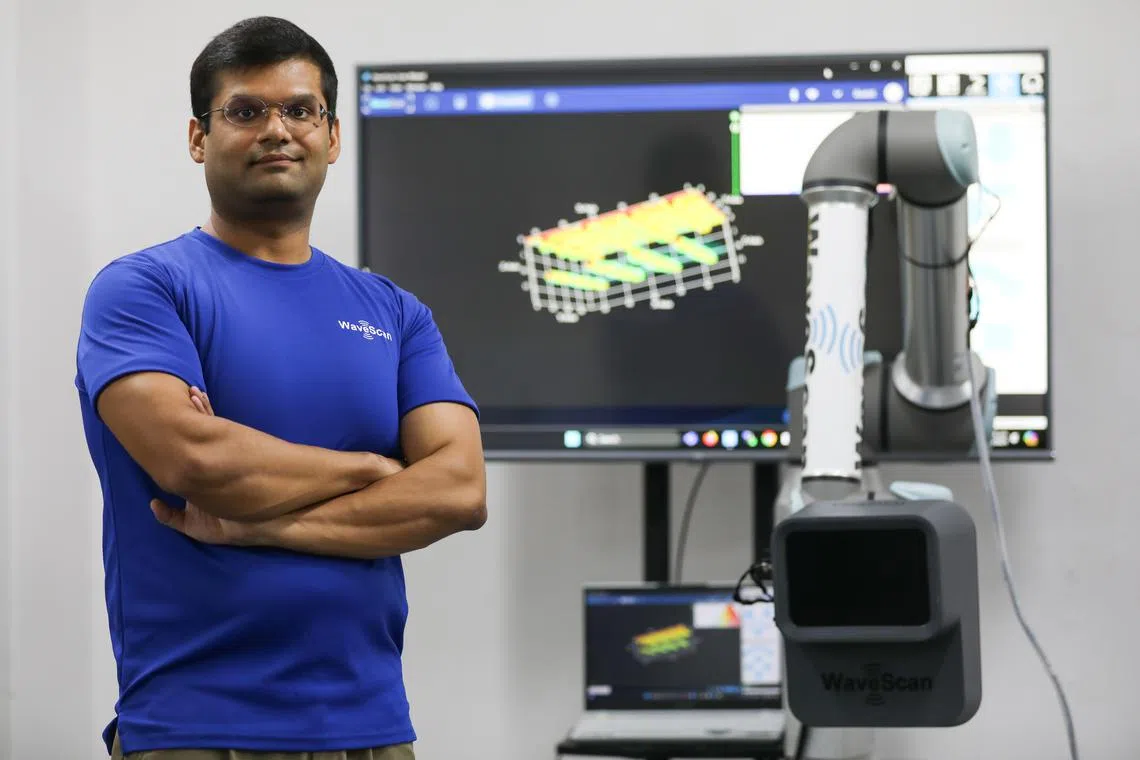
Today, building a Housing Board flat often involves piecing together large prefabricated concrete structures: walls connected at a right angle, say, or a facade wall with windows.
But before these components can be pieced together on-site, they must be scanned to detect potential cracks or empty spaces in the concrete, as part of post-production quality control. Some of this scanning is done by workers using WaveScan’s scanners.
Unlike traditional X-rays, which use ionising radiation and can pose safety risks, WaveScan’s scanners are entirely safe for human exposure.
“We use electromagnetic waves, similar to those in Wi-Fi or cellular signals,” explained founder and CEO Kush Agarwal.
Founded in 2018 as a spinoff from the Agency for Science, Technology and Research, WaveScan was born out of Dr Agarwal’s work on non-destructive testing technology at the research agency.
The electromagnetic waves can scan up to 40 centimetres deep into concrete, providing detailed 3D images of the material’s internal structure.
For thicker structures, the scanner can be used on both sides of the concrete – effectively doubling the coverage to 80 cm.
This enables engineers to spot structural defects such as cracks, voids, and water seepage, all without the need for destructive testing.
Without such scanning, engineers would have to perform core sampling, which involves drilling into the concrete to extract samples – an invasive method that can weaken the structure.
Each scanner can survey one square metre of concrete in about two minutes, translating to 30 sq m each hour.
Once the raw data is collected, data analysis is carried out automatically by an AI algorithm that detects and labels structural defects.
A report is then automatically generated for engineers to review.
“This drastically reduces the expectation of know-how on the end-user’s side,” Dr Agarwal said. “They just need to know how to open the software, look at the data, and find the labelled defects.”
The applications extend beyond just Singapore’s construction sector, he added.
In oil and gas, for instance, WaveScan’s scanners are used to inspect refinery stacks, LNG tanks and fireproofed metal structures. Here, the technology is primarily used to detect corrosion in metals, hidden beneath layers of concrete or fireproofing materials.
Energy giants such as Chevron, ExxonMobil and Shell have deployed WaveScan’s technology to monitor the infrastructure at their refineries, both locally and overseas.
While 60 to 70 per cent of WaveScan’s revenue currently comes from Singapore, the company is rapidly expanding overseas.
It set up a subsidiary in Hong Kong earlier this year and is working towards securing government approval for its technology, which it expects to receive by the end of the year.
WaveScan has also embarked on R&D on a second-generation scanner, funded by a S$500,000 grant from BCA.
Set to launch in the second quarter of 2025, the new scanner will offer deeper penetration capabilities of up to 60 cm, and sharper image resolution.






