


Cooler servers, cheaper batteries, automated sandblasting: How Singapore firms put RIE support to work
Home-grown businesses are using the S$37 billion in the R&D kitty to take new technologies from lab to market
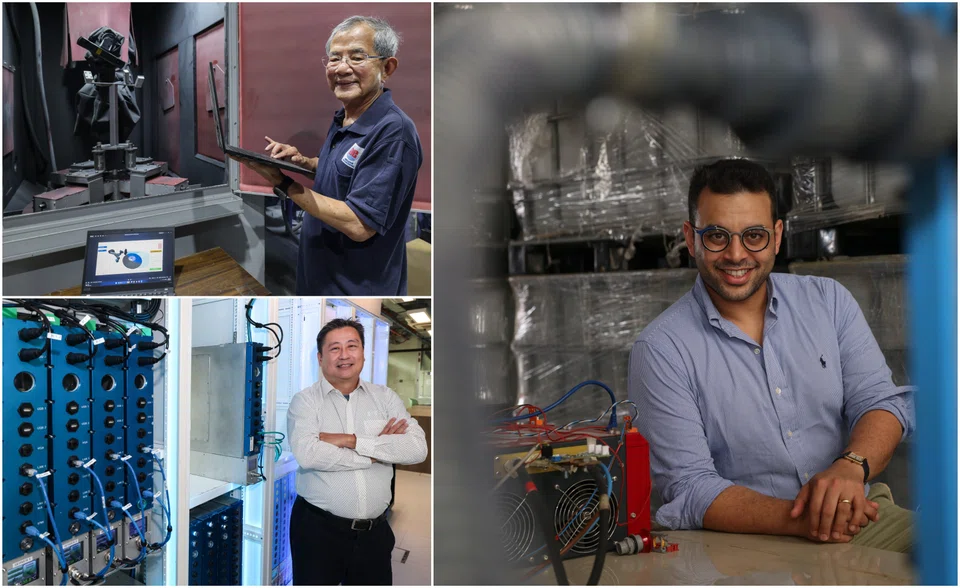
[SINGAPORE] From equipment that gives aerospace and oil-and-gas components a consistent finish and liquid cooling for data centres to batteries designed to store electricity for longer periods, three Singapore companies are turning research into commercial products.
The Business Times met the leaders of Abrasive Engineering, Hyprcool and VFT, whose R&D efforts have received support under Singapore’s Research, Innovation and Enterprise (RIE) plans.
Singapore has committed S$37 billion to research and innovation under its next plan, RIE2030.
The first report card on RIE2025 showed business R&D spending rose 64 per cent to S$9 billion between 2018 and 2023; it also flagged scope to generate more commercial value from public-sector research.
Abrasive Engineering fights obsolescence
Tan Ser Hean believes that enthusiasm alone cannot sustain a business. Even successful companies must keep innovating to meet demand, he said, or risk “closing shop very fast”.
“For a SME (small and medium-sized enterprise), it’s about survival,” said the executive chairman of surface-finishing equipment maker Abrasive Engineering. “It’s no use having passion if you cannot survive.”
His answer is to invest in R&D, which he said will give the business technology essential for its long-term survival.
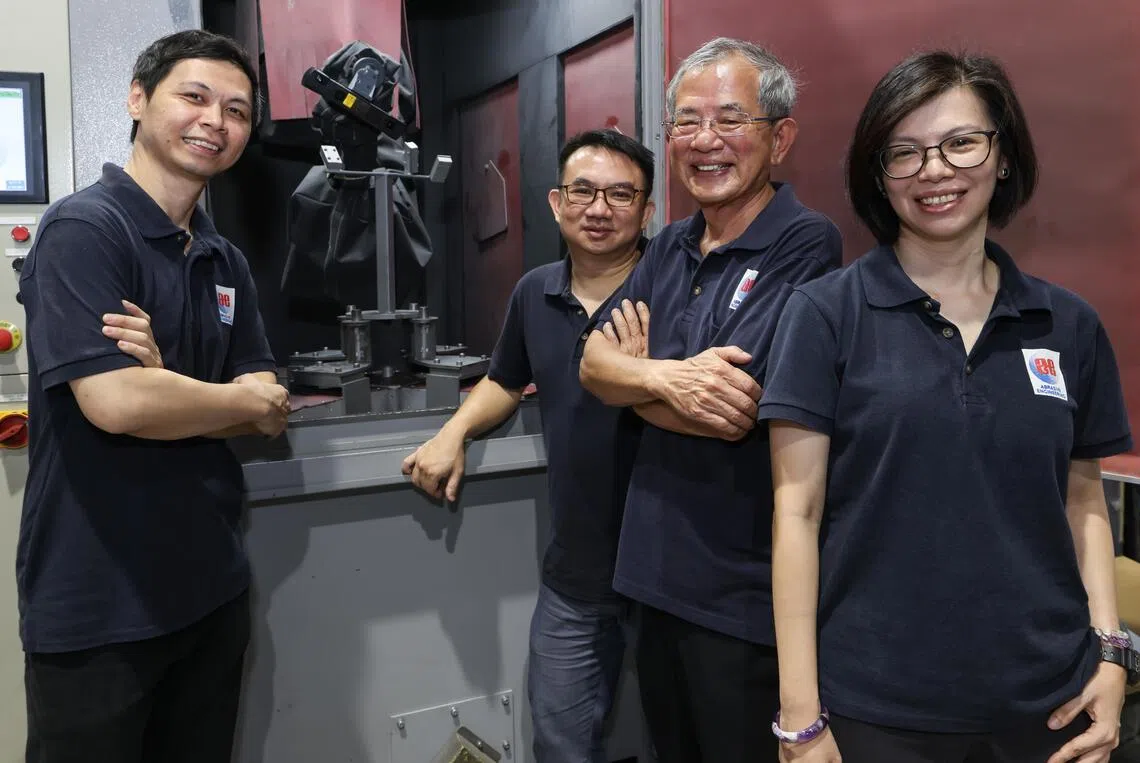
The 71-year-old has handed day-to-day management of the company he founded in 1990 to the next generation. But rather than give them money, he is working on giving them technology instead by developing solutions that improve productivity and equip them to carry the company forward.
Abrasive supplies equipment to major aerospace and oil-and-gas companies through its products which enable them to treat component surfaces consistently.
In 2010, the company spotted an opportunity to develop a magnetic valve to regulate the flow of metallic abrasives. At the time, Tan said, only one manufacturer, based in the US, made such valves.
Abrasive committed about S$500,000 of its own funds to the technology and completed its first functional prototype in 2016. Its system enables one controller to operate four valves, compared with one for the US product. It secured a US patent in 2021.
With the valve market acceptance, Tan was encouraged to develop more products. But having spent years on that valve, he wanted to move faster.
His solution lay in using a research institute with a team of scientists and research engineers. “If we can pull them together and develop things together, it will be so much faster,” he said.
In 2018, Abrasive began working with the Advanced Remanufacturing and Technology Centre (ARTC) of the Agency for Science, Technology and Research (A*Star) and the National Metrology Centre (NMC) on a valve for non-ferrous abrasives.
The 18-month collaboration produced a proof of concept using microwave sensing. ARTC also supplied project management to keep research moving when Abrasive’s staff had to see to urgent customer orders.
The partnership grew into a joint laboratory in 2020, with a combined investment of S$5.5 million over three years to develop flow-control products and automated surface-treatment equipment.
The collaboration received support through research and innovation funding schemes under RIE2020 and RIE2025.
One project, with ARTC and robotics start-up Augmentus, developed a system that scans components and generates instructions for a robotic arm, reducing manual programming.
The first phase yielded six new product lines, including higher-flow valves and automated high-capacity sandblasting systems. Products developed in the lab generated S$3.5 million in revenue between 2020 and 2023, Tan said.
Annual revenue has doubled from S$6 million before the first joint laboratory to about S$12 million.
Further research addressed another vulnerability – dependence on a Japanese sensor supplier. In 2024 and 2025, Abrasive worked with ARTC and NMC to develop its own microwave sensor, incorporating it into products sold in 2025.
A second joint-lab phase launched in October 2025, under A*Star’s S$21 million advanced manufacturing initiative involving several local SMEs, will support further product development and overseas expansion. Abrasive targets annual revenue of S$25 million by 2030.
While some small companies may feel safer keeping money in their pockets, Tan regards technology as an investment in growth, and enables his customers to improve productivity and achieve consistent results.
“You must spend money to acquire technology and develop new products. Then your company can grow,” he said. “If not, one day you will be obsolete.”
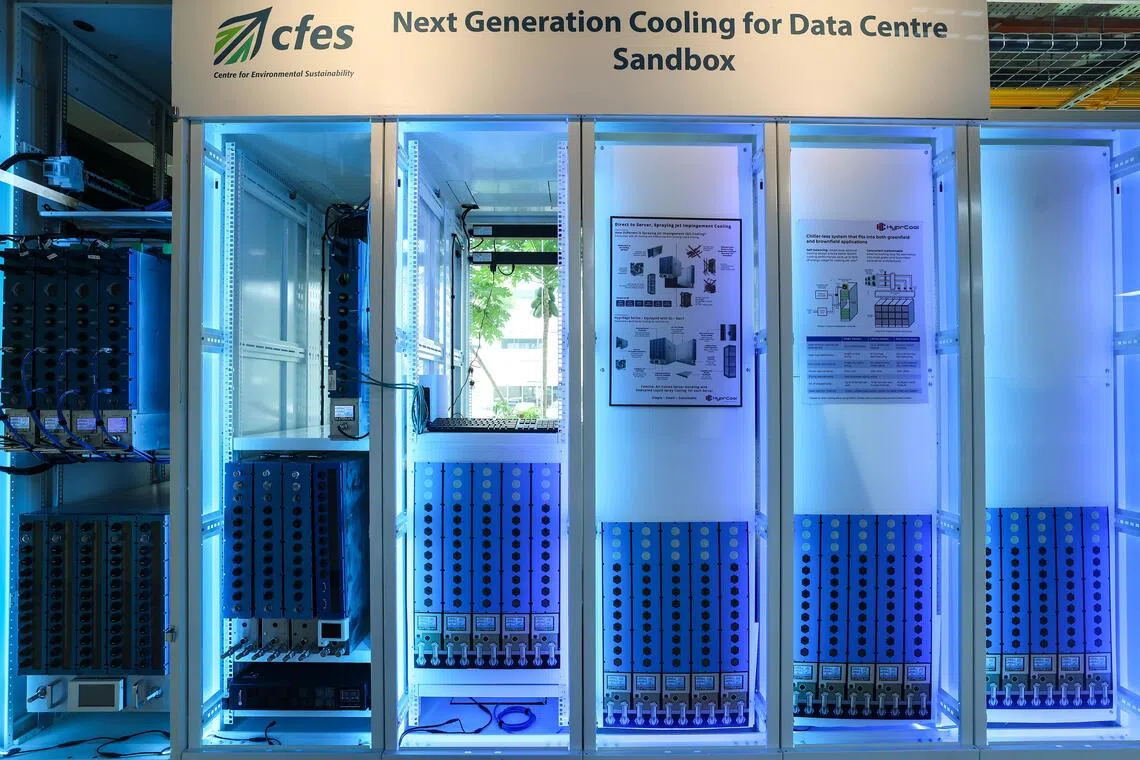
Hyprcool puts liquid-cooling into real-world use
As data centres face growing scrutiny over their energy and water consumption, liquid-cooling technology firm Hyprcool is developing a more efficient way to manage heat generated by artificial intelligence workloads.
Founded by Greg Ong, the company has developed a spray-cooling technology that captures heat directly from server components, unlike conventional systems that use air-conditioning and chilled-water infrastructure to cool the space around servers.
Drawing on 19 years of tech experience and work in the data centre sector, Ong worked on the limitations of conventional cooling systems even as AI raised demand for computing power.
“Considering what we are experiencing in the world today with AI, those cooling demands are 10 to 15 times higher. It’s a tremendous amount of heat coming out of all these servers and the graphics processing units (GPUs) they run. You need a lot of electricity and water to keep up with it,” he said.
Hyprcool’s system uses 70 to 90 per cent less facility infrastructure than conventional systems. It also halves energy consumption, and water usage is “virtually zero”.
Its compact design allows deployment from offices, without dedicated computer rooms in full data centres, and minimal to no noise is generated, Ong added.
The company, which holds patents for its cooling technology in 30 countries, commercialised its first product in 2024.
Hyprcool is one of only three entities in Singapore conducting research into liquid cooling, but is the only one to have commercialised its technology, said Ong.
The firm began its research and development in 2018, working with A*Star’s Singapore Institute of Manufacturing Technology and the Centre for Environmental Sustainability at Ngee Ann Polytechnic, funded by Enterprise Singapore (EnterpriseSG).
While Ong declined to disclose the amount of funding received, he said the collaboration gave the company access to engineering expertise and scientific knowledge that would have been difficult to source independently.
“Sometimes it’s not about the money. It’s the know-how, the expertise, the scientists who bring all this know-how to the table,” he said.
The collaboration helped Hyprcool understand the technical requirements of its cooling system, including the design and internal structure needed to achieve the expected performance.
While funding under the RIE plan supported its R&D, the development process was not without challenges.
The Covid-19 pandemic disrupted progress, and market inertia and unfamiliarity with alternative cooling technologies made it difficult to convince potential customers to move away from conventional systems.
“Everyone grew up in the air-cooling world. Now you’re asking them to go and relearn things. It can be very challenging,” he said.
Hyprcool is now exploring overseas markets and applications beyond conventional data centres.
Last year, it explored supplying a 300-megawatt data centre in the US, but found its manufacturing capacity insufficient to meet demand.
“They were talking about something 50 times larger than what we’re used to,” Ong said. “If they placed an order for a few thousand units, it might take me two years to deliver everything because we don’t have the correct manufacturing setup.”
Hyprcool plans to revisit the US market in the coming months, focusing on smaller data centres.
Meanwhile, the company began its first overseas deployment in Japan this year, where its product is being tested in a pilot project.
Hyprcool is also exploring opportunities in industrial computing, where AI is used in applications such as warehouse robots and cameras monitoring manufacturing processes.
“The challenge right now is that there is a very big market in industrial computing already happening … but they lack the performance of a data centre-grade AI server,” Ong said.
The company is looking to bridge this gap with systems that combine powerful GPU computing with local processing capabilities that would enable industrial users to run complex AI models on-site rather than rely on data centres.
The product is targeted for commercialisation in the third quarter of 2027.
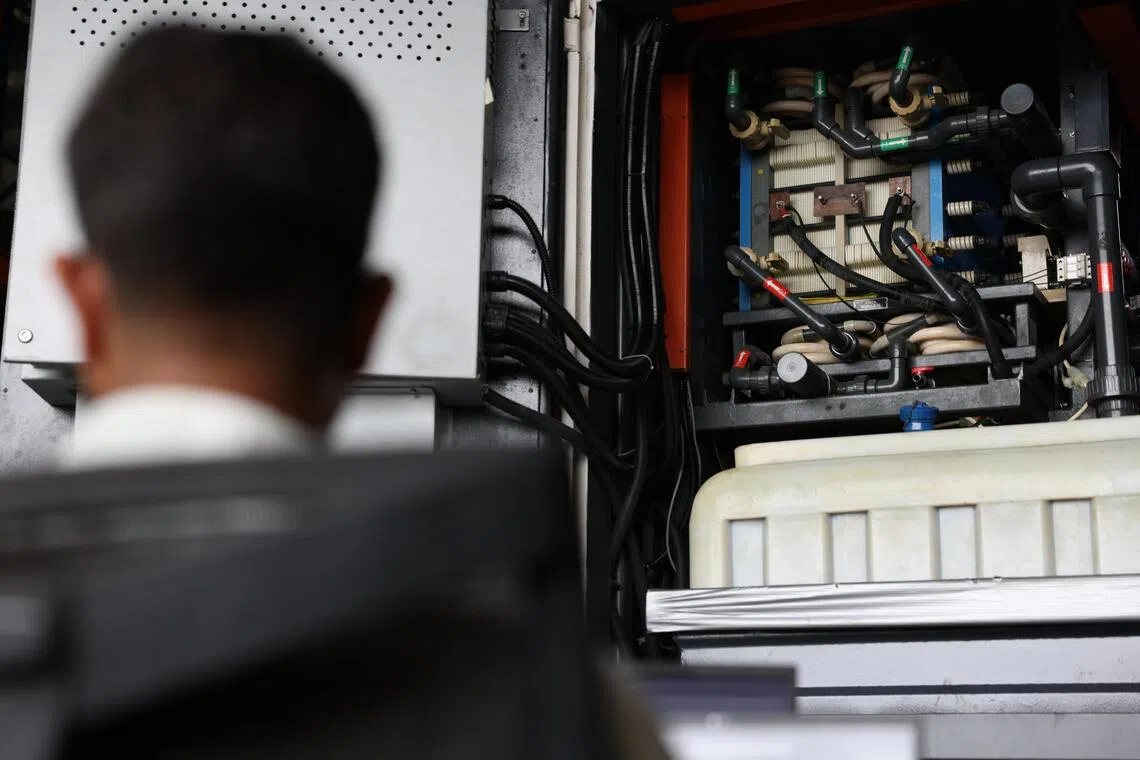
VFT uses waste to cut battery-pack costs
With Singapore’s demand for electricity expected to rise, energy-storage company VFT set out to make it cheaper to store power for longer by tapping R&D to lower the high upfront cost of its batteries.
The push comes as the growing demand for AI drives the expansion of power-hungry data centres, increasing the need for energy-storage capacity, said VFT chief executive Vidal Bharath.
Energy-storage solutions, such as flow batteries and lithium-ion battery packs, enable excess renewable energy to be stored for use after dark, without “having to turn on the fossil fuels later in the evening”, he said.
Founded in 2018 as VFlowTech, VFT develops vanadium redox flow batteries, which are now being used in places such as Pulau Ubin to support the island’s microgrid using a one-megawatt-hour system.
The batteries work by storing energy in a liquid containing the metal, which is pumped through a central cell stack to generate electricity.
One key difference between vanadium redox flow batteries and lithium-ion batteries lies in their lifespans, said Dr Bharath.
While conventional lithium-ion battery packs on power grids last between five and eight years, vanadium flow battery systems can be designed to last more than 20.
However, the higher upfront cost can deter customers from deploying flow batteries, he said.
Earlier this year, VFT’s vanadium redox flow battery packs cost up to US$500 per kilowatt hour, compared to about US$100 for lithium-ion battery packs.
While flow batteries are more cost-effective over a longer lifespan, government and commercial clients may be hesitant to pay substantially more upfront, said Dr Bharath.
The challenge, however, is that vanadium, a key component of flow batteries, is “really hard to extract”, and it accounts for the largest share of production expense.
He added that “getting the cost of vanadium down” is therefore the most important thing for his firm to focus on.
The company has pursued that goal since its founding in 2018, when it began collaborating with the Energy Research Institute @ Nanyang Technological University on commercialising vanadium redox flow battery technology.
More than eight years later, it launched a joint venture in 2026 with an Indian supplier to extract vanadium, a key input for its batteries, from petroleum-industry waste. The arrangement halved the cost of obtaining the metal and brought down battery-pack costs by more than 60 per cent, to US$175 a kilowatt hour.
VFT’s R&D projects received support through the Industry-Alignment Fund – Industry Collaboration Projects scheme under the RIE 2025 plan.
Separately, EnterpriseSG and the National Research Foundation supported its supply-chain integration with the Indian supplier.
The firm has also brought down costs through product standardisation, drawing on experience from pilot-scale projects in Singapore.
These included an installation with liquid storage logistics company Advario in Jurong Island and a project at Alkaff Kampung Melayu Mosque.
Dr Bharath said standardisation lets VFT scale up its battery systems using repeatable components, rather than “reinventing the wheel” for each project.
Beyond Singapore, VFT has about 10 gigawatt-hours’ worth of vanadium-specified tenders in the pipeline in Asia for the next 12 to 18 months.
Potential projects include supporting power grids in India, supplying long-duration energy storage for solar farms in the Middle East and working with customers in South-east Asia.
For Bharath, these opportunities are part of a broader goal to make “renewables more mainstream”.
“It’s not just about the renewables themselves; it’s about the infrastructure that allows them to happen,” he said. “It can’t be solar and wind during the day, then everyone turning back to fossil fuels at night. That’s the gap VFT bridges.”
TRENDING NOW

UOB Q3 net profit almost trebles to S$1.25 billion off low base, but misses forecasts
Stocks to watch: UOB, SGX, CLI, SIA Engineering, CSE, MUST, iX Biopharma

If Europe goes to war, the fallout will be felt in East Asia

Hong Kong’s Link Reit in talks to acquire around 50% stake in Income Insurance’s Eastpoint Mall

