From craft beer to cask: RedDot BrewHouse expands repertoire to spirits
Its new distillery business offers two brands of ‘Made in Singapore’ whisky, gin and rum

SOMETHING is brewing at RedDot BrewHouse – not just its mainstay of craft beer, but a new range of distilled grain spirits comprising whisky, gin and rum.
While spirits are not technically brewed, the production process shares key similarities with that of beer.
Said brewmaster Crystalla Huang: “Essentially, if you’re making a whisky, you first ferment a beer-like product… then you distil it and age it in barrels. We already have the expertise in fermentation; it’s not like we had to relearn it.”
RedDot first considered distilling in Singapore in 2020, having already established similar operations at its then-Melbourne offshoot.
However, it only began setting up its distillery in the Republic in 2022, as the pandemic caused prices for key components, including steel for distilling equipment, to “skyrocket”.
The distillery was completed earlier this year. It uses stainless steel distilling equipment from China and occupies 3,000 square feet (sq ft) at RedDot’s Dempsey Hill premises.
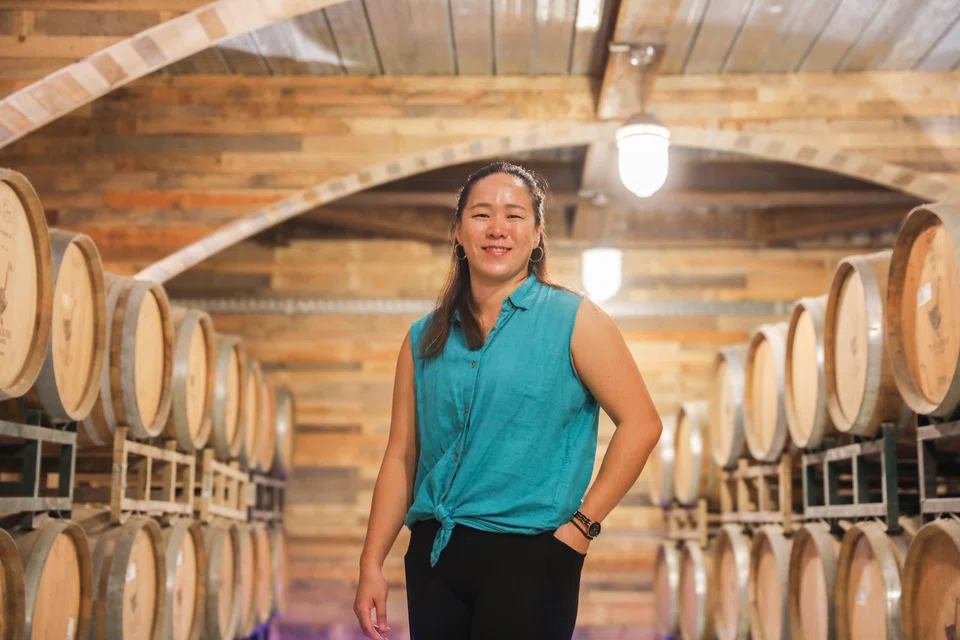
An additional 1,000 sq ft has been dedicated to a cellar, housing more than 100 barrels from the US and Europe.
These barrels were previously used to age other alcoholic beverages such as bourbon and port wine, with each imparting different flavours to the barrel wood in the process.
These barrels will now be used, in turn, to age RedDot’s rum and whisky creations. Gin does not require ageing, explained Huang.
The distillery’s creations will be marketed under two brands: Island Spirits and Hidden Hills.
Island Spirits caters to younger drinkers seeking innovative flavours, with its range including a yuzu-infused whisky and a premixed, ready-to-drink roselle-flavoured cocktail.
These innovations may not be to everyone’s taste. Said Huang: “I had a few people in their 30s and 40s who laughed at a yuzu-infused whisky we made. They were like: ‘Your whisky isn’t clear, this is blasphemy!’ They couldn’t accept it.”
“These same people were buying big, established whisky bottles by the cartons. In their mind, that is what whisky should taste like,” she added.
This is where Hidden Hills comes in. This brand will focus on traditional spirits, targeting consumers in their mid-30s and older.
Hidden Hills has already produced batches of whisky, gin, and rum that it plans to launch in December, just in time for Christmas.
RedDot is in discussions with major Singapore supermarket chains, including FairPrice and Cold Storage, to stock both brands by March 2025.
The liquors will also be available at RedDot’s Dempsey Road premises – which houses the brewery and distillery operations, a retail shopfront and a restaurant – as well as e-commerce platforms, Huang said.
Singapore to Melbourne – and back
The new venture was partly funded by the end of an old one: from the sales of equipment from RedDot’s now-defunct Melbourne brewery.
The Melbourne operation began in 2015 but struggled during the pandemic as Huang and her father, a director at the company, were unable to travel between Singapore and Australia due to Covid restrictions.
In 2020, tariffs imposed on Australian goods by China – a key export market for the brewery – further slowed sales.
In 2021, they decided to shut down the Melbourne brewery and sell its equipment. The three-year sale process was completed this year.
Proceeds were used to partially offset the S$5 million cost of building the distillery, which includes brewing and distillation equipment, cellar renovations and barrel purchases.
The distillery process can still be improved, noted Huang.
For example, RedDot’s neutral grain spirits – fermented from barley for whisky and sugarcane for rum and gin – currently achieve an alcohol by volume (ABV) of 82 to 88 per cent.
By comparison, neutral grain spirits from larger overseas producers typically reach 96 per cent ABV, thanks to advanced equipment and proprietary processes, said Huang. “We are still learning about and refining this process.”
During production, the neutral grain spirits are diluted with water to bring the ABV down to the typical 40 per cent range found in spirits.
RedDot’s lower initial ABV means it produces fewer bottles of alcohol from the same base volume, compared with higher ABV imported spirits.
As a result, production costs are 10 to 15 per cent higher when using their own spirits, compared to relying on imported bases.
Nevertheless, she sees distinct advantages. “If we do everything on our own, it will create a signature house flavour,” she said.