

KinderWorld forges ahead with grit and perseverance
Its founders never gave up despite facing many setbacks, and today, it has grown to be the largest owner of foreign owned international schools in Vietnam.
 Add BT as a preferred source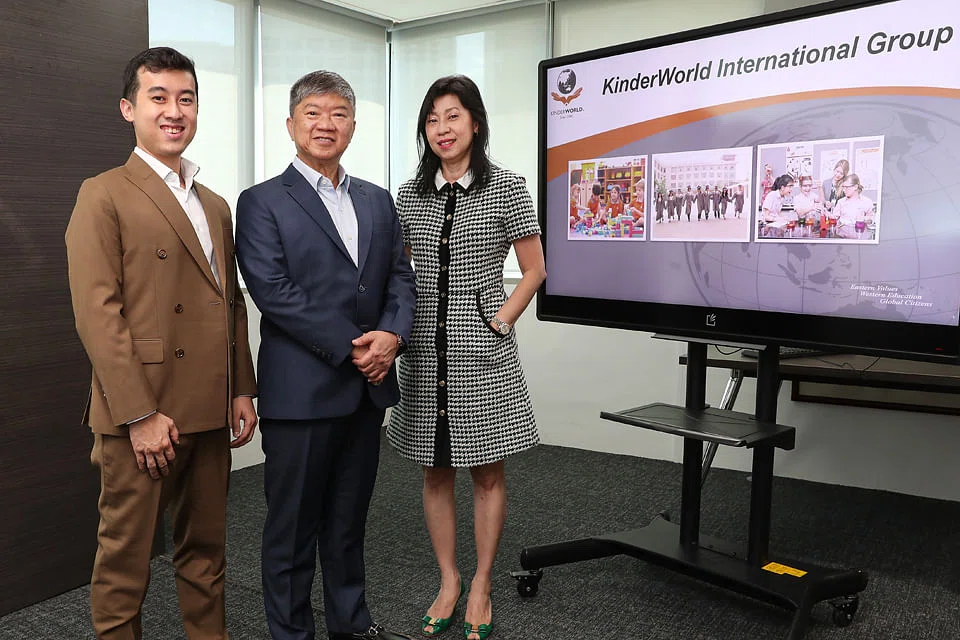
WE never give up.
Through its trials and tribulations, that is the attitude embraced by the founders of private school operator KinderWorld International Group (KIG), Ricky and Carol Tan.
The husband-and-wife team started KIG in 1986 with the opening of their first childcare centre in Changi View. Back then, Carol was a kindergarten teacher and Ricky, a flight engineer with Singapore Airlines. The two had decided to set up their own centre after Carol's exposure to the preschool education sector, which gave the couple some insight into its growth potential.
Over the years, business grew and in 1995, the group took a milestone step by setting up what Ricky calls a family edutainment complex at Suntec City at a cost of S$5 million. The 18,000 square feet space located at Suntec City boasted a childcare centre, an indoor pay-to-play playground, a computer playground, a cyber cafe, and a cafe and family restaurant.
But in 2000, the couple had to make a tough decision: to shut down the edutainment complex and exit home ground Singapore, due to headwinds from the lingering effects of the Asian Financial Crisis, and high rents.
"We had not enough money. We had cashflow problems and we owed our landlord money. We were paying S$100,000 a month for an 18,000 square feet space. In good times, that's fine, but due to the financial crisis people were not willing to spend money because of a lot of retrenchments," recounts Ricky.
Navigate Asia in
a new global order
Get the insights delivered to your inbox.
It was a painful decision. KIG had been really proud of its groundbreaking edutainment complex.
"We invented many new things. People would pay to enter our indoor playground, and the kids would be provided a card that's like a credit card. The father and mother will go and do their shopping or errands, and the kids will come and spend time at our centre. With the card they can also buy food at our family restaurant. Things like chicken nuggets, coca cola and pizza were very popular, and also Hainanese chicken rice."
KIG's edutainment complex was also one of the training grounds used by the National Computer Board to introduce the young to IT, or information technology, as part of the government's initiative to transformed Singapore into an intelligent island, where IT permeates every aspect of the society - at home, work and play.
"Closing company sometimes is not so nice. Many staff like to open company, they hate to close company. But to me as an owner, there was no choice. Need to close means need to close. We had to close and had to go through quite a few legal challenges.
"People even wanted to make me bankrupt," says Ricky.
Instead of being down and out, KIG opted to continue pushing into China and Vietnam - the 2 markets that it had just started to venture into before closing its Singapore business.
"Pushing on is the character of this company, we never give up," he says.
The decision to exit the familiar Singapore market to focus on its nascent foreign ventures might seem like a senseless decision, but he believes that it was the right decision for the firm.
"The 2 main costs of running a school are rental costs and staff costs," explains Ricky. Back then in China and Vietnam, the group was able to obtain what he considered to be good rental rates. It was also able to piggyback on Singapore real estate giants such as CapitaLand to grow its presence by setting up KIG's schools within the former's developments in these markets through synergistic collaborations.
But in 2005, after opening 7 kindergartens in China, KIG once again made a tough decision to cease its operations in the country and focus solely on Vietnam due to policy challenges in China that made it difficult for KIG to expand, and limited funds.
While naysayers questioned why KIG gave up the China market in favour of a country where "even the birds won't lay eggs", it was a decision that Ricky firmly believes has paid off.
"There is no right or wrong, but that was the decision for me as an entrepreneur at that time. In Vietnam we could do more," he says, while in China, the policies made it restrictive for the firm to grow.
KIG's success in Vietnam speaks for itself. Today, it has grown from being the operator of a single childcare centre in Singapore, to the largest owner/operator of foreign owned international schools in Vietnam with an estimated investment (including related entities) of close to S$120 million over the past 2 decades.
Its network comprises 16 campuses in 8 major cities, where it runs a through-train programme from kindergarten to pre-university. It has more than 600 teachers and roughly 3,800 students.
It operates under 3 brand names: KinderWorld International Kindergarten, Singapore International School and Singapore Vietnam International School.
There are 3 major programmes - the International Programme, Integrated Programme and the Premium Vietnamese Education Programme, all of which offer various pathways to educational qualifications.
The Singapore International Schools, for instance, offer the International Programme from Year 1 to 12, with curriculum content and skills promoted by the Singapore educational system and international curricula.
Students sit for the Primary Exams, the Cambridge IGCSE, the Cambridge AS/A Levels and/or complete the NCC Education Level 3 International Foundation Diploma for Higher Education Studies.
A Singapore curriculum renowned for academic rigour is part of KinderWorld's unique draw.
And as rents continue rising, KIG has over the years adapted its operating model, choosing to own the land that many of its schools occupy rather than be at the mercy of landlords and rising rents. The land on which its campuses sit spans around 20.78 hectares, of which 7.43 hectares is owned by the group.
Moving forward, the group has plans to expand beyond Vietnam, and is exploring markets such as Myanmar, Laos, Cambodia, Indonesia and even Kazakhstan. It is also looking to go back into China.
But most importantly, KIG wants to return home to Singapore. Since February last year, KIG has almost tripled its staff strength here from 7 previously to 19 currently.
"Singapore to us is very important. We have hired all these people to prepare ourselves for a V-shaped growth curve."
And while the Covid-19 virus has impacted the global economy, Ricky is not letting this faze him.
"As a forward-looking company we must position ourselves well to take opportunities," he says.
The intention is to set up international schools in Singapore through an asset-light business model that will see KIG leasing the land that its schools will be built on.
The firm has been engaging government agencies such as SLA, JTC and EDB, and is looking to see if there are any unused school facilities that can house its schools.
The group has also been exploring an initial public offering, a move that Ricky says will enable KIG to reward its staff - many of whom have worked for KIG for more than a decade - and continue expanding.
"We must reward. After all when we die, we can't bring everything along," he says candidly.
KIG is currently fully owned by the Tans. Last year, the couple's son Stefan Tan took on the role of chief sustainability officer and executive director for business development, at KIG.
The younger Tan may be hospitality trained, but has quickly developed a passion for the education business. He is also spearheading the groups sustainability efforts, such as the installation of solar panels in its schools.
He says: "I find education to be a very fulfilling and noble industry. For me, handing out certificates to the kids when they graduate - that's the best feeling.
"Just that alone makes you feel that what you are doing is very meaningful."
Decoding Asia newsletter: your guide to navigating Asia in a new global order. Sign up here to get Decoding Asia newsletter. Delivered to your inbox. Free.
Copyright SPH Media. All rights reserved.

