Fishing beyond the Singapore seas
From its humble beginnings in Singapore, Barramundi Asia has expanded into Brunei and Australia and looks set to go even further.
Singapore
MOST Singaporeans may not be familiar with the barramundi, but it is a fish that is currently being farmed in waters here.
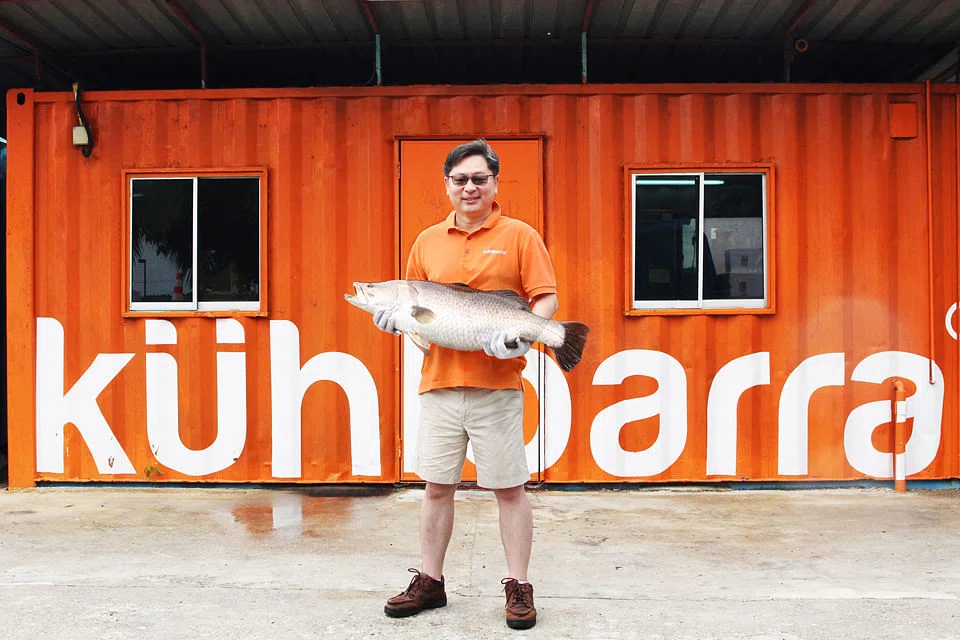
The city-state may not be well-known for its fishing industry, but the Kühlbarra brand and its parent company, Barramundi Asia, intends to change that. And it has ambitions to grow beyond local shores by casting a wider net overseas.
Established in 2007, Barramundi Asia is the first company in Singapore to farm barramundi in large ocean enclosures. Started out by Joep Kleine Staarman and Hans den Bieman, both formerly from salmon supplier Marine Harvest, it was their desire to find a white fish equivalent of salmon that led to the birth of Barramundi Asia.
"It is like a white salmon project," said Andrew Kwan, chairman of Barramundi Asia. "One of the criteria for the project to take off, whichever species they choose, must also be for the fish to grow out well to the standard sort of harvestable size. So for salmon, that's about four to five kilograms."
"Today, if you look at our barramundi, we are also able to grow that out. In fact, all of our fishes are four to five kilograms when we harvest," said Mr Kwan. Besides size, barramundi was also selected because it was a tropical fish.
Today, the company, in which Commonwealth Capital is a controlling shareholder, has two local fish farms in Singapore - one at Pulau Semakau and the other off Raffles Light House. So why did the company decide to venture overseas, particularly in Brunei and Australia?
"We realised that from a productions standpoint, we will be limited in Singapore," said Mr Kwan. "Singapore does not have endless coastline like say in parts of Europe where it is very conducive for salmon farms to proliferate. We are limited unfortunately and that is a reality."
Currently, the company's local production capacity size per year is capped at 5,000 tonnes.
With the surrounding fishing industry being proliferated with "mom-and-pop sort of operators" that do not uphold responsible farming practices, it made their search even harder.
"We are trying to go for places where biosecurity is not an issue," explained Mr Kwan. "It will be very critical to know that not only are we holding our own standards, our neighbours... must also do the same thing."
Thankfully, the company found an ideal location in the Nankivell Offshore Aquaculture Site in Brunei. With a size of 6,613 hectares, the Bruneian fish farm has an estimated annual production capacity of over 40,000 tonnes valued at S$300 million.
Citing its Brunei farm as a "green field" and being "unspoiled", Mr Kwan also added: "If you have clean waters now, you don't want to attract the wrong sort of operators who can corrupt even the best of water quality currently prevalent in Bruneian waters."
Its other recent acquisition is Marine Produce Australia's (MPA) Cone Bay Ocean barramundi farm, the "largest barramundi farm in all of Australia" and "the only farm in all of Australia that actually farms with cages in the sea".
Now known as "Kühlbarra @Kimberley", Mr Kwan labels it as a "game changer". "This farm in terms of capacity, combined with our biomass in the water, meaning the amount of fish in the water in terms of weight will be equivalent to about 4,000 tonnes . . . That is almost equivalent to all fish farms in Singapore combined."
Better still, the company is armed with a permit to grow up to 15,000 tonnes of barramundi fish from the Australian fisheries department.
Located in Western Australia, another plus point of the farm is the daily 11 metres inter-tidal change in the farm's cages. "From an aquaculture standpoint, it means there is a lot of good sea water that goes in and goes out," explained Mr Kwan.
"This does two things - it creates a high level of oxygenation and provides a lot of exercise for the fishes . . . because when water goes in and out, your cages are static so it is like a treadmill for the fish. Also, this creates a lot of oxygen."
Using the analogy of raising a child, he added that with plenty of oxygen, sunshine and nutritional food, like a child, the fish will grow bigger to the maximum potential.
Other reasons for expanding into foreign countries include the need for diversification of risks. "You want to have multiple geographies so that if there are any sort of unwanted or unexpected calamities, you are diversified . . . When we start selling to retailers and multi-market bases, not just in Singapore, Australia or Brunei, we need to have that constancy of supply and assuredness that we can deliver," said Mr Kwan.
Barramundi Asia also appears to be hungry for more with plans to expand into China in the pipeline.
"We intend to take our farm to fork model to another level in China," said Mr Kwan. "We want to allow customers to track and trace across countries. So if we are going to export into China, we want to allow Chinese consumers, who are savvy and purchasing off their mobile devices, to know that actually this batch of fish literally came from Australia, Singapore or in the future, Brunei."
Other future plans also include the marketing of its autogenous animal vaccine, which was created by Barramundi Asia's subsidiary company, Uvaxx Pte Ltd. It also creates customised vaccines to some of the "biggest players in other species of fish". When asked on the marketing plans for the vaccines, Mr Kwan said, "We are in conversations."
"There are animal vaccine companies in the world, mostly in Europe. We are in conversations with a few of them who want to start up here in Asia."