FT Consulting helps SMEs go abroad, but now invests in them as well
Its investment arm aims to get up to S$20 million in play in the next three years, but the company wants to keep consulting as a core activity

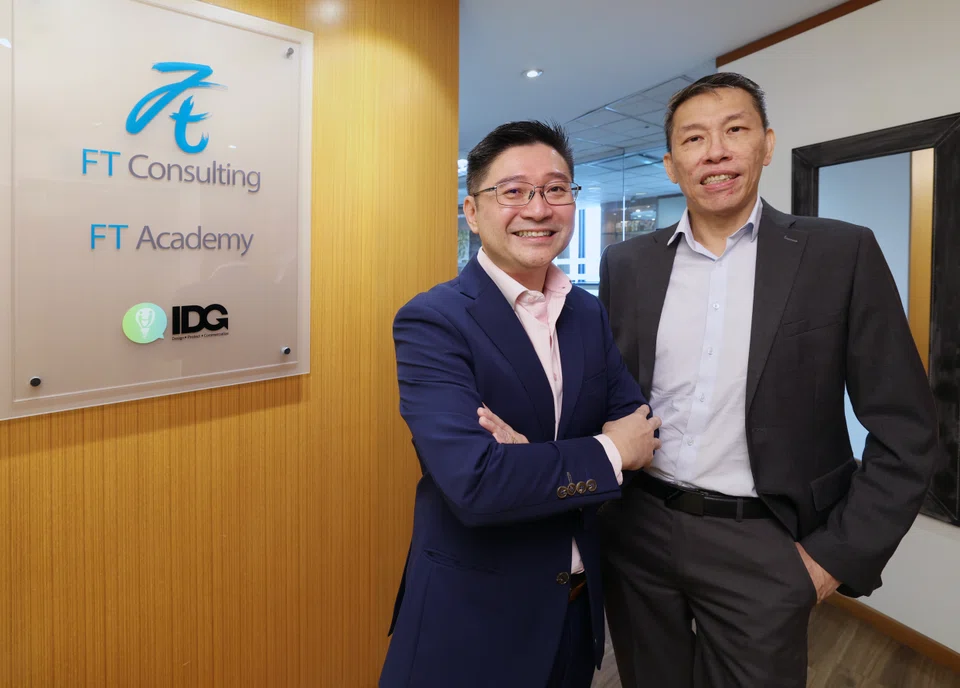
AFTER more than three decades of helping businesses go overseas, FT Consulting now invests in them, too.
While its original business of internationalisation consulting remains core, it has also developed two more units: equity investment and workforce training.
As chief executive officer Winston Chan summed up in an interview with The Business Times: “The three entities that make up the structure of (FT Consulting) seek to ready the client’s workforce, reshape the company’s strategy, and resource it appropriately and adequately as they enter overseas markets.”
The firm’s newest arm is First Tree Capital, launched in the first quarter of 2023 and which invests in promising clients to fund their overseas growth plans.
The funds come partly from internal resources and partly from high-net-worth individuals (HNWI); First Tree helps them manage this wealth in exchange for a percentage of future returns.
Chan declined to reveal the amount invested so far, but said that First Tree intends to make up to S$20 million in equity investments in the next three years.
Said FT Consulting executive chairman John Ong: “The company prefers to stay within its core of providing professional services, not turn into an investment company.”
He added: “With the commitment from some of our (HWNI) friends, a pool of S$10 million to S$20 million is the most that we would go to.”
The estimated value includes non-cash contributions. Chan said: “We also contribute in-kind – in terms of management expertise – that accounts for a part of the investment, converted to shares.”
Talent and training
Beyond the equity investments, the investment arm helps to place temporary talent with clients that are about to embark on an overseas expansion.
Its “C-suite as-a-service” programme temporarily fills senior management roles for its clients, while the clients look for permanent hires. These temporary C-suite officers either hold the fort at home while the client’s own management focuses on going abroad, or lead the overseas charge themselves.
These temporary executives are sourced from FT Consulting’s own pool of consultants or its network of business associates. Said Chan: “Because of our many years in the market, we know who is available to help what kind of client.”
FT Consulting’s education arm, FT Academy, also deals with talent – but in terms of workforce training.
It runs SkillsFuture and Singapore Workforce Skills Qualifications-accredited courses targeted at mid- to-upper management individuals, with a focus on internationalisation training.
It has also partnered educational institutions such as Singapore Management University and the Singapore University of Social Sciences to run courses for adult learners.
FT Academy was created in early 2020 after Ong and Chan spotted a business opportunity beyond consulting.
“A lot of our clients, even those who want to expand (overseas), do not have the necessary (training) in order to do that,” Chan said. “A natural way for us to support them was to go into the training business.”
Consulting core
All of this is on top of FT Consulting’s core business of consultancy, which accounts for some 70 per cent of its overall revenue.
In this arm of the business, the firm helps clients – about 80 per cent of which are small and medium-sized enterprises – venture abroad. Services provided include franchise development, market research, intellectual property management, and branding and marketing.
The firm has developed a niche in helping clients monetise their non-tangible assets, Chan said. For instance, it works with clients to document and patent their unique workflows, which can then be licensed to third parties in a similar field.
Even as it helps clients to go abroad, FT Consulting has an overseas presence of its own. Said Chan: “To be frank, if we ourselves have not gotten our hands dirty, we cannot profess to be consultants that help clients (to) internationalise.”
The firm made its first overseas foray to Malaysia in 1993, and is now also active in Indonesia, Vietnam, Japan and Thailand.
But it has also had some misses, setting up a subsidiary in Dubai in 2019 only to shut it down in 2022. FT Consulting realised a “six-figure” loss from this, with challenges largely brought about by pandemic-era movement restrictions, Ong said.
“The Dubai market is really propped up by expats,” added Chan. “During the Covid-19 times, a lot of expats were just no longer there.”
This was compounded by many companies pausing internationalisation operations to the country during the pandemic, because of the lack of a “natural local base”, he added.
Currently, FT Academy contributes to about 20 per cent of the company’s revenue, with First Tree accounting for the remaining 10 per cent or so.
But in the next three to five years, the proportion of revenue from consulting is expected to fall to about 50 per cent, as contributions from the education and investment arms grow, Chan said.
By 2026, the firm expects to grow its overall revenue to S$12 million, he added, though he declined to disclose current figures.
TRENDING NOW
Simba admits exceeding spectrum limits amid failed M1 deal; parent company Tuas’ full-year profit surges 277%
He built the Vingroup empire. Now South-east Asia’s richest man is handing some key roles to his sons
Ex-execs of CW Group, Allied Tech charged with offences linked to lawyer’s S$76 million misappropriation
Singapore to prioritise high-value AI infrastructure as Asean markets play to their strengths: Tan Kiat How