Helping HDB businesses get crowds and go digital
The annual Heartlands Festival brings a buzz to neighbourhood shops
Paige Lim &
Ammiel Jr Wan
HEARTLAND businesses need to innovate, go digital, and keep providing the personal touch – and the annual Heartlands Festival hopes to encourage this while bringing in the crowds, said Lai Cheng Yi, executive director of The Federation of Merchants’ Associations, Singapore (FMAS).
Running till Feb 24, the three-month-long festival is organised by the Heartland Enterprise Centre Singapore (HECS), a subsidiary of FMAS. It is supported by FMAS, Enterprise Singapore (EnterpriseSG) and the Housing and Development Board (HDB).
The first edition was held in November 2021 to bring customers back to the heartlands during the Covid-19 pandemic, as well as encourage digitalisation, said Lai in an interview with The Business Times (BT).
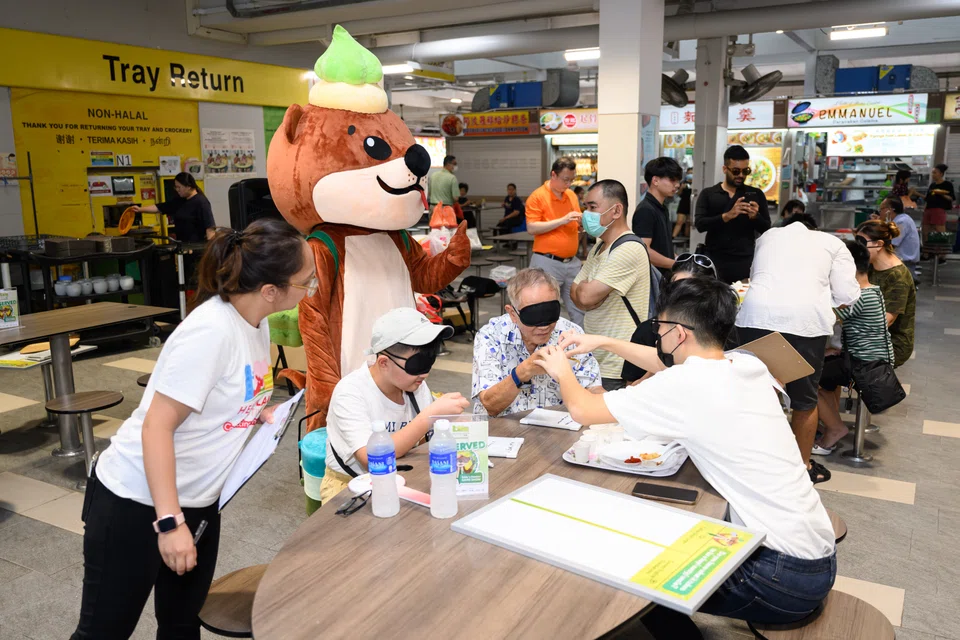
This year’s festival sees more in-person activities – such as a hawker-themed “game show” for shoppers and an “amazing race” competition – that similarly aim to increase footfall, raise awareness of HDB shops and hawkers, and promote digital payments.
To encourage higher spending and electronic payments, those who spend at least S$10 in participating outlets can enter a lucky draw, with an extra chance to win if they pay digitally. More than 180,000 entries have been received since the festival began on Nov 19.
As of December 2022, 93 per cent of heartland enterprises have adopted electronic payments, while 66 per cent have taken up additional solutions such as e-commerce platforms under EnterpriseSG’s Heartlands Go Digital programme.
But even as they go digital, HDB businesses are “constantly challenged” by neighbouring shopping malls and cheaper buys on online platforms, noted Lai.
To help businesses retain and attract customers, HECS launched a service excellence diagnostic toolkit in January, alongside free consulting sessions with business advisors to assess service levels and identify gaps.
Said Lai: “Kopitiam uncles will spot you from afar and yell out your kopi-O order; shops remember their regulars and will chat about other things. The heartlands are a place for friendly matters, and must always sustain (such service).”
With the theme “Connecting Generations”, this year’s festival hopes to get shoppers to appreciate “heartland history, culture and heritage”.
Yet succession planning is another challenge for businesses themselves, with the younger generation preferring corporate jobs over carrying on the family business, said Lai.
Still, he noted that some second- or third-generation owners have overhauled traditional business models with innovative and digital offerings.
Rent is cheaper in HDB units than in shopping malls and commercial buildings, lowering the entry barrier to doing business, Lai added.
“Younger generations can consider starting up their business or testing new business ideas in the heartlands … they can expand and scale up their businesses if their models are proven to be successful.”
BT speaks to two next-generation owners of HDB shops who have modernised their family businesses.
All Things Hainanese
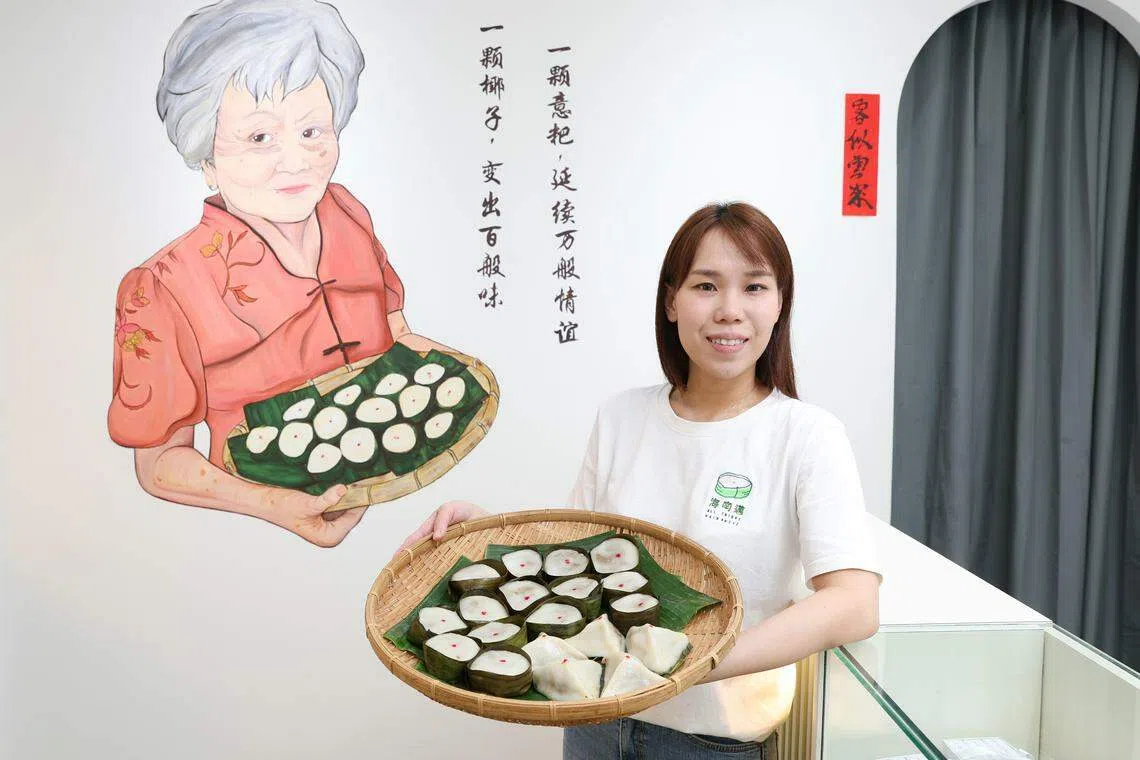
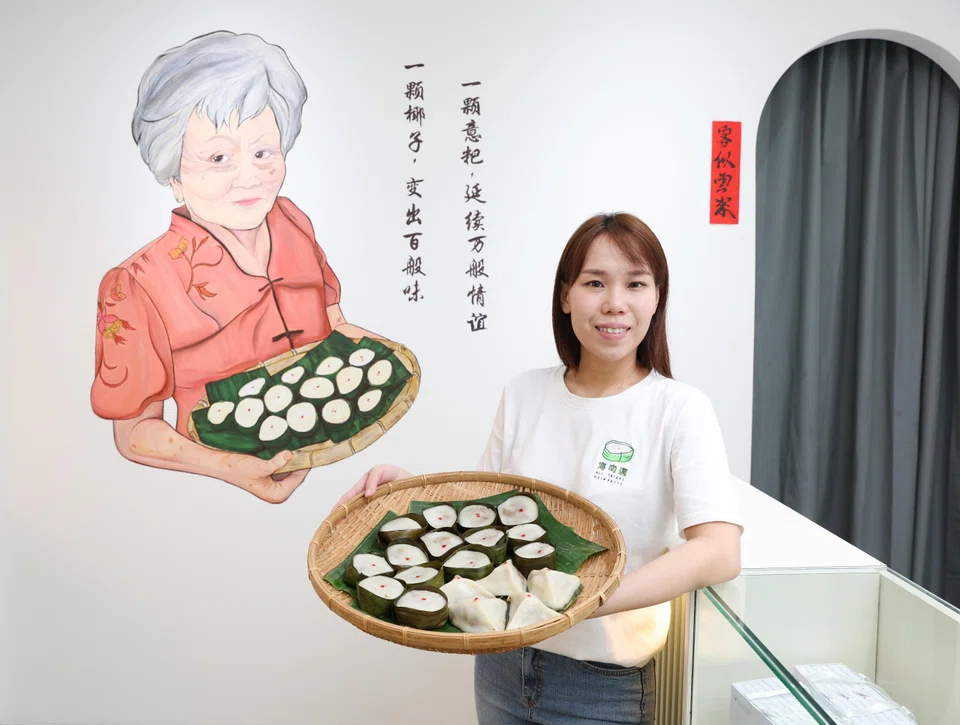
A tradtitional kueh has been reimagined as butter cookies and mochi at All Things Hainanese, run by third-generation owner Jocelyn Loi.
These fresh takes on the Hainanese yi bua are symbolic of the family business: traditional at its core, but with a modern twist.
Despite these creative culinary ventures, the store still mainly sells kuehs made from traditional recipes, such as kueh lapis, ang ku kueh and its undisputed bestseller, yi bua.
Made from glutinous rice flour, with a filling of peanut, coconut and ginger-flavoured sesame, yi bua remains its “signature item”, said Loi. More than 200 pieces are sold each day, rising to 600 pieces on the weekends, at the original Toa Payoh store.
Loi’s grandmother started Hainan Cuisine & Snacks there in 1978, selling traditional Hainanese kueh as a means to support her children after her husband’s death. Loi’s mother joined her from the start, at the age of 12, and still runs the stall today.
Instead of joining the family business, Loi pursued a career in the hotel industry. But when her grandmother died in 2019, Loi was prompted to carry on her legacy, thinking at the time: “If I don’t do this, there might be no more connection left between us and her.”
In September 2020, Loi started selling traditional kueh out of her home-based kitchen on weekends, under the name All Things Hainanese. She offered online ordering with deliveries and self-collection.
One challenge was publicity, as not many knew of this traditional Hainanese kueh. Loi therefore created Facebook and Instagram pages to promote her business.
She also added “a modern twist to the menu”, turning her grandmother’s recipe into something that caters to younger customers: mochi yi bua. The mochi is coated in crushed peanuts, which neutralises the strong ginger flavour of traditional yi bua, she said.
In December 2022, Loi opened her first physical store at Bras Basah Complex, leaving her job to fully commit to this venture.
The shop operates from Tuesdays to Sundays, with 60 per cent of its loyal online customers now making their purchases in person. Revenues have risen 10 to 15 times, said Loi, though she did not provide exact figures.
After the current store’s lease is up in a couple of years, she hopes to “expand into a bigger space to cater for dine-in seating”, creating a space where customers can enjoy Hainanese kueh as well as fuller meals, such as laksa.
Chen Soon Lee Book Stamp & Coin Centre
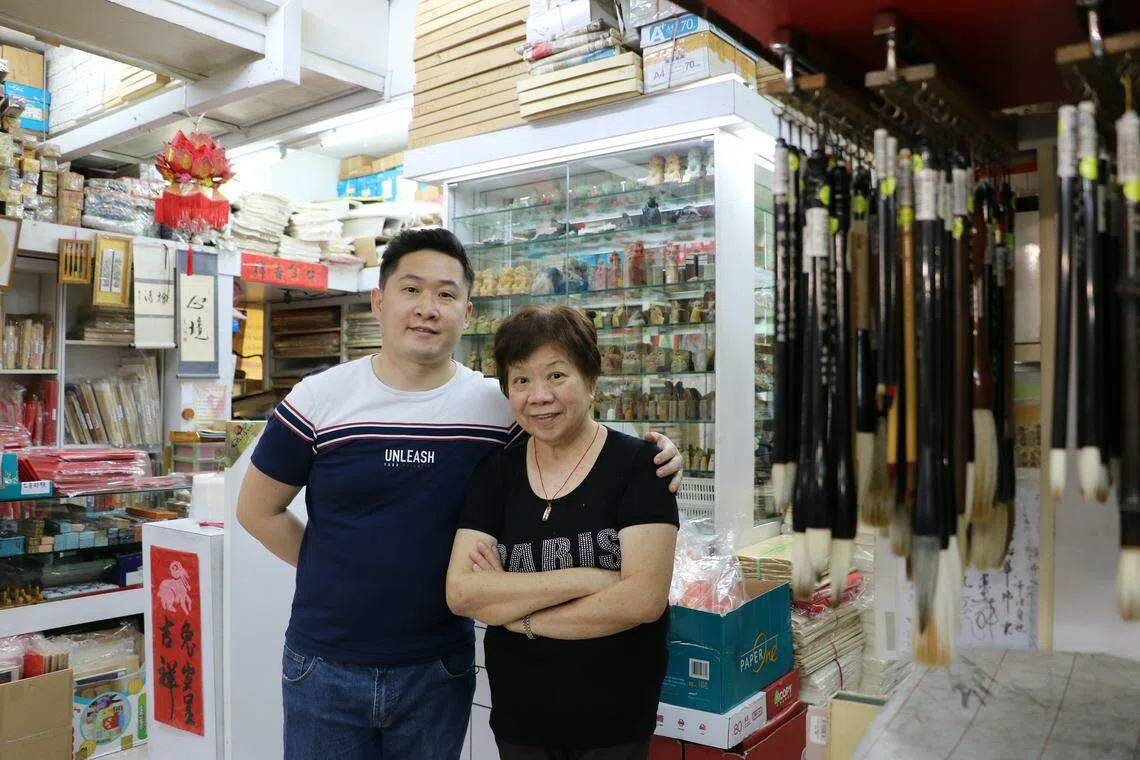
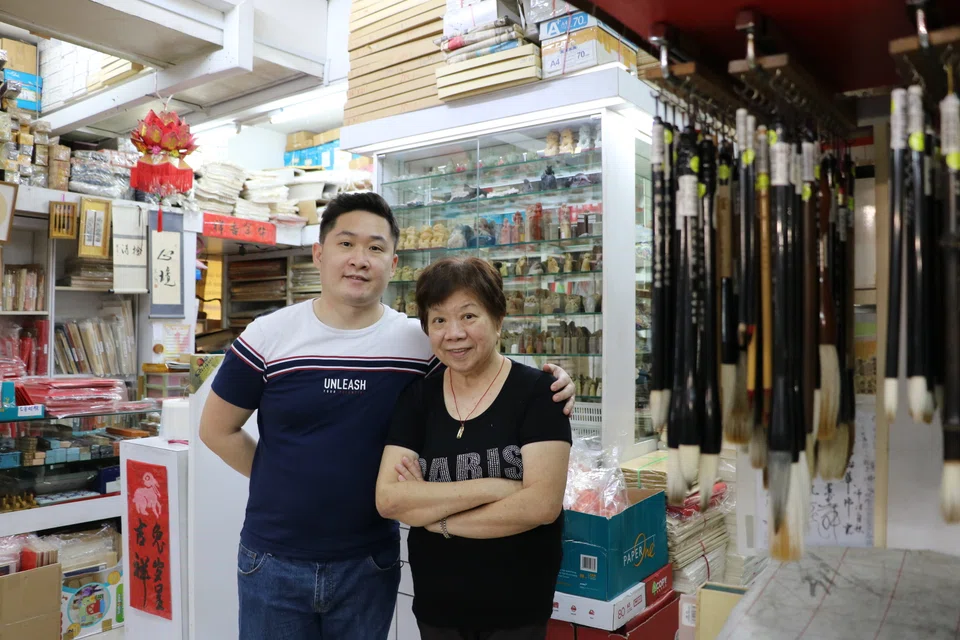
As an electrical engineering undergraduate, Jack Chen had never expected to take over his family’s brick-and-mortar art supplies business, Chen Soon Lee Book Stamp & Coin Centre.
But in 2013, while studying at the University of Queensland, he learnt his father had died from a sudden heart attack. His parents had founded the family business in 1981.
“My mother was getting old and planning to close the business if I didn’t take over,” said Chen, who was then a semester away from graduation and had planned to work in Australia as an engineer.
“But I realised that the store is our family’s only legacy. I wanted to carry it on, so my parents’ hard work (in building it) would not be forgotten.”
Chen’s father was an interior designer while his mother was a contractor. Driven by their mutual love of stamp and coin collections, they set up a shop to sell these: Chen Soon Lee Trading Company, located in Bukit Timah Shopping Centre.
But in 1986, the store moved to Bras Basah Complex – where tenants were, at the time, required to have businesses mostly related to books and stationery. It thus pivoted to mainly selling Chinese painting and calligraphy stationery, adopting its current name in 1988. The store still carries coins and stamps, but no longer brings in new stock of these.
After returning to Singapore, Chen spent two years completing a degree in business management before joining his mother to run Chen Soon Lee full-time in 2015.
Chen’s first order of business was to introduce an electronic point-of-sales (EPOS) system integrated with inventory management, and a separate accounting software. Previously, daily sales and stock-taking were recorded on paper.
“There was a whole room with more than 10 years’ worth of records – from purchase bills to invoices, stock cards, sales receipt books. The accountant would take two to three months to settle our annual audit each time,” he recalled.
The Covid-19 pandemic in 2020 spurred the store’s next wave of digital transformation. When Chen Soon Lee could not operate during the “circuit breaker”, Chen created an online store using e-commerce platform Shopify. Yet it received barely any orders due to a lack of marketing, he said.
The store saw more success when it joined online marketplaces Shopee, Qoo10 and Lazada in July 2021, with the support of EnterpriseSG’s e-commerce booster package.
Today, online sales make up 10 per cent of Chen Soon Lee’s overall sales.
Only 5 per cent of its catalogue is online, as the store has more than 10,000 unique items, said Chen. Patrons also prefer to shop in person, as they can consult staff for recommendations.
The store has since upgraded its EPOS system to a cloud-based one with unlimited data storage and remote inventory tracking.
Having completed the store’s digital overhaul, Chen is now focusing on driving sales and growing its customer base. Last month, he rolled out a membership system with discounts to encourage repeat visits.
Chen also plans to venture into livestreaming to introduce novel ways of using Chinese art supplies, especially to the younger generation.
The store’s customers are mostly above 30 years old, but about a fifth are art students between the ages of 20 and 30.
“The use of Chinese art supplies is not restrictive,” said Chen. “You can even use them for Western art or clay modelling. But most people don’t know that, unless you do a live demonstration for them.”