


How green is your SaladStop! salad? Unravel Carbon finds out

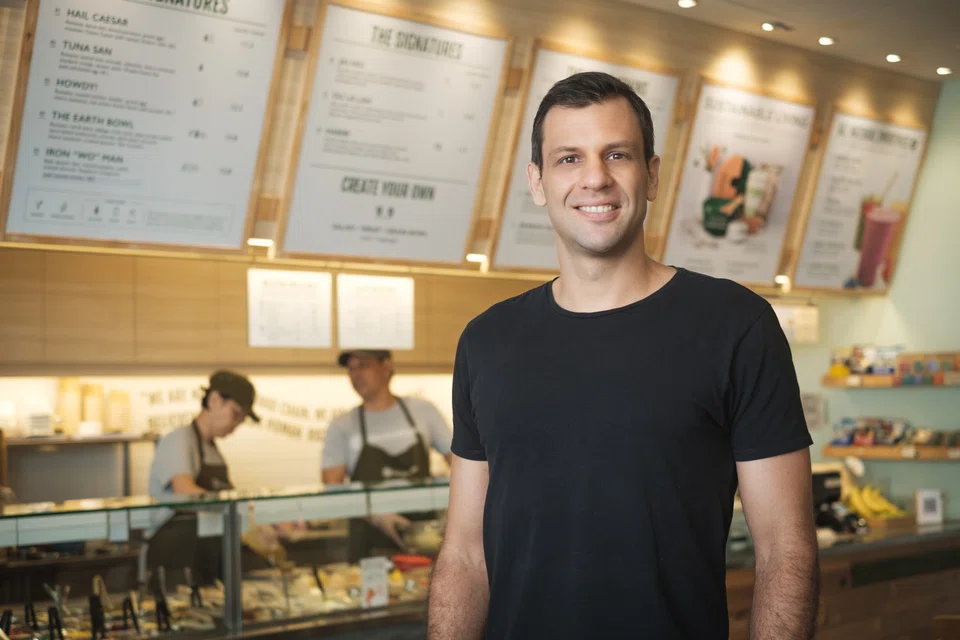

WHAT salad ingredient has the largest carbon footprint? Local food and beverage (F&B) chain SaladStop! discovered that for them, lavosh bread accounts for the most emissions but feta cheese is most emissions-intensive – insights gained via Unravel Carbon’s carbon accounting services.
More companies are growing keen to reduce their carbon emissions, but they may not always know where to start. This is where Unravel’s software-as-a-service comes in. It transforms accounting data into supply chain carbon data, allowing firms to identify specific areas of high carbon emissions.
“Every dollar that a company spends has a carbon footprint attached to it,” said Grace Sai, co-founder and chief executive officer (CEO) of Unravel Carbon. “The financial data is the company’s richest source of truth – it is reviewed 20 times a month, it’s audited, it’s interrogable”.
Unravel matches companies’ accounting data against its own proprietary database of the prices, sources, and associated “emission factors” of various products – with some 700,000 data points for the food and agriculture industry alone. This allows them to calculate the total emissions for a given amount of a specific product.
“We convert a company’s accounting data into carbon data in seconds,” said Sai. “Currently companies are hiring the ‘Big 4’ consulting firms and they do it in a manual process that takes up to 9 months just for data gathering.”
The time saved on the measurement process allows a business to get started on its decarbonisation efforts right away, she added.
Unravel specialises in tracking and reducing “scope 3” emissions: indirect carbon emissions associated with a company’s value chain rather than its own activities. Scope 1 refers to direct emissions from activities such as burning fuel in factories, while scope 2 emissions result from purchased electricity.
Scope 3 emissions usually make up 85 per cent of a company’s total emissions, said Sai, with 15 categories including business travel, employee commute, operation of investments, as well as purchased goods and services.
Rather than pegging products to a generic category and calculating the emissions in a broad way, Unravel’s algorithm uses a 5-step method that begins by trying to match the exact supplier of a good or service. If that is not possible, the system moves to the next level of specificity, with lowest level 5 being the global sector level-based emission factors.
“Our worst-case method of measuring carbon emissions is today’s best case scenario in the industry,” Sai said. “This can only be done through the power of computing.”
How green is a salad?
Last November, SaladStop! began working with Unravel to create its first carbon net-zero outlet, which opened this June in the CapitaSpring integrated development.
With 69 stores worldwide, SaladStop! aims to have all 18 of its Singapore stores turn net-zero by 2025, and the rest by 2030, said chief executive officer Adrien Desbaillets.
Sourcing locally to keep its carbon footprint low has been important to the F&B establishment right from its beginnings in 2009, he added.
For example, SaladStop! gets its kale from local hydroponic farms. This August 2022, it launched a new salad comprising 7 ingredients that are all locally grown on the island of Singapore.
“We have always had sustainability baked into our DNA,” Desbaillets said. “On the product side, as much as possible we look for local sources first. If it means we could work with a local cheese manufacturer, we would; if it means we could work with a local fish farm, we would.”
Thanks to sustainability efforts over the years, the average carbon footprint of a SaladStop! outlet is about 126 tonnes per year – just 20 per cent that of an average restaurant, and lower than that of a typical fast food outlet, which registers about 558 tonnes of carbon per year, he added.
But even with this focus on sustainability, SaladStop! still had gaps to address.
By churning the company’s accounting data, Unravel found that lavosh bread accounts for the largest share of SaladStop!’s total emissions: about 9 per cent or 11 tonnes per year.
Meanwhile, cheeses had the highest carbon intensity, particularly feta. In SaladStop!’s supply chain, 1 kg of feta cheese is associated with approximately 7 kg of carbon dioxide emissions, while lavosh bread registers about 1.6 kg of emissions per kg.
Although the total removal of feta cheese from their menu was not a viable option, the discovery prompted SaladStop! to look for alternative local suppliers rather than sourcing the cheese from Germany, and to find lower-carbon white goat cheese substitutes, Sai noted.
“Since 2009, they (SaladStop!) didn’t know that information until they used our platform,” she said. “Now you can really aggregate – then all the higher carbon emitting ingredients or food will decrease in demand, then that will really move the needle on a market systems level.”
Unravel has been a key partner in creating SaladStop!’s “sustainability playbook” that can be adapted for international markets, Desbaillets said.
“There are real-time updates – the moment we update the menu, that's updated into their (Unravel) system. The next step, obviously, is we'll be working with them on international markets, and that is a very exciting next part of the journey,” he added.
Besides providing carbon accounting services, Unravel also generates reports for environmental, social, and corporate governance reporting. “This is a fan-favourite feature because it removes many hours of filling up forms – low-value work,” Sai said.
Apart from SaladStop!, Unravel Carbon is also working with Indonesian grocery delivery startup HappyFresh; Indonesia-headquartered sustainable forestry products company Lestari Group; and food ecosystem management platform TreeDots, to help them analyse their emissions and reduce their carbon footprints.
In the future, such analysis will become even more efficient. Unravel is building up its automated solutions engine, which can create a tailored path toward net-zero for each client based on its unique dataset.
Developing this software takes about 2 to 3 months for a sector. Having built the engine for 2 sectors thus far – food and agriculture as well as tech and e-commerce – Unravel estimates it will take about 2 years before the engine can be rolled out to all sectors.
“We believe that in the future, every consumer, business and capital decision will also be based on climate metrics – and where is this data going to come from? We want to build the largest repository of carbon datasets in Asia,” Sai said.
Once the industry carbon database has been fully built, the information can be used for many other purposes, such as sustainability-linked loans; product tagging, with the information printed on product labels; and even informing employees’ decisions of which companies to work at, she added.
TRENDING NOW

Government to bring forward raising of retirement age, give employers more financial support to create flexi-load jobs
Former minister Maliki Osman, Revolut chairman join Asia Gulf Holdings advisory board

Is Manila Asia’s new dining hot spot?
Simba at risk of losing operating licence over spectrum misuse

