Margin squeeze puts F&B players in a spot over food delivery demand
Home delivery bumps up sales but brings additional costs; while some F&B operators are holding back, more and more are forced to pass on costs
Singapore
FOOD delivery looks set to become a more permanent source of revenue for food and beverage (F&B) firms in Singapore, but its related costs are also increasing firms' overall operating costs, putting them in a conundrum.
As a result, some operators are already passing on costs to consumers, while others that have held up so far may eventually have to do so as they are caught between a rock and a hard place.
One F&B group, which spoke on the condition of anonymity, said: "We know a lot of restaurants mark up their prices on certain delivery platforms but we have the same prices as dine-in. We absorb the additional fees."
Jake Pang, co-founder of Wafuken, is also reluctant to hike prices for now, for fear of driving customers away. Likening the situation to a deadlock, he said: "If customers are unhappy, they're unlikely to patronise your shop again."
Already, food prices have been edging up since September last year, according to Singstat data. The latest figures, released last December, showed that food inflation in November was 1.8 per cent, after hitting 1.7 per cent the previous month, mainly due to a steeper rise in the prices of non-cooked food and restaurant meals.
This comes as food delivery continues to generate a sizeable portion of sales for some F&B businesses, even as restrictions on dining in restaurants have been further relaxed. Since Dec 28 last year, people have been able to dine in larger groups of 8, up from 5.
However, the Restaurant Association of Singapore noted that the safe management measures still in place mean that F&B businesses continue to operate at "less-than-full" seating capacities. And with a number of offices still operating on work-from-home arrangements, "many F&B businesses are still relying on food deliveries to augment their outlet sales," the association added.
Mr Pang said footfall at his two outlets in the Central Business District remains less than ideal. However, business at Wafuken's cloud kitchen outlet has not been affected and has even "gained a bit more".
Others think that food delivery has simply found a greater acceptance among consumers after Singapore's quasi-lockdown last year, when dining out was banned to curb the spread of Covid-19.
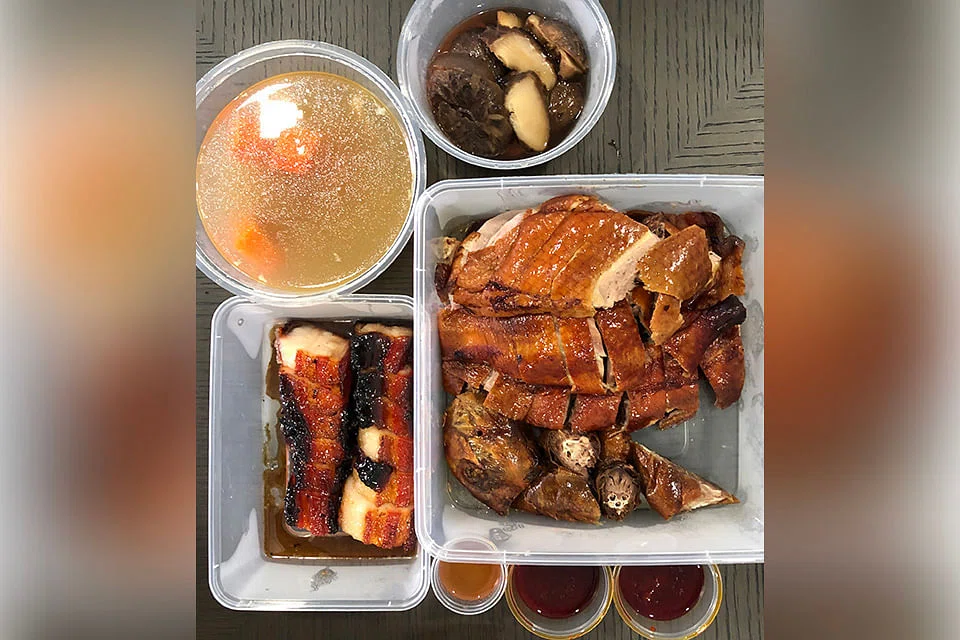
At Kam's Roast, 30 per cent of sales still come through food delivery, although it is down from the 80 per cent during the partial lockdown last year. "We think this proportion will likely continue even after Phase 3 (of Singapore's economic reopening)," the restaurant said.
Dim sum restaurant Swee Choon said it continues to rely more on food delivery on weekdays. The restaurant, which is located at Jalan Besar, has invested in setting up a cloud kitchen in Tampines to better reach customers in the East.
"We view these costs as necessary as we believe that consumer behaviour has changed and delivery is here to stay," Swee Choon said. "We believe in putting in additional investment in infrastructure to let our customers have convenience and a better experience."
Yet, the additional costs of offering food delivery are eating into F&B establishments' profit margins, which are very thin - in the low single digits - to begin with.
"If food delivery orders rise, we don't know if it's a good or bad thing. If they rise, we need more manpower; costs are also higher," said Nicholas Heng, a co-founder of Altitude Holdings, which runs Korean barbecue restaurant Yoogane. About a quarter of Yoogane's sales continue to be generated by food delivery.
Kam's Roast said that delivery-related costs now form 35 to 38 per cent of all its key costs, which include rental and labour, typically two of the highest costs for F&B businesses. "These (delivery-related) costs have cut into our profits quite significantly," the restaurant added.
Delivery-related costs can include that of food packaging, fuel costs and commission fees charged by food delivery platforms, which are said to be about 30 per cent of revenue on average.
The government gave subsidies on commission costs and delivery costs through third-party logistics partners when F&B operators were forced to rely on delivery and takeaway orders during the partial lockdown. Those subsidies ended last July, however.
Aside from passing on the costs to consumers, manpower may be the next to give. But Altitude Holdings' Mr Heng said: "We can't cut any further, our operations would be crippled."
Kam's Roast, meanwhile, said it has introduced family-set menus to increase the basket size of its orders, in order to cope with the increased costs.