


MaxSteel toughened by pandemic challenges
Home-grown steel supplier gears up for expansion
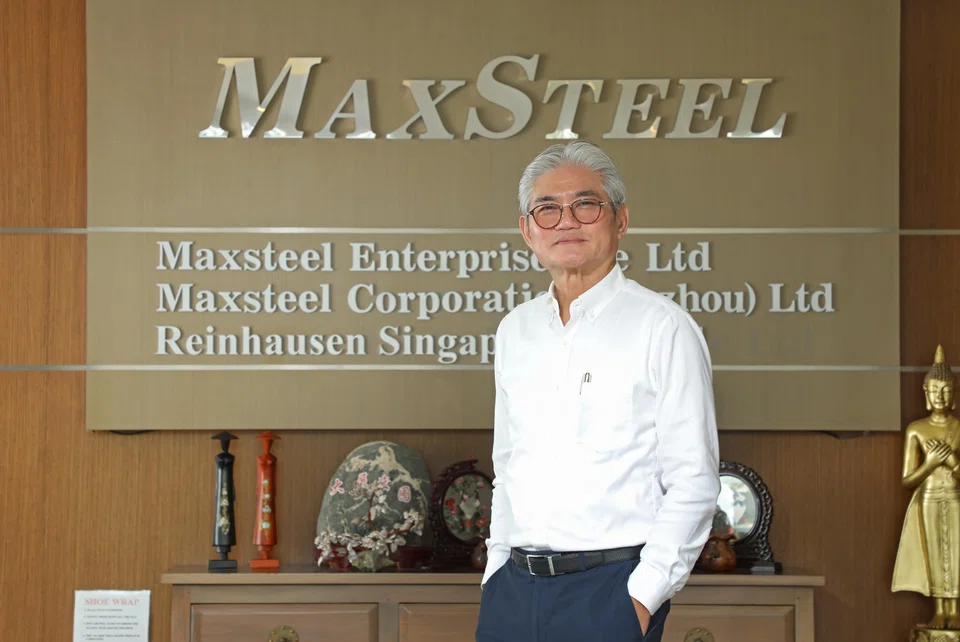
AMID the pressures of the Covid-19 pandemic, local steel supplier MaxSteel Enterprise forged stronger bonds with clients.
Early in the pandemic, when border closures disrupted supply chains, MaxSteel supported customers whose other suppliers could not operate. It was able to cater to their urgent needs as it was operating as an essential service and had materials imported from less affected regions.
In May 2021, when freight costs jumped five-fold, MaxSteel refused to cancel any customer orders. The company’s commitment to its customers paid off, as it retained their confidence. Just two months later, it made profits of over four times what it had lost.
That year, MaxSteel recorded a record turnover, up 200 per cent from the first pandemic year, and became a first-time Enterprise 50 Award winner.
Credibility and trust are two things MaxSteel cannot afford to lose, said founder and chief executive officer Henry Ng.
Ng had previously been a sales and marketing manager in the steel mill subsidiary of a Japanese conglomerate. In 1995, he started MaxSteel with his wife, Judy Tan, to supply steel as a raw material to consumer product manufacturers.

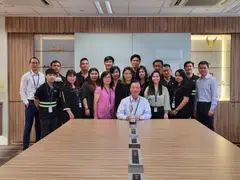
The firm began with paid-up capital of S$100,000. Today, that figure is S$2.7 million. It has over 50 employees in its offices in Singapore and Suzhou, China, and recorded a group revenue of S$110.6 million in 2021.
The company’s steel is used in household appliances, automotive parts and medical equipment, among others. In Singapore, it supplies steel to the fabrication and construction industries for pipes; air-conditioner ducts in MRT stations, hospitals and data centres; as well as steel drum packaging. Abroad, it also supplies steel to Asean markets, India, Saudi Arabia, Israel, South Africa and Latin America.
“We are like the backstage crew who prepares the backdrop to allow actors and actresses to shine on stage,” said Ng, who aims to “improve lives with every kilogram that MaxSteel processes”.
Meeting unique needs
MaxSteel started off renting a factory at Tagore Lane, in Upper Thomson. After operations grew, it moved twice before finally purchasing a factory at Senoko Drive in 2000.
In its initial years, the company tackled and overcame challenges such as funding as well as finding and retaining talent. It was willing to take risks, becoming Singapore’s pioneer importer of steel from Korean mills when the industry was saturated with Japanese steel.
At MaxSteel, the message to clients has always been “We will see what we can do for you” and never “No, we don’t have that”, said Ng.
He had seen how big, traditional competitors had rigid, centralised processes, leaving customers frustrated with inflexible pricing, long lead times and limited product offerings. MaxSteel differentiates itself by meeting customers’ distinct needs. When faced with unique specification requests, MaxSteel’s approach is to be agile: embracing them, not dismissing them.
This customer-centric approach drove innovation, and became a springboard to its success when end-product manufacturers began to source for new types, shapes and sizes of steel.
In 2022, MaxSteel invested S$5 million in new production capabilities, including advanced processing lines which enabled it to process a wider range of materials and specifications. This has diverted business from its competitors, who are not as capable of processing complex materials, said Ng.
To improve efficiency, it recently invested S$1.09 million in a fully automatic packing line. Another efficiency move was made before the pandemic: a web-based enterprise resource planning (ERP) system that allowed it to automate manual tasks.
When Covid-19 border closures prevented foreign workers – who had gone home – from returning to Singapore, this ERP system enabled MaxSteel to overcome the resulting manpower shortage. Via the system, employees were cross-trained and able to perform some of their tasks from home.
Regional moves
MaxSteel has also expanded and diversified geographically, to lessen the risks of operating in a small local market and relying on domestic demand. In 2004, it entered China with the establishment of MaxSteel Corporation (Suzhou).
With this business presence in China, MaxSteel managed to sign a sales and marketing strategy cooperation agreement for South-east Asia with one of the country’s largest steel mills in October 2019.
Earlier in 1998, MaxSteel had also formed a joint venture company, European Trafo Products (ETP), with Italy’s Cedaspe and the United Kingdom’s Webster Wilkinson to stock and distribute transformer accessories in South-east Asia. In April 2018, German company Maschinenfabrik Reinhausen invested in ETP and the company was renamed Reinhausen Singapore, with MaxSteel retaining a 30 per cent stake.
In 2019, with the aim of becoming a regionally renowned steel company, MaxSteel conducted a feasibility study in Yangon, Myanmar for establishing a 5,000 square metre factory, targeting the transformer and Internet of Things industries. While temporarily shelved due to political instability, the idea is for the factory to replicate MaxSteel’s Suzhou factory in terms of layout, equipment, and organisation structure.
This series is part of the Enterprise 50 Educational Project between the E50 partners and the NUS Business School. MaxSteel Enterprise was among the winners in 2021. The annual E50 ranking is co-organised by The Business Times and KPMG, sponsored by OCBC Bank, and supported by Enterprise Singapore, Singapore Exchange and Singapore Business Federation.
Decoding Asia newsletter: your guide to navigating Asia in a new global order. Sign up here to get Decoding Asia newsletter. Delivered to your inbox. Free.
Share with us your feedback on BT's products and services
TRENDING NOW
China Investment Corp, PGIM’s 50% stake in Nex mall up for sale; asking about S$1.2 billion

Higher rates, weaker spending: Is the Philippines entering stagflation?
Singapore tech stocks plunge as Nasdaq bloodbath spills into region
OCBC wealth clients turn defensive amid market volatility as Q3 profit rises 3%

