


More SMEs outsource back-end roles amid rising business costs, labour shortages

TO CUT costs and tackle a manpower shortage, Singapore’s small and medium-sized enterprises (SMEs) are increasingly outsourcing back-end business functions – or entire departments – such as IT support and payroll processing, service providers said.
“The local labour market is very tight, and SMEs are struggling to find the right staff, so they look to outsourcing,” said Chester Leong, managing director of accounting and tax services provider BoardRoom Group.
“At the same time, because the cost of doing business – such as rental and interest rates – has also gone up, SMEs have no choice but to look at places to save money,” he added.
Ang Yuit, vice-president of the Association of Small and Medium Enterprises (Asme), said: “The challenge with in-house functions is that you have to handle training, development, human resources, and innovation on your own.”
“With outsourcing, you have a certain level of peace of mind, and you actually bring the costs down, because you’re not paying for a full headcount,” he added.
Covid-19 boost
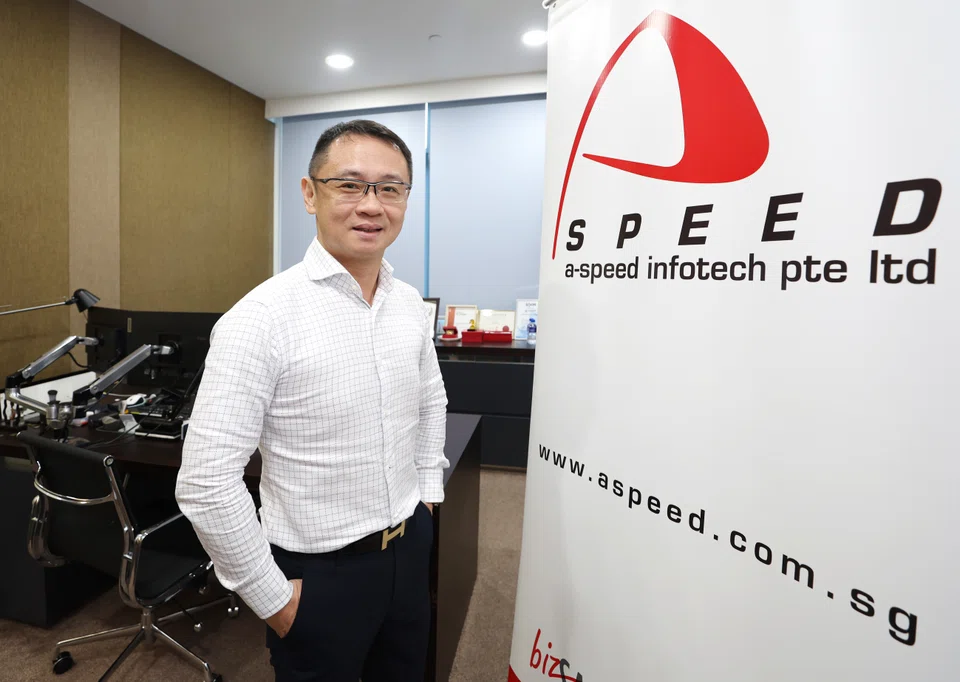
Covid-era restrictions on workers in offices provided an impetus to outsource functions, said Alan Wei, chief executive of IT services provider A-Speed Infotech. For many SMEs, their first taste of outsourced solutions was when remote working became the norm at the height of the pandemic.
As companies scrambled to develop the necessary IT capabilities – such as installing and managing a virtual private network to give employees remote access to company files – they turned to outsourced service providers.
The pandemic’s normalisation of remote working helped to accelerate the trend, said Ronald Soh, managing director of IT services provider Win-Pro Consultancy.
After realising the cost benefits of outsourcing, many SMEs did away with in-house capabilities altogether, said Soh, whose company provides outsourced IT services.
SMEs can achieve overhead and labour costs savings of up to 50 per cent by contracting a third-party provider instead of building in-house capabilities, he estimated. As service providers handle multiple clients, they incur lower costs per company and can charge less than in-house solutions.
Win-Pro has about 450 clients, of which some 90 per cent are local SMEs. Some of the smaller companies – those with 20 to 50 employees – have outsourced their entire IT departments. Win-Pro expects to be contracted by 40 per cent more local SMEs in 2023.
For BoardRoom, too, momentum has endured beyond the pandemic. In the past six months, it has seen a “tremendous increase” in demand from local SMEs for its outsourced services. These are services that a typical finance department would handle, from bookkeeping to payroll processing.
In the first three months of 2023, revenue from BoardRoom’s outsourcing business has more than quadrupled from the same period last year. Leong expects the company’s outsourcing arm to have some 2,600 Singapore SME clients in 2023, up 61 per cent from 1,613 in 2020.
To cope with the increased demand, BoardRoom has been relying on a pool of 100 offshore employees in Malaysia, and plans to grow that team to 140 by end-2023. Offshoring to countries with cheaper labour allows service providers to lower their costs and therefore their fees, Leong said.
Win-Pro similarly plans to expand its Malaysian headcount to 15, from the current 10, by the end of the year.
Water quality and treatment company Environsens cut its IT-related manpower costs by 60 per cent when it began outsourcing some functions, such as data analytics, to a service provider in 2022.
But data security was a concern, said chief executive Shailesh Kharkwal. As the outsourcing model inherently means that companies have less control, some functions – such as those dealing with more sensitive data – could not be outsourced, he added.
Concurring on how firms have less control with outsourcing, Asme’s Ang stressed that SMEs have to be “prepared for the amount of work that is required” to choose the right service provider. “These are things that people will discover – sometimes it’s not as ideal as what they think, as perfect as what they think.”
Not just cost savings
Still, outsourcing also gives SMEs access to expertise that they would otherwise be unable to tap, as they may not be able to build the required in-house capabilities, said Wei. A-Speed provides outsourced artificial intelligence (AI) and cloud computing services, for instance, on an hourly-use basis.
Smaller companies may find it difficult to hire the right people to build and operate an AI model, or to kit out and maintain a data centre, he added. A-Speed has some 80 local SME clients and expects to grow this by 30 per cent in 2023.
In any case, many business owners regard back-end functions merely as a cost centre, and would prefer not to pay much attention to them, said BoardRoom’s Leong. “By outsourcing these functions to us, they can concentrate and focus on hiring staff to grow the business instead.”
TRENDING NOW

Once staunchly pro-China, Malaysian Chinese businesses are now distancing themselves from Beijing

Stocks to watch: HPL, Aims Apac Reit, Zico, Advanced Systems Automation, ComfortDelGro

‘How many will survive?’: Bubble fears arise as China’s humanoid robotics face reality check

Smaller board lots can’t fix a market run by three banks

