Nanyang Poly students help HDB enterprises refresh offerings, go digital
Under a new MOU, the polytechnic will also work with the Federation of Merchants’ Associations to develop training programmes for heartland merchants

FROM websites to smart vending machines, students from Nanyang Polytechnic have helped heartland enterprises come up with digital solutions and refresh their offerings.
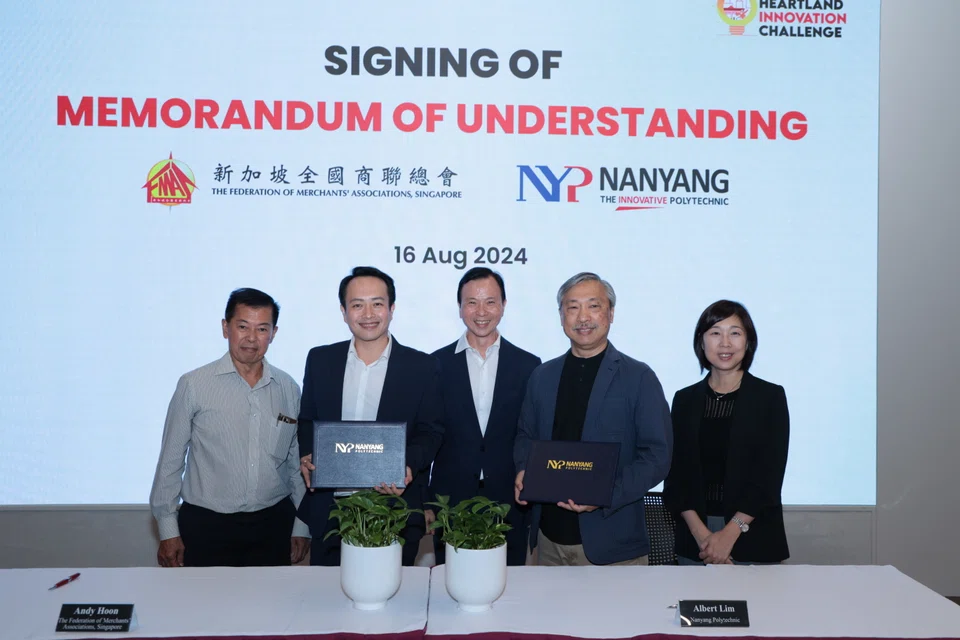
And further help is on the way, under a memorandum of understanding (MOU) signed between the Federation of Merchants’ Associations, Singapore (FMAS) and Nanyang Polytechnic.
FMAS will work with the polytechnic’s students and staff to co-develop projects for heartland businesses in areas such as placemaking, business innovation, and digital transformation.
Over the next three years, both sides will also co-develop workshops and training programmes for heartland enterprises. The aim is to rejuvenate neighbourhood town centres and encourage Housing and Development Board-based merchants to come up with new business solutions to stay competitive.
The MOU was signed on Aug 16 at the awards ceremony of FMAS’ Heartland Innovation Challenge 2024, held at Nanyang Poly’s School of Design & Media.
Esther Ho, Nanyang Poly’s deputy principal for lifelong learning and enterprise services, said: “By equipping heartland enterprises with tools and knowledge to navigate the digital economy, we hope to enable them to stay ahead of industry trends and adopt innovative practices.”
FMAS president Yeo Hiang Meng said the polytechnic’s expertise and resources will be valuable in helping heartland enterprises future-proof themselves. “As our economy grows, heartland businesses have to upgrade themselves – otherwise it will be difficult for them to survive.”
Held from April to August, the Heartland Innovation Challenge saw 15 heartland enterprises work with 52 students from the School of Design & Media to develop innovative solutions to meet business needs.
This year’s fourth edition of the challenge was the first collaboration between the School of Design & Media and FMAS.
Students had to use design-thinking methodologies to come up with market-viable business strategies for the businesses they were paired with.
Revitalising old trades
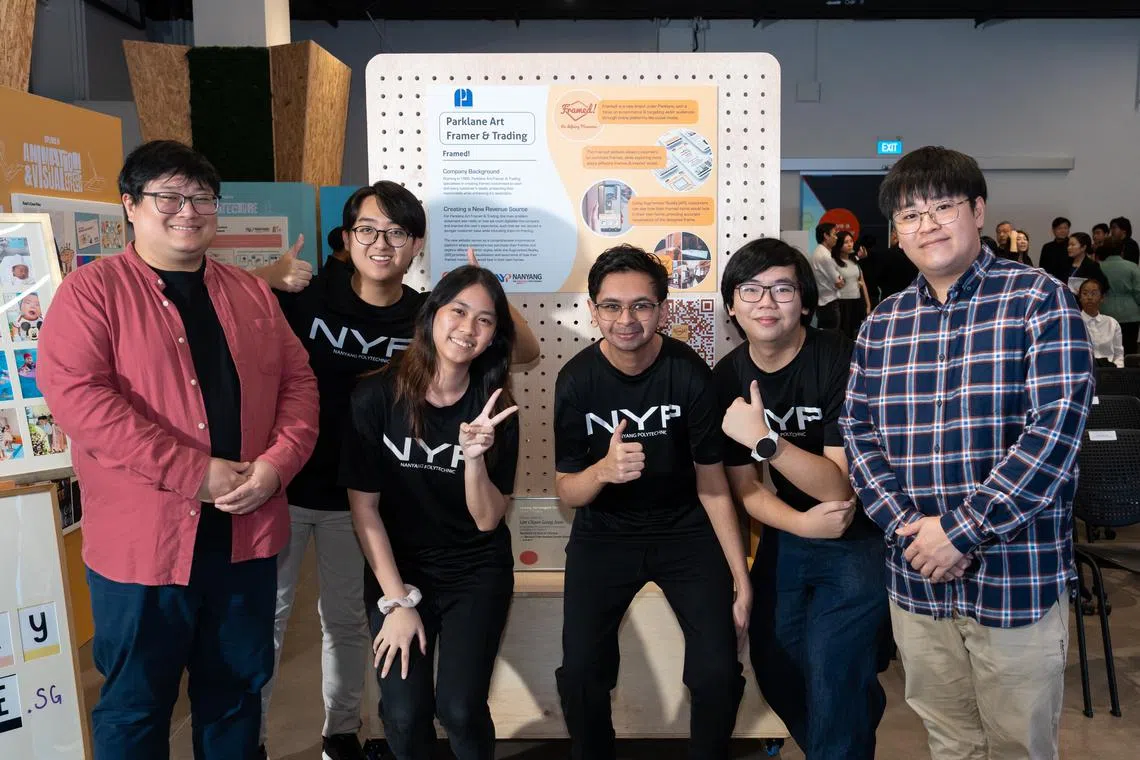
The top prize went to Parklane Art Framer and Trading, a 29-year-old family business in Clementi that provides customised picture frames to protect and display memorabilia.
With most of the shop’s patrons above the age of 35, second-generation owners and brothers Leon and Louis Lim were looking to attract younger customers.
Over the past decade, sales of the shop’s picture frames have declined by about 25 per cent due to the ubiquity of smartphones with cameras, Leon Lim told The Business Times. Fewer consumers now see a need to print and frame photos, since digital photos can be easily saved to phones and computers.
As part of the Heartland Innovation Challenge, the Lim brothers worked with four students to design a website prototype for a new, trendy brand under ParkLane called “Framed!”, targeted at younger customers.
The website lets customers upload their own images to visualise how these photos or artwork would appear with different pre-set frame designs.
Through augmented reality (AR) technology integrated on the website, customers can then project the filled frame against real-life backgrounds. This helps them to envision how the finished piece would look in their own home or office environments.
The Lim brothers also worked with the students to design a dedicated experience zone in-store, where customers similarly use AR to project their frames against stock backgrounds.
One of the students helping Parklane was Seah Zhan Hwee, a third-year student majoring in interaction design.
“We really wanted to revitalise the entire retail experience for customers across Parklane’s online and offline stores,” he said. “Though the workload was challenging, it’s been really rewarding to see our solutions implemented in real life and have clients benefit from it.”
The Lims now hope to tap government grants to support the full development of their website and a web app, aiming to launch these in the next two years.
Thinking out of the box
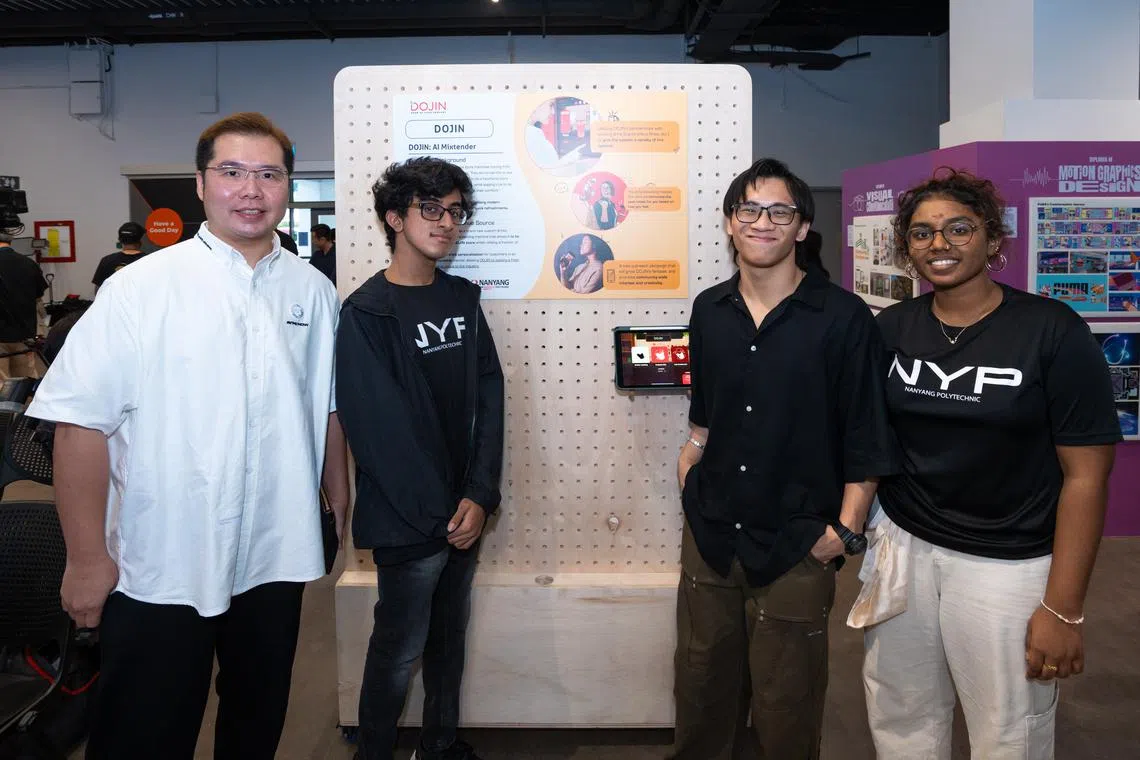
Similarly, the rise of e-commerce has meant lower footfall for heartland convenience store chain Dojin.
Dojin began as a traditional minimart in Bedok Reservoir Road over 30 years ago. It has since become a convenience store chain stocking both local and foreign goods, with a franchise model.
Sales spiked during the pandemic as people could not travel out of Singapore – but have fallen some 10 per cent since 2023, as Covid-era demand eased, said Dojin’s director Fabian Loi.
“Besides, traditional minimarts have never really evolved,” he said. “We wanted to do something out of the norm in order to attract the younger generation to come and shop at our stores.”
Hoping to offer a new retail experience to the young, Loi worked with three students to develop a smart vending machine that can make bespoke drinks.
The machine features a “bartender” powered by artificial intelligence (AI) that recommends pre-designed drink recipes when customers tell it their mood. Customers can also express specific preferences to the bartender, which will then customise drink recipes.
“For instance, if you tell the AI bartender that you’re feeling tired, he’ll try to think of a drink on the spot that matches your mood,” said Peter Joseph, a third-year interaction design major who worked on programming the AI.
“And if you have certain dietary restrictions such as being lactose intolerant, the bartender will take that into account to make the drink.”
Customers can save their personalised recipes for future re-orders at the vending machine. Loi is now engaging vending machine solution providers and hopes to launch the smart machine across all Dojin franchise stores by the fourth quarter of 2025.
The second and third prizes of the Heartland Innovation Challenge went respectively to Unidbox Hardware, a retailer of hardware and household products, and fish store That Aquarium.
Unidbox Hardware collaborated with students to develop omnichannel solutions to raise awareness of its products online. It also set up an experiential showcase in-store to allow customers to try its products before purchase.
Meanwhile, That Aquarium created a prototype website with three-dimensional video previews, user-friendly customisation features and expert support. The website allows hobbyists to build and order their own customised aquariums online.