


New directions and goals for the new year
Singapore
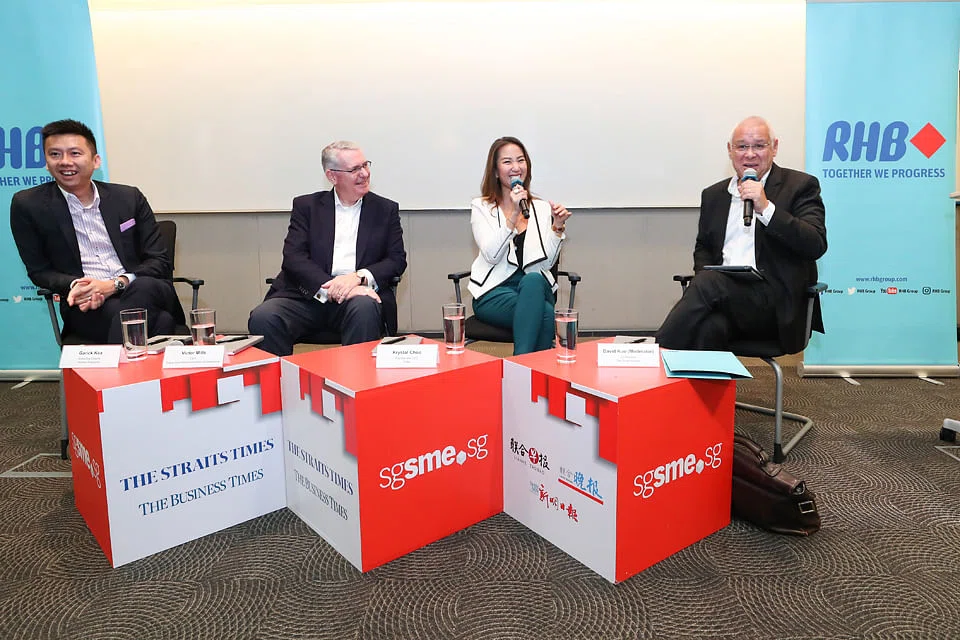
A PANEL discussion titled "Where do we go from here?" capped the afternoon at Possibilities 2020.
Moderated by David Kuo, co-founder of The Smart Investor, it featured industry experts discussing opportunities and challenges in the new decade ahead.
Panellist Victor Mills, CEO of the Singapore International Chamber of Commerce, noted a worrying trend towards protectionism as governments in countries adopt populist policies that isolate nations, instead of fostering interconnectedness and working together.
Mr Mills said: "To paraphrase Senior Minister Tharman Shanmugaratnam, the problem is not globalisation - the problem is a failure of domestic policy. The problem nationalism and populism have is too many people are left behind, and too many governments haven't cared about it until it becomes an electoral issue.
"So, many governments around the world have tried to address that problem by moving towards de-globalisation, if there is such a word."
Also on the panel, Garick Kea, executive director of consumer insights at Nielsen Singapore, noted that increased protectionism will lead to a lack of international standards, harming consumers.
Mr Kea gave the parallel development of 5G networks between US and China as an example, as phones might not be compatible with both networks.
"It will be difficult for businesses as well, who want to internationalise. From a manufacturing standpoint, coming up with products that have to be localised for different markets, you end up with several variations of the same product."
Mr Mills suggested that the classic investment advice of diversifying across markets would help in mitigating uncertainties.
"Here we are, located in the most vibrant, in terms of economic growth, region of nearly anywhere in the world. The potential to increase inter- Asean trade, to develop, sustain and reinvent products and services is very high."
Panellist Krystal Choo, CEO and founder of Tickle, shared her experience working with MNCs seeking to instil innovation and entrepreneurial qualities in their teams.
"What we found is not an innovation problem, but a team problem," said Ms Choo, specifying teams with a South-east Asian culture.
"The key problem that they face is employees don't know how to have difficult conversations. We start seeing chaos happening, but no one brings it up, out of fear or psychosocial dynamics that are going on with the group."
She said there is a "bottleneck in leadership quality" from locals, and that it is difficult for a local company to internationalise.
"When they do attract foreign talent, talent that's supposed to help bolster the productivity and outcomes of those companies, they are not able to fit into the local-centric culture and so leave," she quipped.
On sustainability, Mr Mills said the path for businesses should be the circular economy.
A circular economy seeks to gradually decouple economic activity from the consumption of finite resources, minimising waste and allowing natural resources to replenish.
"We hope to see companies move away from a linear production model, where goods are designed, consumed and then end up in a landfill or incinerator," he said, "This is a critical decade to make the changes in order to be sustainable."
To sum up the discussion, Mr Kuo asked panellists for their parting advice to the audience for 2020.
Mr Kea advised businesses to take a long term view, and to stay in sync and in touch with the market.
"It could be geopolitical, it could be economical or financial implications, but it's also about understanding the opportunities in the domestic level as well as the international level. Diversification of risk, taking a more long term perspective in terms of what are your safety nets is critical."
Mr Mills said businesses should focus on what they can control, and try to make a positive impact.
"Nearly every business knows what it needs to do - it needs to look after its customers, employees and be responsible to the communities in which it lives and works. If you worry about the things you can't control, it leads to inaction. Far better to stay positive."
Ms Choo's advice was for business leaders who want to drive transformation efforts: "Adopt a growth mindset, not to just expect your customers or employees to change, but to also look inwards and develop yourself personally, to see if there are areas where you might be rigid."






