Precision engineering growth faces bottleneck of talent shortage
Talent flows from traditional source countries have dried up, say industry players

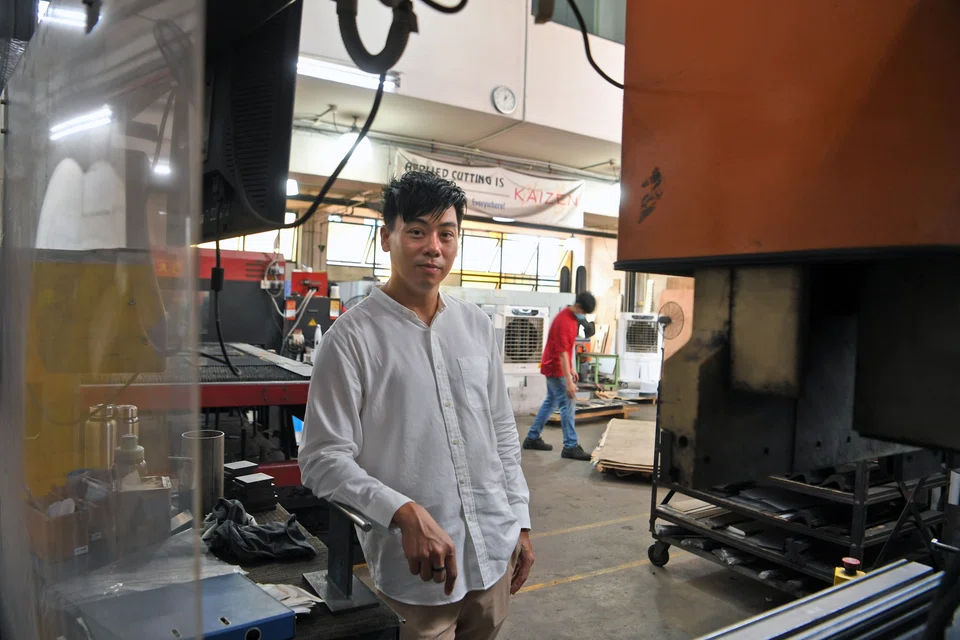
SINGAPORE’S precision engineering (PE) industry has seen strong growth, but a lack of skilled workers may throw a spanner in the works. While labour shortages are occurring across the manufacturing sector, precision engineering is particularly reliant on specialised workers who are harder to acquire, with even overseas sources running dry, industry players told The Business Times.
After a 2.5 per cent contraction in 2019, the precision engineering industry saw double-digit annual growth in 2020 and 2021. In the first 7 months of 2022, PE output grew 6.5 per cent from the year-ago period, according to figures from the Singapore Economic Development Board.
Yet a major limiting factor is a lack of manpower. Industry body Singapore Precision Engineering and Technology Association (SPETA) and government body Enterprise Singapore (EnterpriseSG) recently held a closed-door session to talk about “anything under the sky”, as SPETA generation II chairman Tan Ru-Ding put it. (*see Amendment note)*But there was only one topic on attendees’ minds, he added: “Three hours long, (and) everybody was talking about nothing other than manpower issues.”
“There are a lot of challenges in attracting people to our industry. Because of that we turn elsewhere… we start looking at foreign markets,” said Tan, who is managing director of Flexmech Engineering.
But manpower flows from the industry’s usual sources of Malaysia and China have dried up, he added. Malaysia’s pool of available engineers has nearly been exhausted, and China’s economic growth in recent years has made working in Singapore less attractive to the Chinese.
Another issue is a quirk of classification. As part of the manufacturing sector, the PE industry can only hire work permit holders from what the Ministry of Manpower (MOM) considers “traditional sources”: Malaysia, mainland China, and the North Asian sources of Hong Kong, Macau, South Korea and Taiwan. But the niche skilled labour needed in PE, such as welders and machinists, hail from other countries too.
Ryan Ng, general manager and director of Chong Fong Engineering, once tried to hire a welder from a non-traditional source country who had been laid off in the marine sector. Companies in the construction, marine and process sectors are allowed to hire work permit holders from such countries; Ng’s company was not. That same worker would have had to be hired on an S Pass, with a minimum monthly salary of S$3,000 – even though he had previously earned about S$700 at a shipyard.
“If I need a welder, I can’t get a fresh guy and train him to be a welder, it’s not so simple,” Ng said. “We are constrained by the Ministry of Manpower’s manpower policies which makes (the labour crunch) even tighter.”
The industry may get some relief from Sep 1, 2023, when services and manufacturing companies will be able to hire work permit holders from non-traditional source countries for a restricted set of occupations. In manufacturing, these include PE occupations such as welders and flame cutters, as well as metal moulders and coremakers.
This will give PE firms a more level playing field when getting workers for hard-to-fill roles, said Tan. But he noted that other important roles such as programmers, machinists, surface treatment workers and electroplating workers are not on the list.
For Tan, there is still the hope that more locals will join. With greater automation and modern technology, the PE industry has made significant strides in work conditions and offers lucrative career prospects today, he said.
Simon Lim, executive director of SPETA, said that the “fast moving” industry has grown more attractive to young graduates and new entrants as companies transform in line with the Industry 4.0 push: using data, technology, robotics, and advanced manufacturing techniques.
“For young people wanting to join an industry which is data-driven and understand how data is being applied in a real-world setting, precision engineering has many examples,” he added.
Yet Ng’s view is that Singaporeans remain generally unwilling to do hands-on factory work. Kwan Li Feng, enterprise development manager of CKE Manufacturing, agrees. While there is some success in getting graduates from polytechnics and the Institute of Technical Education into management or specialist roles, not a lot of them are willing to do technical and machine operation work, said Kwan.
“One of the challenges is that our current work pass policy is not very growth-oriented,” Kwan said. Citing the example of startups which are able to procure funding before they are financially successful, he argued that the PE industry should be allowed to have more flexible work pass policies until they are able to entice locals to join.
While the government has been supportive of the PE industry’s needs, it cannot create solutions in isolation, and requires constant feedback and cooperation from industry players, said Lim. This is where SPETA comes in: organising conferences, exhibitions, and industry networking opportunities to consolidate and provide feedback to government agencies, as well as connect PE firms with industry partners that can help solve their issues.
“Sometimes they may be suppliers and customers, and sometimes even if they are competitors, they can give mutual support to each other,” Lim added. “The Singapore government is quite active in giving help, but we want to make sure that all the members are aware of the help... be it in innovation, manpower, (or) in training and upgrading.”
*Amendment note: A previous version of this story stated that Tan Ru-Ding is the chairman of SPETA. He is the chairman of the SPETA generation II committee.