


S$10 million funding round boosts carbon accounting platform Evercomm’s overseas push
It intends to leverage the overseas network of Mitsubishi Electric, a co-leader of the round

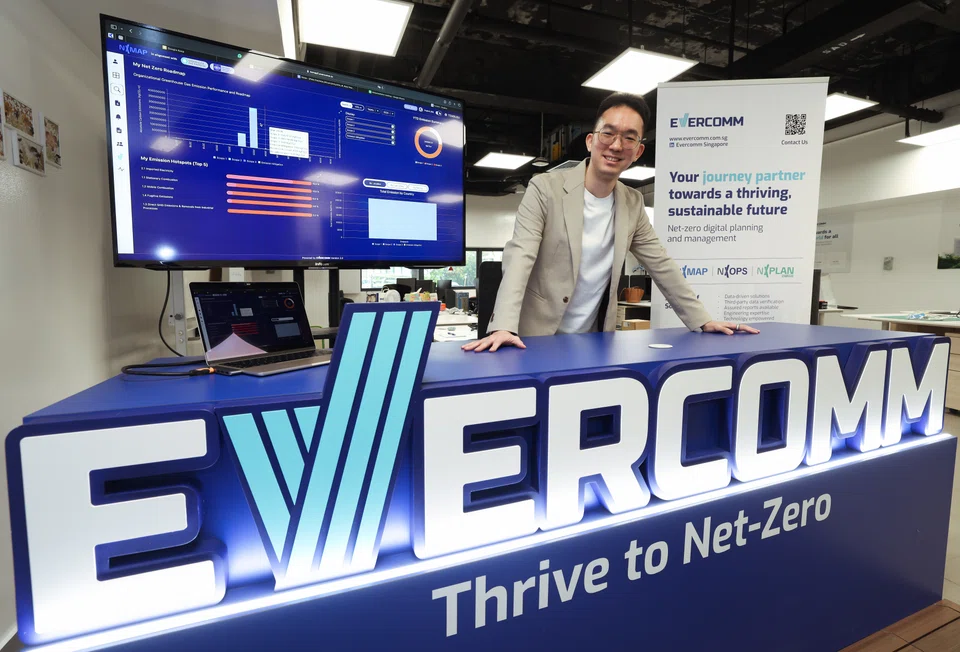
A S$10 MILLION Series B funding round – co-led by electronics giant Mitsubishi Electric – will help to propel carbon accounting platform Evercomm’s further expansion into Europe. Since being founded in Singapore in 2013, the company has entered Taiwan, Thailand, Malaysia, Indonesia and Vietnam.
The Series B funding round is set to be completed by the third quarter of this year.
With Mitsubishi as a backer, Evercomm intends to leverage the Japanese multinational’s overseas network – particularly in Europe and Japan – for growth.
Said Evercomm co-founder and chief executive Ted Chen: “We are working closely with Mitsubishi Electric’s Europe team to see how we can bring our services to (their) European customers.”
In line with this, the company opened its first European office last month, in Luxembourg.
“Luxembourg is a financial hub,” explained Chen. “Many financiers – including family offices – are based in Luxembourg, and it is located between the two big markets of Germany and France.”
The ease of access to capital will facilitate future fundraising. Beyond that, a key target group of customers – European multinationals – are either headquartered in Luxembourg, or have their regional head offices sited there, easing communication.
Evercomm’s initial overseas forays were in 2019, to Taiwan and Thailand. But travel restrictions in the ensuing Covid-19 pandemic meant that operations abroad had to take a pause, and restarted only last year.
In Japan, Evercomm does not intend to set up a physical office. Instead, it will offer its solutions – which are all digital – to Mitsubishi’s network of customers and suppliers, on a remote basis. “We will just tap (Mitsubishi’s) channel to grow; there’s no point for us to set up in Japan (separately) since they’re so strong there,” said Chen.
Reducing emissions
Evercomm helps clients track, manage and subsequently reduce their carbon emissions. It does so by collating relevant data – such as real-time water and electricity usage – from a company’s operations.
Previously, it provided clients with customised hardware for data collection, such as sensors that measured power, temperature, or water flow.
But last year, Evercomm moved away from hardware-related operations, and pivoted to solely being a software provider. “Traditionally, a lot of our revenues are contributed by hardware sales, but the problem with that is, although the number is high, your margin is very little,” said Chen. Much of the company’s cash flow was also tied up in inventory, he added.
By engaging third-party vendors to install the necessary hardware for data collection instead, Evercomm no longer needs to maintain inventory, and can operate on an asset-light basis.
It can also scale up its operations much more quickly, as it does not have to depend on its own supply chain to provide the needed hardware.
Data collected from clients’ operations is uploaded to Evercomm’s proprietary carbon accounting platform, NXMap, which automatically converts the different data streams into one metric: carbon emissions. The conversion process and output both meet international standards and are accepted by regulators, bankers, and sustainability certification providers globally, Chen said.
Using the data presented in Evercomm’s platform, companies can then devise ways to reduce their carbon footprint.
Some “low-hanging fruit” solutions are switching to more resource-efficient machinery, or using renewable energy, Chen said.
Processes can also be optimised, with tasks redesigned such that less energy is required to generate the same output, he added.
Growing plans
The global sustainability reporting push is what drives demand for Evercomm’s service.
Said Chen: “For the very large emitters, they have to meet their compliance requirements, especially for carbon taxes.
“For other companies, their customers are demanding it of them – they need to know their carbon footprint, because their footprint (is also) the customer’s footprint.”
The company’s clients are typically industrial and commercial players, such as manufacturers and data centre operators. Notable clients include data centre operator Digital Edge; beverage maker F&N; and Thai sugar producer KTIS Group. But about half of its more than 100 clients are small and medium-sized enterprises.
“For them, the driving force (for adoption) is really coming from their customers, who are the ones pressuring them,” said Chen. “For the bigger companies, it’s coming more from meeting regulations.”
After the end of its hardware operations, Evercomm’s subscription-based platform now accounts for all of its revenue.
This is also why revenue fell to S$500,000 in 2023, down from about S$1.5 million in 2022, with hardware sales generally accounting for the difference.
Evercomm is not yet profitable, but aims to grow its topline to some S$10 million in the next two years.
To fuel this growth, the company also aims to double its headcount from the current 50 employees to more than 100 in the same period.
On the ambitious sales target, Chen said: “That’s very doable, because all the partners that we work with, they are really the leading ones in their industry. We are quite confident of their ability to help us channel to different markets.”
He also expects overseas sales to account for about 80 per cent of overall revenue in the next two years, up from about 60 per cent now. “(Most) of it will definitely come from overseas,” said Chen. “The Singapore market, in this sense, is quite limited.”






