


A safer way to save farmed fish
Local biotech startup TeOra is developing an alternative to antibiotics
Zenith Wong
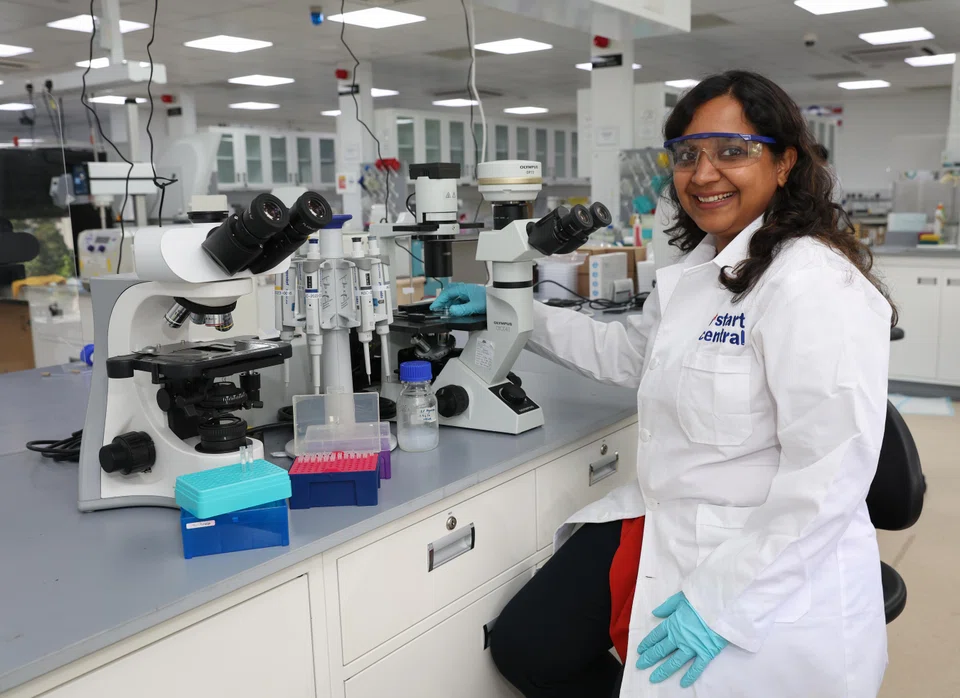
FISH farmers will be able to protect their livestock from disease in a safer and more sustainable way than through the usual antibiotics, with vaccine-like “biologics” – that is, biologically-derived medicines – created by Singapore biotechnology startup TeOra.
In June, TeOra’s vaccine development system won S$1 million in grant funding in The Liveability Challenge, an international competition presented by Temasek Foundation and organised by Eco-Business. The contest searches for and supports the commercialisation of sustainable solutions to urban challenges.
TeOra is developing an orally-delivered biological drug for Asian seabass, targeting a virus that causes fish scales to fall off. The vaccine-like biologics can be applied as a coat on fish feed, and thus integrated into existing farming operations.
Apart from the prize, TeOra gained a S$100,000 investment from venture capital (VC) firm PeakBridge VC. The startup aims to use the funds for further testing and certification of its vaccine technology as well as hiring talent.
By improving the health of farmed fish and reducing fish deaths, the aim is to improve the profitability of farms and ultimately achieve better global food security.
“We already produce enough food for 10 million people, yet one in three calories are lost to reasons like pests or diseases,” said TeOra chief executive officer and founder Rishita Changede in the startup’s winning presentation.
Saving fish to help farmers
While working as a research fellow for a medtech startup, Changede decided she wanted to develop a biotechnology solution of her own. Having grown up by the sea in Mumbai, India, she saw first-hand the detrimental effects that diseased fish had on farmers.
“I’ve seen people suffer and struggle. I know that if farmers lose their crops two or three times, that’s it. They’ve lost their livelihood. There are farmers who unfortunately are driven to suicide because of the debt, because of the difficulties that they have to face,” she told The Business Times.
Farmers take a “disproportionate” risk to feed the world, she added: “These farmers are putting in all their money, effort and hard work into farming, and if the crop is lost, they are the only ones to suffer. But this is food that we all need, so it’s just so unfair.”
This spurred her to start TeOra in January 2020. The startup uses bioinformatics and materials science to develop disease management solutions for the food production industry – where research is lacking, compared to human pharmaceuticals, she said.
TeOra focuses on aquaculture because the industry’s technology is far behind that for land-based agriculture, meaning that a solution in this area would have the most impact, she added.
Singapore’s government, too, aims to reduce fish mortality. In a speech last October, Deputy Prime Minister Heng Swee Keat said that the country aims to reduce the mortality rate from common fish diseases to a range of 20 per cent to 50 per cent, down from the present 70 per cent to 100 per cent.
How it works
Typical vaccines contain whole viruses or bacteria that have been inactivated. But there remains a risk that these pathogens could stay reactive and thus infect fish with the actual disease.
In contrast, TeOra’s proprietary biologics development process identifies only the virus fragments that are relevant to a particular disease. This overcomes regulatory barriers in some countries that restrict the use of whole viruses or bacteria in vaccines.
Known as Solaq, this proprietary process includes using software to design a vaccine as well as the physical production process itself. The technology is patent pending, with three provisional patents filed.
When information about a disease is put into Solaq’s digital system, the software can predict the protein structures that could provide immunity. Using this information, microorganisms are modified to act as “factories” and produce the vaccine-like biologics.
This method also allows for the production of biologics that incorporate protein structures from multiple viruses or bacteria, providing broader immune coverage.
An oral vaccine produced via Solaq has already been tested successfully on shrimp to protect them against the white spot syndrome virus, which can typically kill an entire pond of shrimp in four days. Across trials in Singapore, Vietnam and India, the vaccine raised survival rates to over 90 per cent, compared to less than 2 per cent for unvaccinated shrimp.
TeOra hopes its oral vaccines will represent an improvement of existing aquaculture disease management methods. For example, injections are difficult to administer and stressful to animals, while antibiotics and pesticides may accumulate as toxins in the fish.
What’s next
Beyond the funding earned at The Liveability Challenge, TeOra has also received seed funding from VC firms such as Investible and Berkeley Skydeck.
Companies in farming and related industries – such as agriculture disease management – have expressed interest in the seabass vaccine and are willing to trial it, said Changede.
She expects TeOra to achieve profitability within two years. By then, its solution would have attained regulatory approval.
Companies in half of the world’s 12 major shrimp-producing countries – India, Indonesia, Vietnam, Thailand, Malaysia and Ecuador – have already expressed interest in TeOra’s vaccine for shrimp, she added. “The technology is working, the customers are there. With regulatory approvals and with the scale of our products, we can reach profitability.”
While TeOra is focusing on aquaculture first, it eventually intends to provide disease and pest management solutions for crops and livestock, too.
The main challenge, said Changede, is that investors tend to invest in newer solutions such as alternative protein, rather than “traditional industries” such as farming.
“Alternative proteins and all are great, (but animal protein) is the food that is feeding 100 per cent of the world today,” said Changede. “Alternative proteins can feed a small portion of the world sometime in the future. But these problems are existing in our current food production systems, and that’s what we’re trying to solve.”
TRENDING NOW

Once staunchly pro-China, Malaysian Chinese businesses are now distancing themselves from Beijing

Stocks to watch: HPL, Aims Apac Reit, Zico, Advanced Systems Automation, ComfortDelGro
‘How many will survive?’: Bubble fears arise as China’s humanoid robotics face reality check

Smaller board lots can’t fix a market run by three banks

