Security staff provider creates tech solutions for more efficient manpower use
Interlock Security and Investigation Services has also developed solutions for hospitality and is doing the same for facilities management and childcare

[SINGAPORE] Set up as a provider of security staff, Interlock Security and Investigation Services now helps clients optimise the use of manpower – thanks to its technology solutions.
“There’s a huge shortage of security manpower in Singapore,” chief executive Sanjiv Sharma told The Business Times.
“Our vision was to make the security profession more attractive by incorporating security technology, which would enable officers to dabble in high-tech stuff.”
Interlock was founded in 1993 by Sharma’s father, who had overseen the deployment of military personnel in the Singapore Armed Forces for 26 years before that. Going into security services was thus a natural transition for him, said Sharma.
Sharma himself started out as a security officer in Interlock. He was appointed operations director in 2010, when his father was the managing director. He became CEO in 2020, with his father serving as chairman and adviser.
Initially, the company focused on deploying trained security personnel to commercial and residential sites.
But after winning a tender to provide security services for condominium complex Melville Park in 1996, it began venturing into technology.
Upskilling security workforce
Melville Park – the company’s biggest assignment at the time – has 1,232 residential units spread over a land area of 75,611 square metres.
As part of their duties, Interlock’s security guards had to write down the details of visitors as they entered and left. But this form of record-keeping was not ideal, given the condo’s sheer size and number of units.
Sharma recalled that condo management authorities or police officers often requested specific visitor records, whether for due-diligence purposes or when there was suspicious activity.
“It was a tedious process. We couldn’t give this information quickly, because we’d have to get two to three guys to open the book and flip through records from months back,” he said, noting that 500 or more visitors were passing through the condo’s premises on any given day.
That spurred Interlock to develop a computerised visitor-management system for its own use, which it rolled out in 2000.
Instead of keeping paper records, security guards key in visitor details and car plate numbers, which can be retrieved anytime.
In the following years, Interlock built other standalone products for its own purposes, including a licensed number-plate recognition and smart-parking system, a self-registration kiosk for visitors and virtual patrolling CCTV cameras.
In 2015, Interlock integrated these systems into one centralised platform. This covers security from “every angle of a residential condo”, with a dashboard that was controlled and updated from an app, said Sharma.
From 2019, it began selling the platform to external parties. Today, more than 63 clients – ranging from residential to commercial to industrial sites – use the platform on their premises. Interlock can provide security officers to operate the platform, or train existing officers on the client’s payroll.
“Our platform helps to eliminate human errors. With this technology, condos can also cut down on security expenses in the long run; they don’t need to hire as many security guards,” said Sharma.
For instance, Melville Park now needs only seven security guards in the day and five at night – down from 16 and 13, respectively, before it got on board the platform.
Yet, Sharma stresses that Interlock’s products are not intended to replace security personnel. Instead, the aim is to redesign their jobs and help them digitally upskill.
This also helps Interlock optimise its own pool of manpower, comprising 500 full-time security officers and 100 part-timers.
As fewer security officers are needed on a single site, the company can deploy manpower to more sites and bid for more security services tenders.
Banking on smart hospitality
With its expertise in tech, Interlock has diversified beyond the security sector.
After developing a concierge and wayfinding bot for malls and hotels in 2018, it is now banking on hospitality tech as a growth area.
Many foreign housekeepers had to return home during the Covid-19 pandemic, creating a severe labour crunch in hospitality, noted Interlock’s chief operating officer Kevin Singh, who joined the company in 2021.
He led the company to develop smart-hospitality solutions to provide a “seamless” check-in and stay.
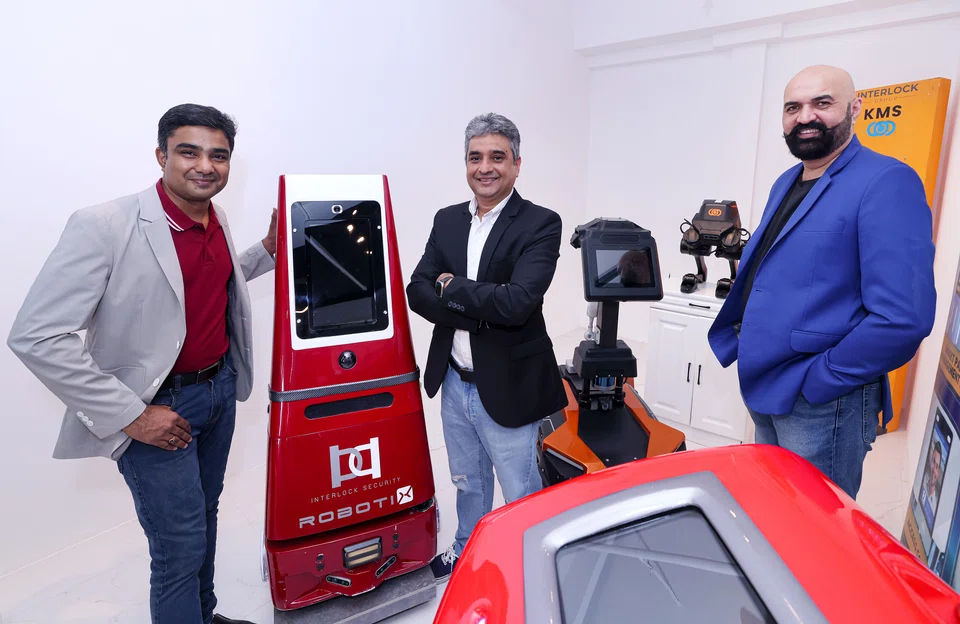
These include a virtual concierge hologram to assist guests with check-ins; an autonomous “bell bot” to carry luggage up to the rooms; a robo vending machine that dispenses hotel amenities; as well as smaller delivery bots to bring items to rooms.
The post-pandemic travel boom has supported demand for Interlock’s hospitality solutions.
Its products have been adopted by four hotel chains in Singapore, and will soon make it to the Middle East, where Interlock inked a Memorandum of Understanding last December with a global hotel chain headquartered in Dubai.
Since 2021, Interlock’s revenue has grown 10 per cent year on year, to reach S$25 million for its most recent financial year ended October 2024. The company expects this to increase to S$32 million in FY2025, as it scales up its smart hospitality solutions.
About 60 per cent of revenue comes from manpower staffing services, and the rest from technology sales. The company hopes to achieve an even split between both in the next two years.
More innovation on the way
Interlock is now developing tech solutions for other industries, from facilities management to childcare.
In July 2024, the company worked with the Infocomm Media Development Authority (IMDA) to build an integrated smart-building system that enables landlords to optimise their building operations to save energy and costs.
With sensors, artificial intelligence (AI) and data analytics, the system manages the various systems in buildings, such as heating, ventilation and air conditioning, security as well as water.
The company is now a pre-approved vendor for this system under IMDA.
Interlock is working on an automated pipe declogger, after winning a call for solutions by JTC in October 2024.
The call was for solutions to inspect and clear choked drain pipes in buildings. Interlock’s bot maps a blueprint of the building’s piping system, enters the pipes, and clears blockages using nano-vibrations. It intends to patent the declogger once the prototype is completed.
The company has also developed tech for the childcare sector: CCTV cameras with AI that can take attendance, screen children’s temperatures and detect distress, and then send this data to teachers’ phones through an app. One childcare centre has already procured this technology.