SMEs can start small, tap available grants when adopting sustainable practices
Now is the best time to begin as climate change will not wait for economic recovery

Renald Yeo
SINGAPORE’S small and medium-sized enterprises (SMEs) can tap available “low-hanging fruit” to ease their transition to more sustainable practices, said Minister for Trade and Industry Gan Kim Yong.
For instance, SMEs can look into installing energy efficient appliances in the face of high energy prices, which reduces business costs but also contributes to the Republic’s sustainability efforts, he said.
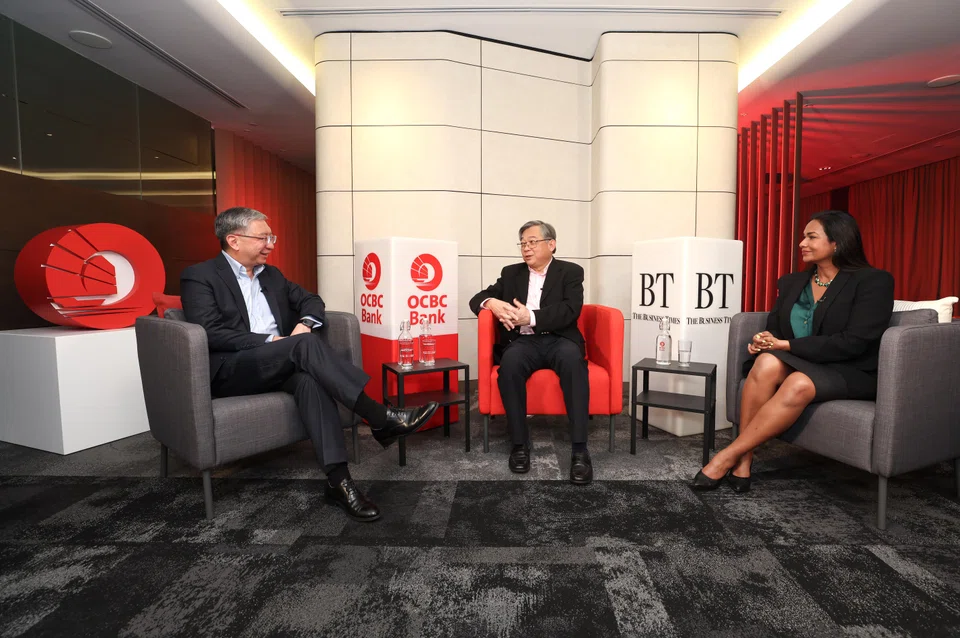
He was speaking alongside OCBC’s head of global commercial banking Linus Goh at The Business Times (BT) Sustainability Dialogue 2023 on Friday (May 5).
OCBC was the presenting sponsor for the hour-long dialogue, which was moderated by BT senior correspondent Anita Gabriel.
“Aside from thinking of it as something further out, the reality is that today, energy prices have gone up significantly,” said Goh.
To that end, government schemes such as the Energy Efficiency Grant (EEG) are available for SMEs here, said Gan. “I think we have a very strong interest from our companies, especially the SMEs, in adopting energy efficiency measures.”
“This is particularly in recent months because of rising energy prices, and it has become more urgent for them to explore these solutions,” Gan added.
The EEG provides funding for the implementation of pre-approved, energy-efficient machinery by SMEs in the food services, food manufacturing, and retail sectors. In Budget 2023, the scheme was extended by a year till Mar 31, 2024.
Beyond energy saving measures and appliances, other low-hanging fruit for SMEs to kickstart their sustainability efforts include recycling and reducing waste, along with sourcing for more sustainable raw materials, said Gan.
Gaining a competitive edge
Singaporeans too, are “increasingly demanding” for more sustainable practices among companies, said Gan, who noted that local consumers are generally prepared to pay more for greener products.
He added: “Companies, therefore, will find that it is better to move faster towards sustainable practices, and this will give them a competitive edge versus their competitors in terms of bringing to new markets, (and) securing and retaining their customers.”
Concurring, Goh noted that sustainability efforts are no longer a “distant consideration” for SMEs, as it was five to 10 years ago, but a strong motivator for them to future-proof their businesses.
“The pressure points are coming from all fronts – the consumers, the big buyers, the regulations, the standards across emerging industries, across value chains, are all coming in at the same time,” said Goh.
One example would be multinational companies, which typically work with many SMEs in their value chain. Such multinationals are more likely to continue to work with SMEs who meet their sustainability standards, Goh said.
And as more SMEs future-proof their value proposition by meeting sustainability targets set by their customers, a cascading effect will follow.
“It’s all about business, because if they are able to grow new customers, (then) others in the industry will follow, because they know they will be missing out,” said Goh. “I think this is very powerful.”
‘No shortage’ of funds
But for SMEs to adopt sustainable practices, there would have to be ready access to capital, BT’s Gabriel noted.
In response, Goh said: “Frankly speaking, the banking sector … is hungry for opportunities to invest, and to finance companies that are forward looking, that are shifting towards sustainability. There’s no shortage of investable funds.”
He cited the SME-specific framework for sustainable finance that OCBC launched two years ago for green loans under S$20 million, which more than 500 local SMEs have since tapped.
The framework was created to lower the barriers of entry – such as high consultancy fees – that SMEs could have previously incurred in setting up their own guidelines.
In Goh’s view, the adoption of sustainability efforts will grow to the point where the “capital available for green loans will be greater than what is available for non-green” lending.
This is especially the case for certain industries – such as those in high-emission sectors – where the “rush” for green financing would come “much faster than you would expect”, he added.
Gan agreed: “I think in time to come, green financing may become the default – if you are non-green and non-sustainable, you will find it very difficult to raise financing, because the banks, (and) even the banks’ shareholders, will have a view on this.”
Apart from loans, SMEs are also able to tap the government’s Enterprise Sustainability Programme (ESP) for their sustainability efforts, which covers capability building and grant schemes, Gan added.
One component of the ESP is the Enterprise Financing Scheme – Green, which supports banks – such as OCBC – in lending funds to companies by undertaking risk sharing of 70 per cent.
Since the scheme’s launch in October 2021, 50 SMEs developing and providing green solutions have received support, and some S$260 million of green loans have been disbursed, The Straits Times reported in April.
Relying on inherent nimbleness
One advantage that SMEs possess is their small size and nimbleness, said Gan, who noted that business adjustments will be needed along a company’s sustainability journey, as markets and technologies shift.
This was made plain during the heyday of the Covid-19 pandemic, when companies had to scramble to digitalise their operations, said the panellists, who drew a parallel between digitalisation efforts then, and sustainability practices now.
“Sustainability, in a way, it’s the new digital,” said Goh. “We saw that whole momentum through the pandemic with digital; likewise, we will see that in sustainability, precisely because the businesses are small.”
The pace of climate change, meanwhile, will provide the same trigger for the adoption of sustainable practices as the Covid-19 pandemic did to the acceleration of digitalisation efforts, the panellists said, even as inflation and economic slowdown continue to take a toll.
“The pace of climate change will not slow down just because our economy slows down, so the world has to continue to catch up with the pace of climate change,” said Gan. “This is, in fact, the best time ever to start. Tomorrow will be one day late.”