


SMEs show more interest in GST registration, but applications may rise only later this year

Paige Lim
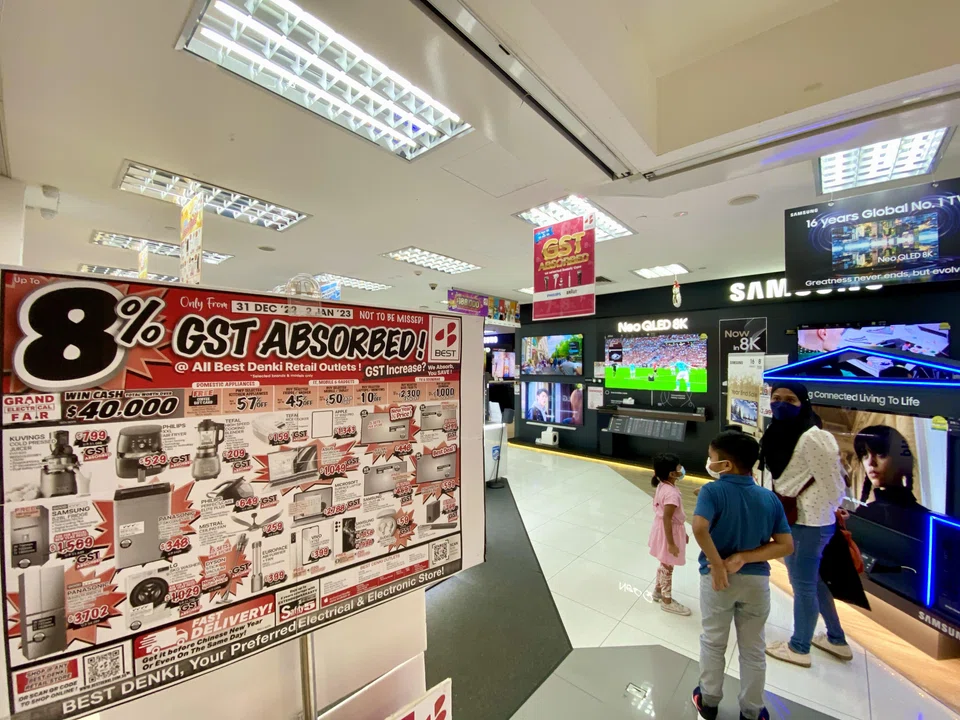
SMALL and medium-sized enterprises (SMEs) are showing more interest in voluntary goods and services tax (GST) registration, accounting companies told The Business Times, though actual applications have yet to rise significantly. Companies may be reluctant due to compliance costs and concerns about raising their prices, said observers, but may find it necessary to do so as business expenses go up.
KPMG has seen more such interest from SMEs in the last four to six months, said Gan Hwee Leng, principal consultant of indirect tax at KPMG in Singapore.
Gan noted that the GST hike is taking place “amid increasing business costs”, which may motivate companies to seek means of defraying their higher expenses.
The GST rate rose from 7 per cent to 8 per cent on Jan 1, and will further rise to 9 per cent on Jan 1, 2024. Businesses must register for GST if their taxable turnover at the end of the calendar year exceeds S$1 million, or if they expect to reach this in the next 12 months.
In the last six months, accounting service provider TNB Global Outsource has received 15 per cent more enquiries about voluntary GST registration compared with the six months before; though this is “not a drastic or sharp increase”, said director Lily Tan.
Since October, the Association of Small and Medium Enterprises (ASME) has received 20 per cent more enquiries from SMEs on this issue. Said vice-president Ang Yuit: “Companies that are actively enquiring are those that’ve noticed macro trends a bit more, are more savvy, and are exploring how they can reduce costs.”
The increased interest has not yet translated into applications. In response to BT queries, the Inland Revenue Authority of Singapore (Iras) said that numbers and patterns of voluntary GST registration have remained “largely the same” for 2022 and 2021. There were fewer voluntary registrants this January than in December.
Industry observers said this could be due to a time lag, given that the hike kicked in only recently.
Richard Mackender, indirect tax leader at Deloitte South-east Asia, said: “Our assessment would be that SMEs have yet to incur a significant increase in GST costs because the rate has only just been increased, and the transitional rules mitigated some of the immediate impact.”
He expects SMEs to see an increase in their January costs, and subsequently “assess their situation over the next few months”.
Noting that many companies tend to be “laggards” in implementation, ASME’s Ang said that “interest does not often immediately translate into action” and may not cause an immediate surge. ASME plans to organise a seminar on voluntary GST registration in March.
Cost of registration
Business might also be reluctant to register because of compliance costs, as well as a lack of resources to meet the associated accounting obligations – even if they rely heavily on GST-registered suppliers, said tax experts.
Yeo Kai Eng, Asean indirect tax leader at Ernst & Young, said the firm has seen many businesses “struggle” to manage GST compliance after registration. Those registered should also be mindful that non-compliance, such as late payments or over-claiming of GST, may attract penalties, he added.
GST-registered businesses have to file GST returns with Iras every quarter, keep business and accounting records for at least five years, and issue tax invoices to GST-registered customers. Voluntary registrants must remain GST-registered for at least two years.
Noting that companies are “typically concerned about the compliance burden”, Deloitte’s Mackender said: “This is not the cost per se; more that businesses have to ensure that they understand when to charge GST, how to charge, how to collect, and how to meet the filing deadlines. For an SME, this can seem to be quite a lot to manage.”
This was the case for Lee Swee Siong, founder of consultancy and training company TrueVA Capital. He began looking into GST registration in the middle of last year, when his company started working with more GST-registered suppliers.
But he then put it off, as there were “a lot more immediate business imperatives” to deal with. Said Lee: “Actually, it’s worthwhile to do it. I just don’t have the bandwidth to look at the documentation and submission requirements. But it’s something that I plan to do this year.”
Businesses also worry about losing competitiveness if they pass GST on to consumers. This is especially if their customers are individuals or non GST-registered businesses that cannot claim the GST incurred.
If businesses cannot raise their prices, KPMG’s Gan said, registering for GST could “erode their profit margins”. Registering allows a company to claim, from Iras, the GST it pays to others. But if it has to absorb GST on the selling price of its own goods – which would be higher than production costs – then it will still pay a net amount to Iras.
Of course, not all companies would end up paying more. When a business buys big-ticket items such as buildings, plants and machinery, the GST incurred on these – which can then be claimed from Iras – is “substantial”, said Gan.
“SMEs are likely to analyse and decide if they should register for GST voluntarily, taking into consideration the profile of their customers and their business expenditures, including purchase of capital goods,” she added.
The risk of losing customers is why Steven Yong, director of retailer INS Jewellery, remains undecided on voluntary GST registration. The brand currently pays GST on imported pearls that are used in its bespoke jewellery.
Said Yong: “For us, we will need to work out the math, whether to add 8 per cent (to the retail price), or absorb. The key question here is how our customers will react to this.”
TRENDING NOW

Knight Frank’s Tan Tee Khoon leaves firm, Nicholas Keong takes over auction business
Keppel Energy, Sembcorp Utilities and Tuas Power to supply biomethane in pilot project

GovTech retrenches another 38 staff in second round of layoffs

Take-up of new private homes dives 45% in Q3 as prices accelerate with 1.4% rise

