For SMEs, tracking carbon emissions is not about theory but growing the business
Property player CDL works with its SME suppliers to develop a decarbonisation road map
 Add BT as a preferred source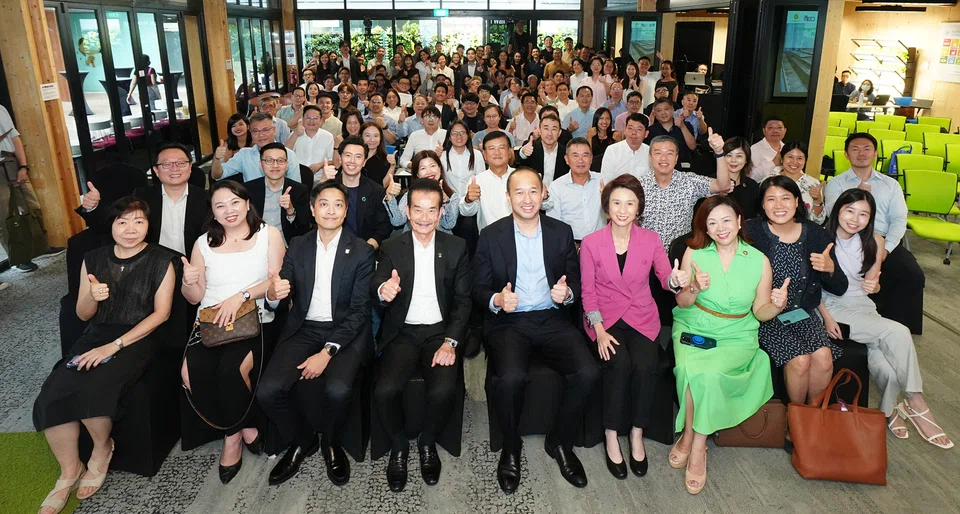
[SINGAPORE] While carbon emissions may appear to affect only the big boys, it is an important area for small and medium-sized enterprises (SMEs) as well.
That was what some 42 SMEs learnt as they underwent the inaugural SME Supplier Decarbonisation Queen Bee Programme with property giant CDL and graduated in October.
The six-month programme was launched in 2024, with support from Enterprise Singapore and in collaboration with sustainability consultant Global Green Connect.
The programme aims to help CDL’s SME suppliers develop a decarbonisation road map, adopt carbon accounting practices and align with global reporting frameworks – such as global non-profit CDP which runs an independent environmental disclosure system and Science Based Targets initiative. This enables them to more effectively track and reduce their carbon emissions.
What did the SMEs learn?
James Yin, chief executive of agriculture solutions company V-Plus Agritech, one of the participating companies, said the programme has two tracks.
“One track is the entity level – what are your carbon emissions as a company? The other is the product level. You analyse the product based on the life cycle, from the cradle to the grave – basically from upstream suppliers and how they get raw materials, all the way to disposal,” he explained.
The outcome is two sets of carbon data: one based on company emissions, and the other based on product emissions.
He added: “We can use the data to extrapolate, for example, if you sell 10 of these products, what does it mean in terms of carbon emissions?”
Yin said he realised the importance of carbon reporting in growing the business, as many potential partners now ask for sustainability reports.
Likewise, another participant, Lester Leong, co-founder and CEO of paint company Gush, felt his business needed a competitive edge.
He said: “Gush’s performance decorative coatings improve indoor air quality and cut operational energy use, yet we lacked a rigorous understanding of our carbon footprint for each product and how we’re benchmarked on a corporate level.”
The programme granted Leong access to greenhouse gas specialists and data-collection methods. “It bridges the gap between a good sustainability story and verifiable, investor-grade metrics,” he added.
As an SME, Gush’s challenges in its decarbonisation journey included a lack of knowledge, limited resources and bandwidth, and capital allocation.
Through the programme, Gush’s management was able to examine the life cycle of its products and make more informed decisions.
Leong added: “It gave us the clarity to see where real changes could be made. For instance, this has already opened up conversations about how we can streamline our logistics, which will lead to a noticeable reduction in our carbon emissions – especially when it comes to freight.”
After attending one-on-one advisory sessions, Leong was able to develop a decarbonisation road map for Gush that he said was “both ambitious and grounded in reality”.
He noted: “Perhaps what resonates most with us is the culture of sustainability accountability that the programme fostered. We now regularly track our sustainability metrics, be it from the consumption of purchases to power, and this has engendered a culture of conscious consumption whenever we trigger a purchase order.”
Noting that companies often talk about sustainability without understanding exactly what it is, having a “commonly accepted” rubric through this programme will help everyone align to the same standards. As a result, SMEs will also be able to “procure wisely” to achieve their goals.
The importance of SMEs
Sherman Kwek, CDL’s group chief executive, said: “To achieve Singapore’s net-zero goals, SMEs play a critical role. With large corporates striving to meet stringent carbon reporting requirements, there is a stronger business case for SMEs to embrace carbon reduction.”
Esther An, chief sustainability officer of CDL, told The Business Times that the world will not be able to be net zero without SMEs.
In Singapore, SMEs account for more than 99 per cent of local enterprises. SMEs also account for more than 40 per cent of Singapore’s greenhouse gas emissions.
“As a big player and procurer, we want to empower SMEs too. My ultimate objective is to get the suppliers to give us Scope 3 data that is credible, because right now there is a lack of available data,” An said, adding that carbon accounting is a new concept for many SMEs.
Scope 3 emissions refer to indirect greenhouse gas emissions from a company’s value chain that are not owned or controlled by that company.
Lixia Ong, director for enterprise sustainability at Enterprise Singapore, noted that these emissions often comprise the majority of a company’s carbon footprint.
The built environment accounts for a large portion of carbon emissions, energy and water consumption, waste and materials extracted from nature, An noted. Since Singapore relies heavily on imports, it is important to look at how businesses design products and what materials they procure.
“We need to look at upstream and downstream (activities in a supply chain), and we need to account for the carbon footprint in terms of not just energy but also circularity. We are looking at the whole loop… This requires a lot of resources and data,” An said.
Ong added: “With increasing scrutiny and expectations from stakeholders such as investors, customers and regulators, large corporates are facing growing pressure to reduce their carbon footprint and build more sustainable supply chains.”
This means involving suppliers, including SMEs, to integrate more sustainable practices into their operations.
The Queen Bee programme
The programme comprised consultations, workshops and tutorials that were conducted on a one-on-one basis with trainers.
Ong said: “SMEs that participate in the programme can benefit from comprehensive advice and guidance on decarbonisation strategies tailored to each of their specific needs.
“These (carbon accounting technology) solutions streamline carbon data collection and calculation processes, making it easier and faster for companies to establish their carbon footprint.”
Based on feedback from the first cohort, CDL will be shortening the programme to 14 weeks, although it will have the same outcomes.
CDL aims to expand this programme beyond carbon accounting.
“Carbon is only one small part of overall sustainability reporting… Once they get the hang of it, SMEs can expand to other governance data,” An said.
Decoding Asia newsletter: your guide to navigating Asia in a new global order. Sign up here to get Decoding Asia newsletter. Delivered to your inbox. Free.
Copyright SPH Media. All rights reserved.