


Space Matrix uses AI to offer clients the best workplace design options
The design consultancy expects a return to offices as pandemic curbs end

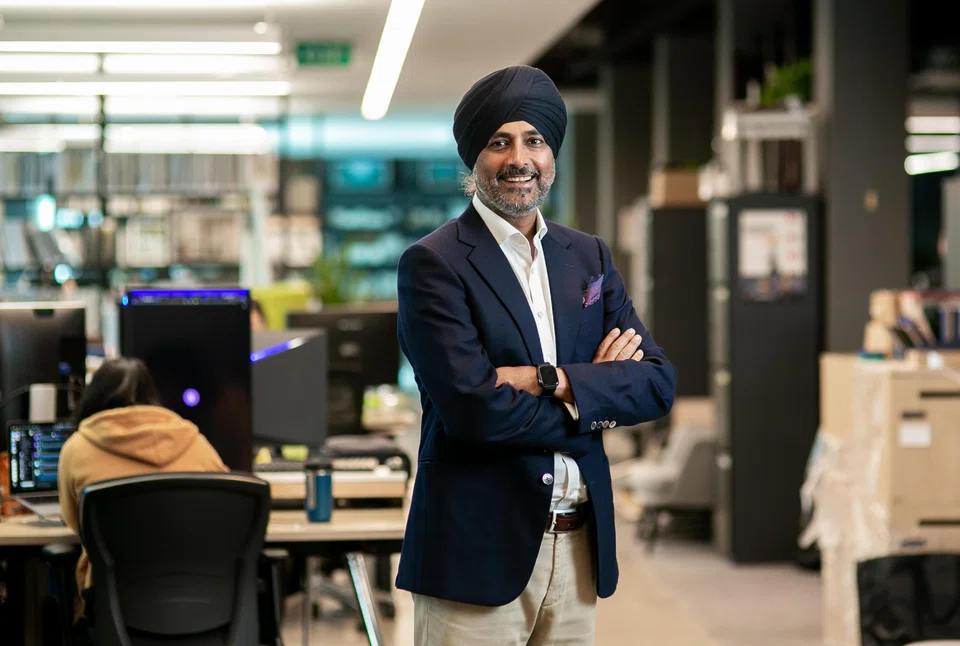
REPORTS of the office’s demise are greatly exaggerated, according to Space Matrix’s global chief executive officer Arsh Chaudhry. Though the workplace design consultancy “had a significant drop in revenue” when Covid-19 made working from home the norm, overall revenue has since recovered past pre-pandemic levels.
“When Covid hit, almost everyone was saying, ‘Hey, we will never need offices anymore’,” he recalled. Yet as the pandemic eases, companies are realising the virtues of working together in a physical space, and how working virtually causes innovation to slow down, he added.
Even as Space Matrix banks on a return to physical workplaces, it is building new digital tools. Having acquired business-to-business procurement platform Pursuite this June, Space Matrix is adapting this artificial intelligence (AI) and machine learning technology for its own design-and-build business.
More than 1,500 vendors from China, India, Singapore and South-east Asia are being added to the Pursuite platform. When Space Matrix’s clients need office equipment and services, Pursuite scours the database, analyses data from past projects and vendors, then suggests the best options for each unique project.
Besides choosing vendors, the proprietary tool can be used for budgeting and cost estimation; generating and managing project schedules; and improving overall quality, said Space Matrix’s chief technology officer Amit Shukla, who was formerly Pursuite’s CEO.
“Space Matrix’s design-and-build clients will get high-quality projects, delivered faster with access to better products at competitive costs and most importantly, a very powerful tool to track their entire project with 100 per cent transparency,” Shukla said. “For Space Matrix, the automation and AI-enabled procurement will mean higher efficiencies.”
“We have a ‘digital thinking’ now within the organisation,” said Chaudhry. Beyond procurement, the tool will increase efficiency in client servicing, design methods, and project management and execution, he added.
The tool is being rolled out in phases, with the full version expected to be ready in the second half of 2023.
New areas of growth
Since its establishment in 2001, Space Matrix has completed more than 2,500 projects across Asia, spanning some six million square feet (sq ft) in total. After taking over in 2016, Chaudhry has focused on customer service, engaging experts, creating learning and development programmes for staff, and expanding geographically.
Under Chaudhry’s leadership, the company entered China and the United States – with multiple offices in both countries – as well as the Philippines. It now has 16 offices with 600 employees, including several in India and Australia as well as one in Bangkok, Thailand.
China has been the main laggard in the recovery of demand, said Chaudhry. In South-east Asia and India, Space Matrix’s clients report that in non-tech sectors, nearly 90 per cent of the workforce is back in the office.
Though office occupancy is “not going to be the same as what it was pre-Covid”, neither will everyone be working from home, he added, expecting a balance to be struck in the next six to 12 months.
Space Matrix’s improved business is due partly to higher demand for “modern workspaces”, with the general trend being a reduction of personal space but an increase in collaborative spaces, he said.
Last year, Space Matrix designed a ”Living Lab” concept for Coca-Cola’s Singapore office at Keppel Bay Tower, spanning 22,000 sq ft. The design featured fewer fixed elements and walls, as well as a casual, open work area with a view of the sea, where employees can enjoy a peaceful moment or do quiet work.
The idea was to enhance the well-being and social experiences of individual staff, while providing collaborative spaces that improve team dynamics, “providing employees with moments and areas to recharge and connect with colleagues”, said Chaudhry.
Other clients in Singapore include private members’ social club 1880 Singapore, law firm Watson Farley & Williams, Prudential, Ascendas-Singbridge, and Uber.
Another workplace trend is the growing emphasis on sustainability, such as requests for buildings or offices with lower carbon footprints or energy-saving measures, Chaudhry noted. “Developers, as well as the tenants within office buildings, are getting more and more conscious about how to reduce that (carbon footprint).”
Preparing for the future
With talent being another focus for Chaudhry, the company created its own 18-month leadership acceleration programme in 2017 for high-performing employees. About 60 have undergone the course, with hands-on projects and real-life situations for them to solve.
The programme provides not just personal development for participants, but business advice for Space Matrix, as the solutions devised by participants can help the company formulate organisational plans.
The company also has general learning and development courses for workers across its service lines. “If we don’t do it, the organisation becomes stale,” Chaudhry noted. “Creating the right learning environment helps the individual grow, and therefore the organisation to grow as well.”
In its pursuit of growth, Space Matrix is one of 15 participants in the current iteration of Enterprise Singapore’s (EnterpriseSG) Scale-up SG programme. The 12 to 18-month programme works with ambitious Singapore companies to help them to scale effectively.
Which geography to expand into, the type of services or products to offer, and the choice between investing resources for geographic expansion or increasing market share in an existing market – these are some examples of tough strategic questions that Space Matrix hopes to solve with Scale-up SG, said Chaudhry.
“Asia offers a lot of opportunities for growth, and it’s easy for any organisation to get distracted by so many opportunities in the marketplace,” he said. “What the Scale-up SG programme really offers is the ability to step back and think about some of these issues (and) provide strategic guidance to the organisations that are part of this ecosystem.”
Space Matrix has identified various areas of growth and is working with EntepriseSG on executing some business strategies in the next 12 to 24 months, Chaudhry added, though he declined to give any hints as to these confidential plans.
TRENDING NOW

DBS remains analysts’ pick ahead of Q3 earnings after Singapore banks’ share slump

Singapore identifies 7 firms responsible for haze fires, notices issued urging action: Grace Fu

Good Class Bungalow market activity picks up pace on ‘realistic’ pricing

High Court rules against Julius Baer’s Singapore trust arm in US$50 million family trust dispute

