


Spike in outbound travel dampens small retailers’ sales
Realities on the ground might not be captured by aggregated official statistics, say industry players

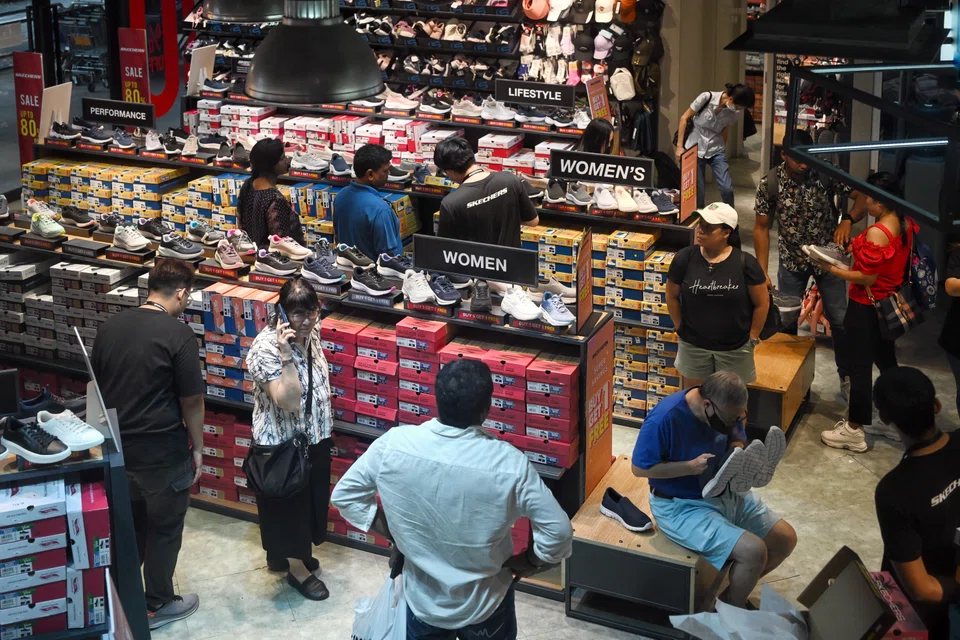
OFFICIAL retail sales data shows growth, but some small retailers in Singapore have seen sales drop by up to 30 per cent year on year (yoy), as increased outbound travel dampens takings at the till.
In an informal poll by tenant advocacy group Singapore Tenants United for Fairness (SGTuff), 35 of 41 retailers said sales from January to May this year have been “worse” or “much worse” than in the year-ago period.
This is in contrast to economy-wide retail sales data published by the Department of Statistics each month.
In the first five months of 2024, retail sales grew yoy for each month except April, most recently rising 2.2 per cent in May.
But this overall growth obscures sectoral differences – and may be boosted by outliers. Excluding motor vehicle sales, retail sales saw yoy growth in two of the first five months; contraction in another two; and stayed flat in May.
“Car sales and some sectors like consumer electronics seem to be doing better numbers,” said SGTuff chairman Terence Yow, in reference to official data.
“But it’s a very different picture on the ground for other sectors, like those in apparel, footwear and optical,” he added.
Large and small retailers may also fare differently, though official statistics do not have such a breakdown.
Ang Yuit, president of the Association of Small and Medium Enterprises (Asme), said: “I think overall, it is the case that SMEs (small and medium-sized enterprises) find this year’s sales not to be very strong.”
More outbound travel

Small retailers to whom BT spoke attributed most of their fall in sales to the increase in outbound travel.
Many of the items sold here – from socks to contact lenses – are generally cheaper in neighbouring countries, industry players said. As more residents are travelling overseas, they tend to purchase fewer such items locally.
In the first five months of the year, Singapore residents’ outbound trips rose 18.4 per cent to 3.9 million, up from 3.3 million in the year-ago period, Immigration and Checkpoints Authority data showed.
Singaporeans have been “opportunistic” in travelling, especially given the current weakness of the Japanese yen and Malaysian ringgit against the Singapore dollar, noted OCBC chief economist Selena Ling.
Paul Khor, founder of lifestyle brand Actually and outdoor retailer Outside, has seen sales fall by up to 30 per cent across his seven retail outlets in the first five months of 2024, compared with year-ago sales.
He said: “This year has been terrible. Singaporeans are travelling like crazy, and not just to Malaysia – it’s just non-stop travelling.”
Socks retailer Citrusox and plant seller The Green Capsule have both seen sales fall 20 per cent for the same period.
Citrusox operates three kiosks in the Junction 8, Jem and Plaza Singapura shopping malls, while The Green Capsule has one retail space in Funan mall and another outlet due to open on Friday (Jul 26) at Paya Lebar Quarter.
“For my product, it’s something that people can very easily buy when they travel,” said Citrusox managing director Lena Ong. “When (residents) come back, they don’t really buy from us.”
Families, in particular, are travelling more during school and public holidays, which has negatively impacted sales, said The Green Capsule’s owner, Ricky Lim.
Optical retailer Nanyang Optical, which has eight retail outlets, saw a smaller contraction of 5 per cent in January to May, compared to the year-ago period, said managing director Bernard Yang.
In particular, sales of contact lenses have fallen. “(In the past,) customers tended to buy half-year or one year’s worth of supplies, but now they are maybe buying four boxes – enough for two months.”
He attributed the drop in contact lens sales to more customers purchasing them across the Causeway, especially as the Malaysian ringgit has remained weak against the Singapore dollar.
With the weaker ringgit, an equivalent product can sell for up to 30 per cent less in Malaysia, Yang noted. “I guess we’re a victim of ‘by-the-way’ shopping, as people go into Johor Bahru to buy groceries and all.”
Other woes
For some retailers, the fall in sales has had a knock-on effect on other parts of their operations.
To free up cash flow, Citrusox had to tighten inventory levels by making smaller orders on a more regular basis.
Yet, this means its logistics costs have risen by up to 15 per cent, as it no longer qualifies for preferential rates based on bulk volumes, Ong said.
Actually’s Khor, who also runs an apparel distribution business, has seen some customers slash clothing pre-orders for upcoming seasons by up to 50 per cent, in light of weaker demand and lower sales.
Industry players are generally pessimistic about sales prospects in the second half of the year.
Part of this is due to disappointing results in the school holiday season of June – also a result of increased outbound travel, they said.
“Last month, we ended June as one of the worst months for this year,” said Khor. “Looking ahead, I don’t see how (sales) will pick up.”
Asme’s Ang added: “Overall, the market is not rosy, and in the second half, people are still concerned about whether sales will turn (out) better.”
OCBC’s Ling noted that the bank’s SME Index report for the second quarter showed that small business owners are less optimistic about business prospects in the next six months.
“Notably, the consumer-facing sectors like F&B and retail appear to be more affected, possibly attributable to a pullback amid the geopolitical fragmented global landscape and disappointing recovery of the Chinese economy to date,” she said.
TRENDING NOW

China recruited exec at Singapore data centre firm to spy on Nvidia CEO Jensen Huang: US intelligence
DBS, OCBC, UOB’s big sell-off: Was it their Q3 numbers or a broader market de-rating?

Could Japan trigger the next global financial crisis?

Philippines’ FDI slowdown exposes uneven investment prospects across S-E Asia

