Tech start-up sets sights on surveillance
Vi Dimensions uses machine learning software to manage existing surveillance systems.
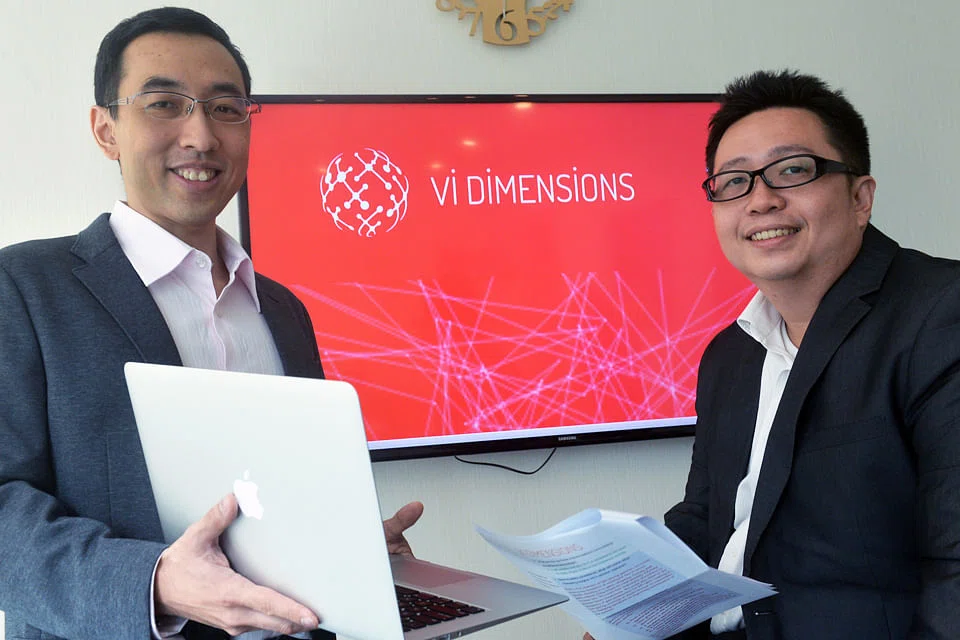
SINGAPORE is heavily populated with security cameras - reports say the police have installed 65,000 cameras since 2012, and they will add another 11,000 over the next four years. But if this gives the impression that you are constantly being monitored, think again.
The CEO of the technology start-up Vi Dimensions, Raymond Looi says: "Surveillance technology today is actually much more primitive than what most people think. There are a lot of security cameras everywhere, but all the video data just gets stored somewhere and goes unused.
"What we are trying to do is harness this untapped potential for surveillance systems by introducing a degree of automation into existing security camera networks. This way, all footage collected can be utilised, making surveillance more effective."
He adds that while the security industry is familiar with rule-based analytics, there is a gap. "(Rule-based analytics) requires you to know what you are looking for and then to specify a rule. This is not efficient because most of the time you would not know what you're specifically looking for."
Given the unpredictable nature of crime and terrorism today, this gap is an important one to close. Vi Dimensions hopes to circumvent this limitation by using machine learning to automate anomaly detection.
Their groundbreaking software development work garnered investment in January this year, receiving S$1.5 million in funding from the Tembusu ICT Fund I. The Tembusu ICT Fund I is the only software-focused venture capital fund in Singapore. It is also one of six funds selected by the National Research Foundation as part of the Early Stage Venture Fund II scheme.
The initial S$1.5 million funding from the Tembusu ICT Fund I has enabled the company to scale up its technology and operations.
While it did not disclose the identity of clients, Vi Dimensions says several companies have expressed interest in their work since the start of the year. It is conducting trials with companies and organisations in the government sector, transportation, entertainment, hospitality, retail, and tourism industries.
It has completed its trial phase with some success and has begun work on the implementation phase.
Vi Dimensions sets itself apart because of its research into machine learning, which is an area of technology that is relatively unexplored. While Mr Looi did not go into the specifics, he says the programs developed and patented by Vi Dimensions are entirely unique and different from all systems developed elsewhere.
Chief technology officer Christopher Tay says this is because the type of machine learning algorithms Vi Dimensions uses is different from other types of machine learning technologies presently out there.
Beyond this, he also says most efforts to automate video surveillance systems use "rule-based" systems, where programmers have to teach machines what to look out for by programming rules.
Mr Tay explains that for example, if a camera was programmed to detect trespassing, then the rule would be to flag every instance when something crosses a certain boundary.
While this method of automated detection is sufficient for basic functions, such as detecting trespassers, it requires programmers to know specifically what they are looking for in advance, and for them to programme specific pre-defined conditions.
Machine learning, on the other hand, would allow cameras to detect if anything out of the ordinary is happening.
"Out of the ordinary" is not a figure of speech, but should be taken literally here - machine learning enables the camera to detect "normal" behaviour within its field of vision, and flag any instance when it sees behaviour which deviates from this norm.
This is not the machine making any subjective decision in its distinguishing what is "good behaviour" and what is not. All it does is detect which behaviours are frequently occurring, and which are not, says Mr Tay.
This immediately presents a problem of dealing with false positives. In essence, if the programme flags any deviation from the norm - and given that human behaviour is irrational and erratic - will this program not flag up many instances of deviance that are not really deviant?
And if a person with suspicious intent loiters at a crowded MRT station, how is a camera going to pick it up and flag it - given that loitering and waiting idly are perfectly normal behaviours in an MRT station?
When presented with these scenarios, Mr Tay says that these are valid concerns that would require a human presence to correct for these potential technological shortcomings.
Mr Tay says: "We are not saying that we want to entirely remove the human element from existing surveillance systems. In the end, there needs to be someone there to decide if there is indeed a security risk detected.
"So in a sense the false positives are not really 'false' because our programs are designed to flag all instances of deviant behaviour, and letting the human decide if it is worth reacting to in the end."
Mr Looi adds: "There might still be false positives even without machine learning technology - where a security guard mistakenly sees someone committing a crime on camera when he didn't, for instance. If, due to automation, we can have 100 per cent of video footage analysed instead of just one per cent as it is now, then I would say security would be greatly improved."
Another hurdle Vi Dimensions had to cross was the inherent difficulty of analysing video analytics, which Mr Tay says is more difficult compared to other forms of data analysis, such as numeric data for instance.
While computer programs are able to distinguish an item in the foreground from the background, it is more difficult for it to recognise specific actions or movements - such as if a fight was breaking out.
Although he did not delve too deep into the technicalities, Mr Tay says Vi Dimensions is able to circumvent current limitations on video analytics for the software to better recognise visual anomalies as they occurred.
"We are not using standard machine learning methods that already exist out there, and the algorithms we have developed is specifically for video analytics."
He gave some examples where the software can recognise fights and intrusions, but highlighted that the software is also designed to spot unforeseen threats which the user may or may not have previously defined or programmed.
Lastly, hardware compatibility is another prime concern, says Mr Tay. Machine learning systems would require a lot of processing power, and the extent of its video analytical prowess would be limited by the quality of the video it has - CCTV (closed circuit television) camera resolution is relatively low.
Vi Dimensions' software is meant to be used with existing security frameworks and devices, and is not meant to replace current security systems. If existing systems are too obsolete, it would hinder the software's effectiveness.
Mr Looi says: "There are some old cameras that are of too low quality or have frame rates which are below our minimum requirements. But in general, because we aim to market our software to large enterprises, we do not think hardware issues will be a problem for our potential customers.
"In the end, it is about creating a product that is powerful and smart enough to learn how to detect anomalous behaviour, but lightweight enough so as not to be too taxing on current hardware systems."
That the final product is lightweight enough is key as they are ultimately building software that needs to be scaled up to thousands of cameras, requiring large amounts of processing power.
Mr Tay says one solution the company could provide would be to create different versions of the software in the future - a lightweight version that is less scalable but also less taxing on computer hardware, and a more powerful version which also requires more processing power to run.