Travel and hospitality players go digital for the return of physical travel

Paige Lim
AS SINGAPORE’S tourism industry begins to recover, some local travel and hospitality players have gone digital – not as a replacement for real-world travel, but to welcome more visitors after 2 years of border restrictions.
There were 418,310 visitors to Singapore in May, which was the highest monthly number of travellers since the Covid-19 pandemic began, according to the latest figures from the Singapore Tourism Board (STB). The Republic reopened its borders to all fully vaccinated travellers on Apr 1.
Some homegrown tourism businesses have used the pandemic downtime to reassess business models, innovate, and adapt their offerings in preparation for the return of inbound tourism in the digital age.
Such efforts have been supported by initiatives such as STB’s Tourism Technology Transformation Cube (Tcube), an innovation platform launched in April 2021.
Tcube has seen a “healthy” take up rate to date, having been tapped by more than 1,000 local tourism businesses such as hotels, attractions and tour agencies, STB chief technology officer Wong Ming Fai told The Business Times.
Tcube provides support for various stages of their digital transformation journey, including upskilling staff capability in data analytics; accessing consultancy and prototyping services; and running proof-of-concepts and data pilots to gauge outcomes of innovative practices.
Wong noted that the Covid-19 pandemic has reshaped consumer behaviour and travel norms, with digital experiences here to stay even as physical travel resumes. Such experiences have lowered costs and provided new revenue streams, and the sector should “push boundaries and find innovative solutions” using them, he said.
“For example, technologies like virtual reality (VR) and augmented reality (AR) are increasingly deployed to enhance the visitor experience, provide meaningful, engaging and shareable content, as well as boost marketing efforts,” said Wong.
Such technologies are also commercially sustainable, he added, as businesses can refresh their content without having to invest in infrastructure changes.
Digital nomads – business travellers who can work remotely – are also a fast-growing segment that homegrown tourism players can capture, as Singapore is an “ideal” base for seeking business opportunities in the region, Wong noted.
“Our tourism businesses can cater to their needs by providing more Wi-Fi bandwidth and coverage, and creating conducive spaces for them to integrate work and play,” he said.
Finally, data collection and analysis can help tourism businesses deepen understanding of their customers and respond more quickly to changes in preferences, said Wong.
“As international travel picks up, we must differentiate ourselves from other destinations to capture pent-up demand. We encourage our tourism sector to tap emerging technologies that can engage, surprise and delight visitors,” he said.
BT speaks to 3 Singapore tourism and hospitality players who used the lull to remain relevant and competitive - from enhancing the visitor experience with AR, to developing data capabilities to guide decision-making and capture new audiences.
Mount Faber Leisure: Improving safety standards with data
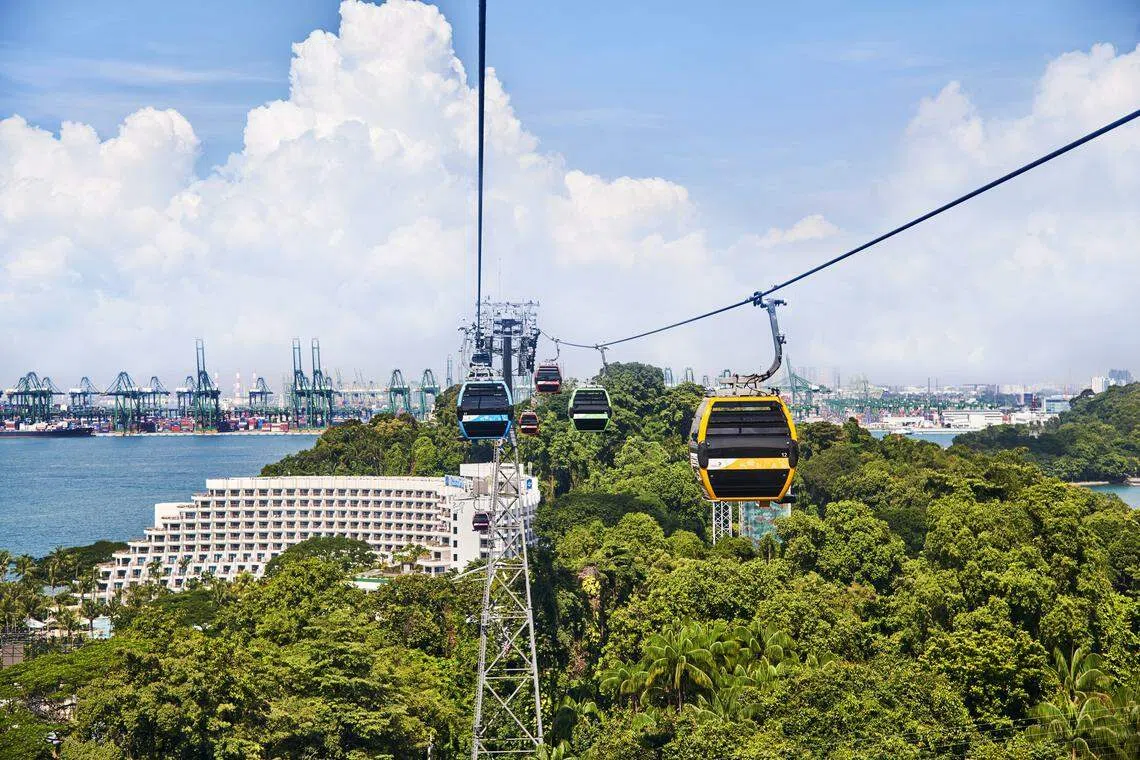
The Singapore Cable Car is not just iconic – with 48 years of history – but also at the cutting edge of tech. (*see amendment note)
In August 2021, Mount Faber Leisure, which runs the Singapore Cable Car, worked with intelligence technology firm Ulisse to track the real-time occupancy of its cable car cabins. The group was part of STB’s Singapore Tourism Accelerator programme under Tcube, which sources for innovative technology solutions.
Sensors were mounted inside each cabin to detect the number of passengers and track where and when they board and alight, in a 1-month pilot study.
Favian Ooi, Mount Faber Leisure’s director of operations and asset development, said such real-time occupancy data would allow for a better emergency response time, and give passengers greater assurance.
Currently, staff have to conduct manual checks of each cabin’s occupancy and relay this information to the attraction manager. “Under (emergency) circumstances, time is of the essence to establish and consolidate the number of people in each cabin, so we can deploy the appropriate safety and recovery measures in the shortest time,” Ooi said.
The data can also provide insights into consumer behavioural patterns, such as peak boarding periods and the average time spent in each cabin, he added. This could pave the way for the implementation of a dynamic pricing model to encourage off-peak ridership.
The group is now working with Ulisse to improve the accuracy of its sensors beyond the current 70 per cent, for eventual mass adoption in its cabins.
Grand Park City Hall: Reaching for the stars with AR
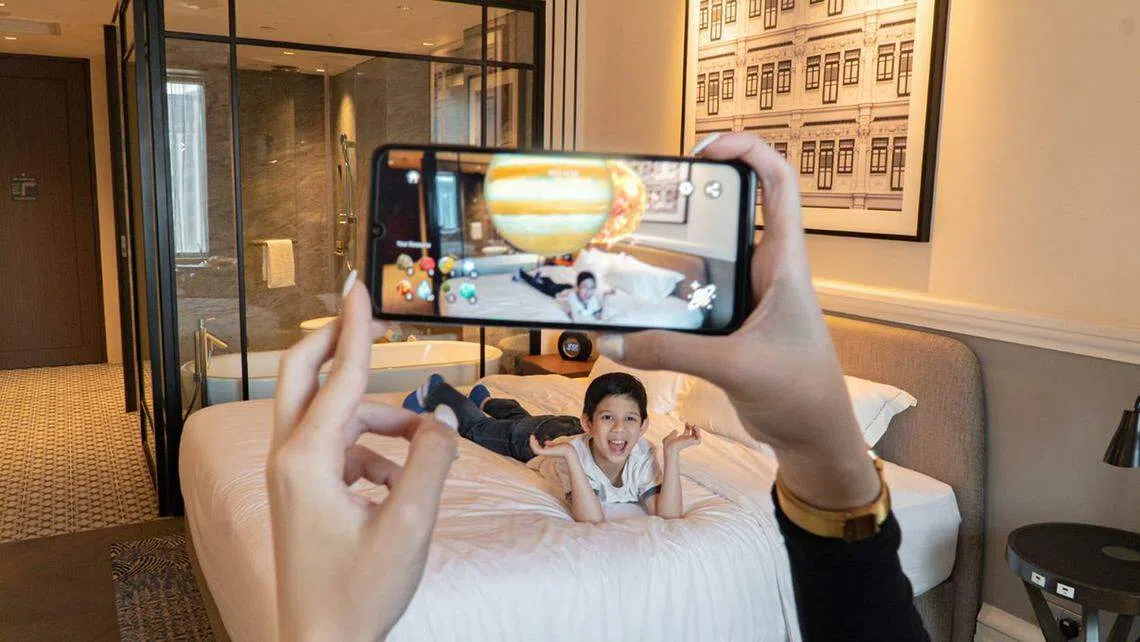
The planets are not too out of reach for guests at Grand Park City Hall, which collaborated with STB to develop a solar system-themed AR mobile app, “A Space Odyssey”.
The hotel has designed a space adventure-themed room package around the app, targeted at families with young children. Using the app, guests can learn more about the solar system by projecting three-dimensional planets around the room, and complete tasks to redeem dining rewards at the hotel’s food and beverage establishments.
General manager Jeane Lim says that Grand Park City Hall is currently the only hotel in Singapore offering an AR room package experience.
“We can’t always be competing based on price, so we were spurred to get creative by coming up with unique themed staycations. Families are also a key target market for us,” she said. The hotel spent a year developing the app before launching it with the room package on Mar 12.
Response has been positive, with most parents “pleasantly surprised” at how realistic the planet projections appear in the rooms.
“It’s an experiment for us, to see if people are willing to pay for such gamified, interactive experiences,” Lim added. “We’re also keen to see if such experiences can increase spending among guests, which is why we incorporated dining rewards.”
Since its launch, Grand Park City Hall’s space adventure-themed package has brought in more than S$100,000 in revenue, with 32 per cent of its bookings made by international travellers and the remaining 68 per cent by Singaporeans.
While the pilot of “A Space Odyssey” was initially slated to end on Jun 30, the hotel is extending its collaboration with STB to offer the room package till the end of the September school holidays due to popular demand, Lim said.
Mandai Wildlife Group: Animals go digital
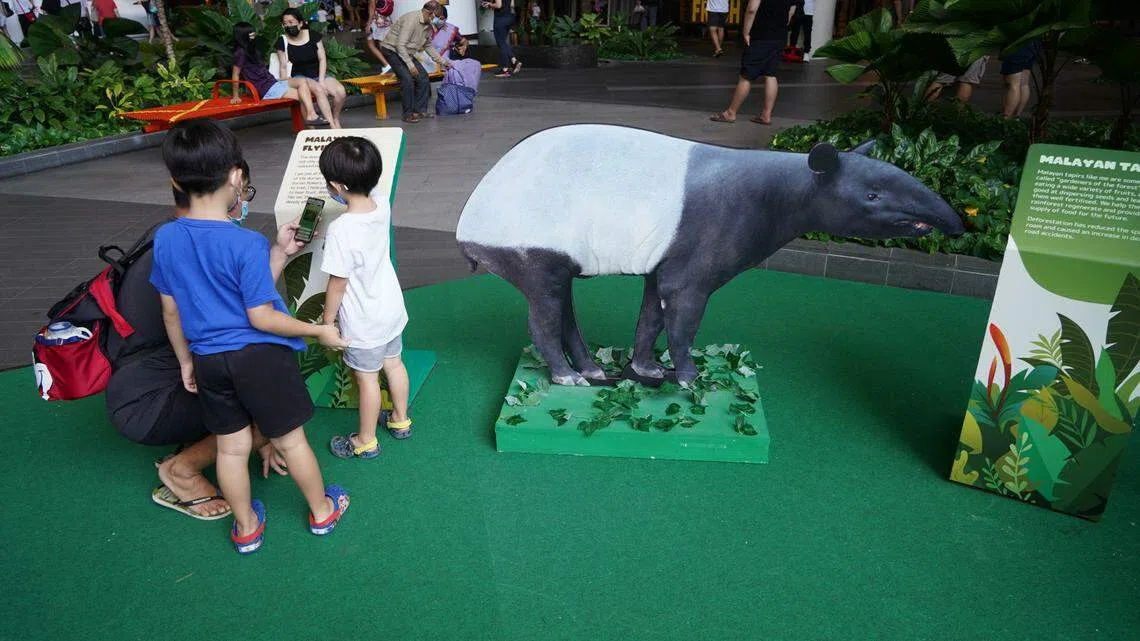
Since late 2020, children have been able to befriend animals from the Singapore Zoo from the comfort of their homes via “My Animal Buddy”, Mandai Wildlife Group’s educational web app.
The app allows them to virtually explore Singapore’s wildlife parks via interactive digital content and weekly missions.
In early 2021, Mandai Wildlife Group joined STB’s Data Transformation Programme (DTP) under Tcube, which aims to find ways for the industry to use data sharing and analytics.
Under the DTP, the group analysed existing data from “My Animal Buddy” to better understand its user acquisition channels and levels of engagement with the app’s content.
“We found that users who subscribed to our app when visiting our parks did not continue to engage with the platform’s content after their visit, as compared to those who had subscribed to the content while at home,” noted Belina Lee, group chief strategy and innovation officer of Mandai Wildlife Group.
Her team realised that such users – mostly parents of children aged 4 to 12 years old – may not have known that they could still access fresh content on the app throughout the year, even at home.
These findings have been key to helping Mandai Wildlife Group retain users and encourage recurring visits to the app.
Lee and her team increased their marketing and outreach efforts – such as sending out more regular email reminders – to inform parents of the availability of new content on “My Animal Buddy”. Such efforts have enabled them to double the number of weekly active subscribers, Lee said. Her team has also since scaled the app up to “Rangers Buddies”, a more comprehensive web app containing more features.
*Amendment note: The article previously said the Singapore Cable Car has 47 years of history, when it should be 48.