Tuition industry gets more crowded, but players are upbeat about prospects
Tuition chains that drill students for exams are becoming passé. Tech-enabled centres now hawk niche areas, soft skills, cross-disciplinary learning

Singapore
FOR all the consternation that Singapore's falling birth rate has caused, it has not stopped the tuition industry from growing - or dampened the conviction of industry players that the demand for their services will stay strong and even increase.
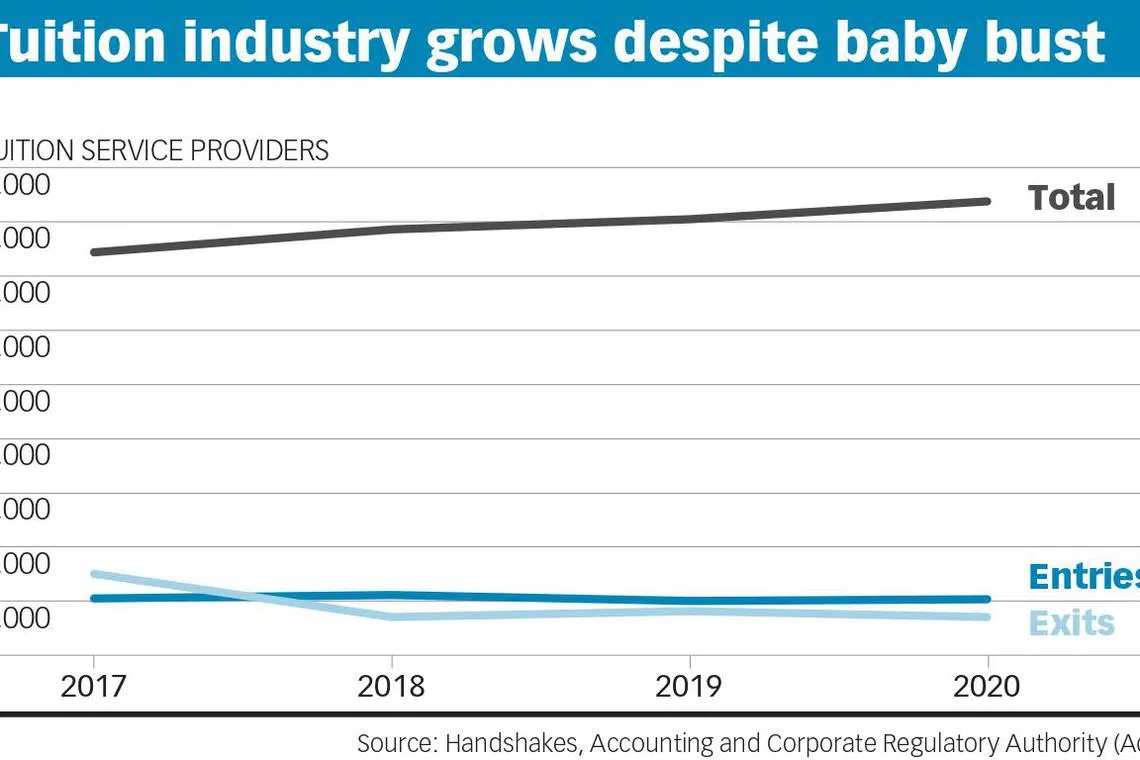
Data-analysis firm Handshakes, studying information from the Accounting and Corporate Regulatory Authority (Acra), found 8,376 active entities offering tuition-related services at the end of last year. (These services included academic tutoring, general secondary and post-secondary, non-tertiary, and higher education programmes.)
The figure was a 12 per cent increase from the 7,447 such entities at the end of 2017 - the year that the Ministry of Education (MOE) announced its biggest school merger exercise in two decades, involving 28 schools - a move which it said was prompted by the declining birth rate.
Tuition service providers told The Business Times that although the number of students may be shrinking, they do not expect demand to fall in tandem.
Alethea Ler, lead teacher and founder of My Chinese Steps Learning Centre, said: "The falling birth rate implies that families are having fewer children. The fewer the children, the more focus and care will be placed on each of these children."
Advo Education Centre founder Kong Yew Kiin agreed: "You want your child to have more opportunities, and you have more to spend. With more children, you would spend less per child."
Indeed, these predictions are borne out by the average household expenditure surveys conducted every five years by the Singapore Department of Statistics.
Average household spending on tuition went up from S$62.70 per month in 2007/2008 to S$88.40 per month in 2017/2018.
The total fertility rate, however, went the other way - from 1.29 in 2007 to 1.16 in 2017.
Industry players have noticed competition getting keener of late, not only in terms of more providers muscling in on their turf, but also in terms of parents who are now savvier about their choices.
Mr Kong, who has been running Advo Education for 14 years, noted that it used to be that only those providers with substantial means to buy print advertisements in local newspapers and magazines had the most effective marketing campaigns.
Today, social media marketing has levelled the playing field, making it possible to reach a large audience and in a more targeted fashion, without needing to produce physical fliers or mailers.
Another trend is that the pandemic has accelerated the use of technology, including the rise of virtual rather than physical classes. Without the need to consider a tuition provider's location in their choices, parents are becoming more selective.
Lily Chew, founder of English tuition provider Lil' but Mighty, pointed out that parents are tech-savvy nowadays, and home-based learning has enabled them to see and judge for themselves how technology is put to use in the classes.
"This means that we need to invest in the right people and explore the use of technology to ensure we bring about an engaging learning experience," she said.
Hamilton Lau, chief executive officer of The Learning Lab, said that the increased competition and shift towards online learning have made it necessary for tuition providers to invest more in staff, classrooms and technology.
Investments in technology also go beyond tools used in classrooms or in online learning platforms. Heuristics Science is investing in artificial intelligence (AI) technology to provide more immediate feedback to students, said its founder Linda Koh. AI technology grades students' work instantly and even provides diagnostic information on the areas that need improvement.
Heuristics Science is also looking into emotion-recognition technology, so that its teachers can track whether students are engaged or distracted - making it a useful tool, given that this is harder to gauge when classes are conducted virtually.
The increased challenges faced by the industry are borne out by revenue and profit data from companies' annual returns filed with Acra in each year, compiled and analysed by Handshakes. Total revenue in the industry rose from S$1.5 billion in 2017, reported by 379 entities, to S$1.68 billion in 2019 reported by 412 entities. (The numbers do not include the income of private tutors who do not register business entities.)
Over the same period, the sum of profits and losses before tax nearly halved, from S$123.1 million in 2017 to S$64 million in 2019.
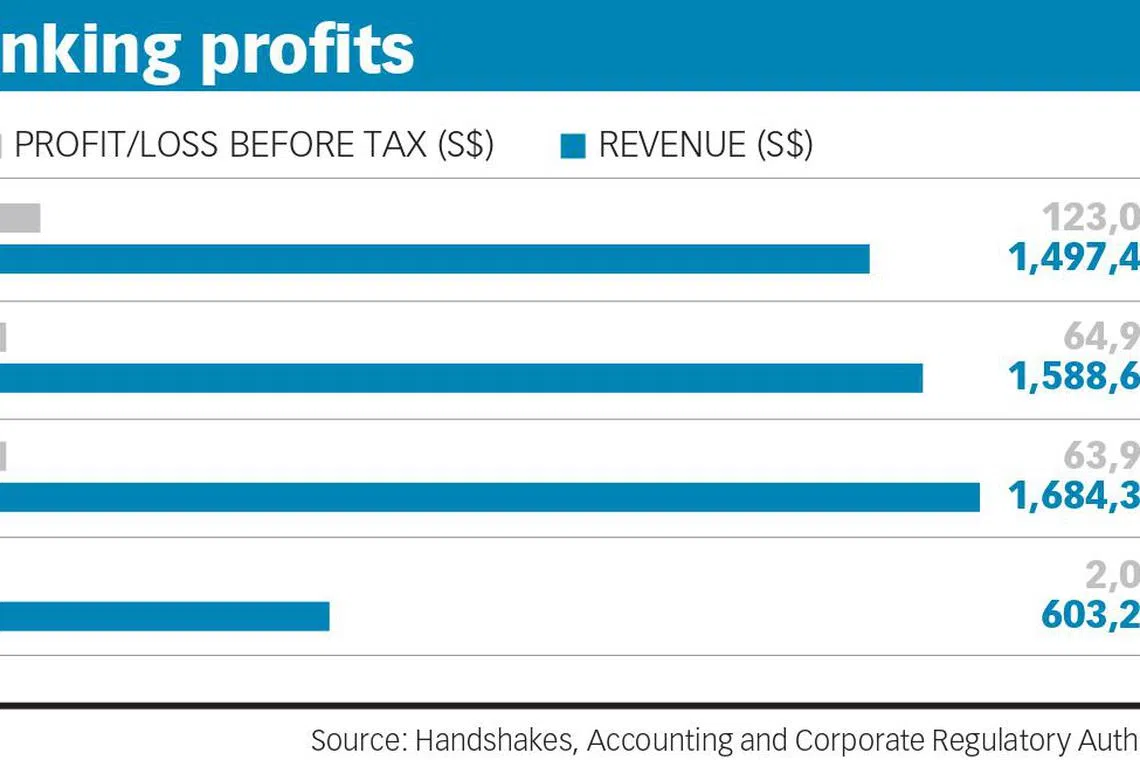
Last year, total revenue reported by 215 entities was S$603.3 million, and total sum of profits and losses was S$2 million.
(It is worth noting that Acra has extended the deadline to companies for holding their annual general meetings and filing their annual returns last year due to operational hurdles posed by the pandemic.)
The percentage of profit-making companies to loss-making companies hovered around 42 per cent versus 58 per cent from 2017 to 2020.
The tuition providers interviewed by BT expressed confidence that the industry will continue growing, although it will come away from the traditional general subject-based methodology and tuition-centre model, both the mainstay for decades.
Standardised examinations, a key driver of demand for tuition, will likely stick around, but their formats may change, requiring tuition providers to adapt.
For example, even as the MOE has moved away from its emphasis on examinations to include more holistic assessments through schemes like Direct School Admission, tuition providers have rolled with the change. Students can now get help from specialised enrichment providers to curate their art portfolios for a better chance at snagging a spot in their desired school, for example.
Heuristics Science director Sunny Tan said the industry will move to align with such new demands, such as the demand for development of skills in communication, innovation and creativity. "Opportunities lost are also new opportunities coming up," he said.
In line with these trends, providers that focus on niche areas will likely benefit in the years ahead. Several providers said they have already seen the industry's shift in direction, with the emergence of more niche providers rather than general tuition centres.
My Chinese Steps Learning Centre's Mrs Ler noted that Singapore's close ties with China mean that Mandarin will continue to grow in importance. The interest in holistic development will also drive demand for language classes, she added, as is happening in the UK, for example, where students are taking up another language like French, or even a third language.
Heuristics Science's Mrs Koh said that instead of just drilling their students in exam strategies, providers will have to teach skills needed for the future, like exploratory learning and self-discovery.
Mr Tan suggested that subject boundaries may become blurred in a move towards more phenomenon-based learning, where students explore cross-disciplinary phenomena and learn problem-solving skills that can be applied in the real world.
Mr Lau of The Learning Lab said: "Ultimately, it is not just Singapore, but rather the entire world, that needs the next generation to be better team players, problem-solvers and out-of-the-box thinkers. "This also means that we must somehow do better in helping children to see the connections between different subjects and disciplines - which may be almost a subconscious process because these connections are never obvious."
Growth in the post-Covid era may also look different from before. The smaller providers, which have one to five locations each, told BT that they do not plan to pursue a tuition chain strategy. Rather, they prefer to grow at a slower pace and ensure that their quality remains high, especially while they figure out how to teach effectively online.
Said Heuristics Science's Mr Tan: "When we talk about expansion, we can't just talk about more centres. That's very traditional. Expansion can be in the digital and online side, and how to combine the online with the physical (side) is the challenging part."
Advo Education's Mr Kong added that being a large tuition chain is no longer as attractive as it once was.
"No longer is it that if you are this brand, you will always exist. Now it is reviews-based, experience-based, and you build your brand based on reviews, not marketing," he said. "It's a consumption pattern that consumers have now. Whether you are a tuition chain or not, the advantage is no longer that significant."
- This study is part of a series by The Business Times (BT) and Handshakes, called the BT-Handshakes Data Series. It is a regular project collaboration to give insights on various business sectors of Singapore, using data from Acra. Singapore Press Holdings, which publishes BT, is a shareholder in DC Frontiers, Handshakes' parent company.