


Udders tailors its scoops of ‘Made-in-Singapore’ ice cream for markets abroad

Renald Yeo
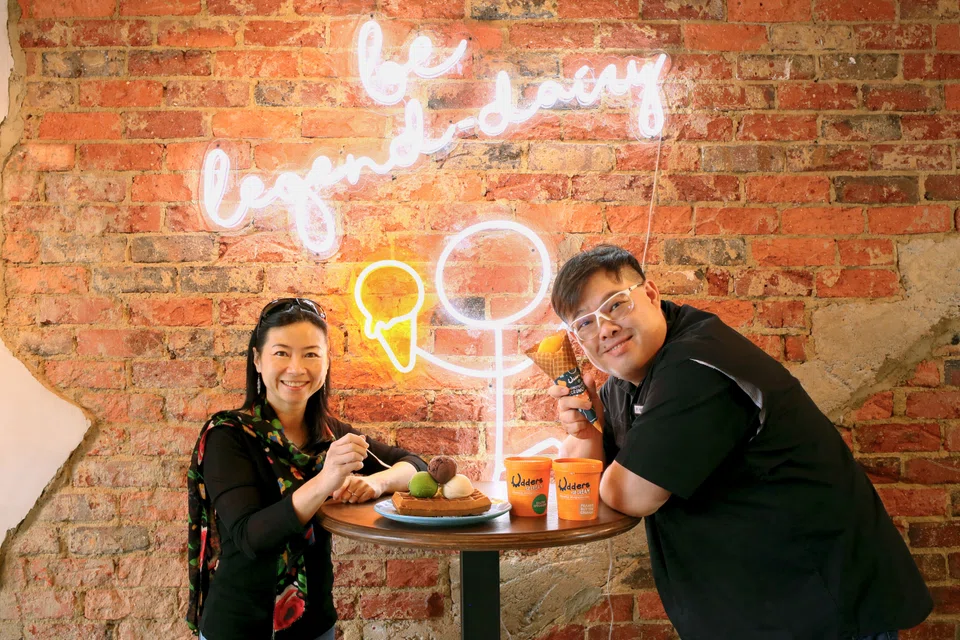
FROM premium durian ice cream in China to vegan scoops with an Asian twist in the UK, Udders is taking a targeted approach to its overseas expansion.
The home-grown ice cream maker aims for overseas sales to account for 60 per cent of its overall revenue in the next three to five years, up from 20 per cent now, co-founder Wong Peck Lin told The Business Times.
In Singapore, the brand has five outlets. Its products are also carried by more than 400 retail points islandwide.
Beyond national boundaries, its ice creams are served on airlines, with national carrier Singapore Airlines being its first airline customer in 2019; other carriers such as Japan Airlines, Vistara and Jetstar were on board later. To date, nearly 10 million cups have been sold for serving at an altitude of 35,000 feet.
Overseas, Udders has outlets in South-east Asia, and banks on retail sales in China.
From Friday (Feb 16), its products will be available in the UK, at Singapulah – a new London restaurant. The brainchild of Singaporean restaurateur Ellen Chew, Singapulah is located in the heart of London’s Chinatown, offering Singaporean cuisine through a rotating menu that features different local food manufacturers.
Four vegan flavours from Udders will be available in takeaway cups and tubs there, as well as incorporated into drinks and desserts. For instance, Wong said, the ice cream may be blended into non-dairy shakes, or plated as part of a dessert.
For now, this will be Udders’ only presence in the UK. This route into the UK market has lower costs and risks, in that it enables commercial buyers and distributors to “try the product in the way it is supposed to be served”, potentially paving the way for wholesale sales.
“If I just give them the frozen cups, it’s not very inspiring,” said Wong. “But if you come to the restaurant, and see how the coconut ice cream can be made into a shake, or how the durian ice cream can actually enhance a plated dessert, then there are all sorts of possibilities for the product that could interest commercial buyers.”
Elsewhere in Europe, the company is looking into exporting its vegan offerings to the Netherlands. Talks with partners there are ongoing. Udders intends to export only vegan products to Europe, because of its dairy-import regulations and evolving consumer preferences there, Wong said.
Durian in China
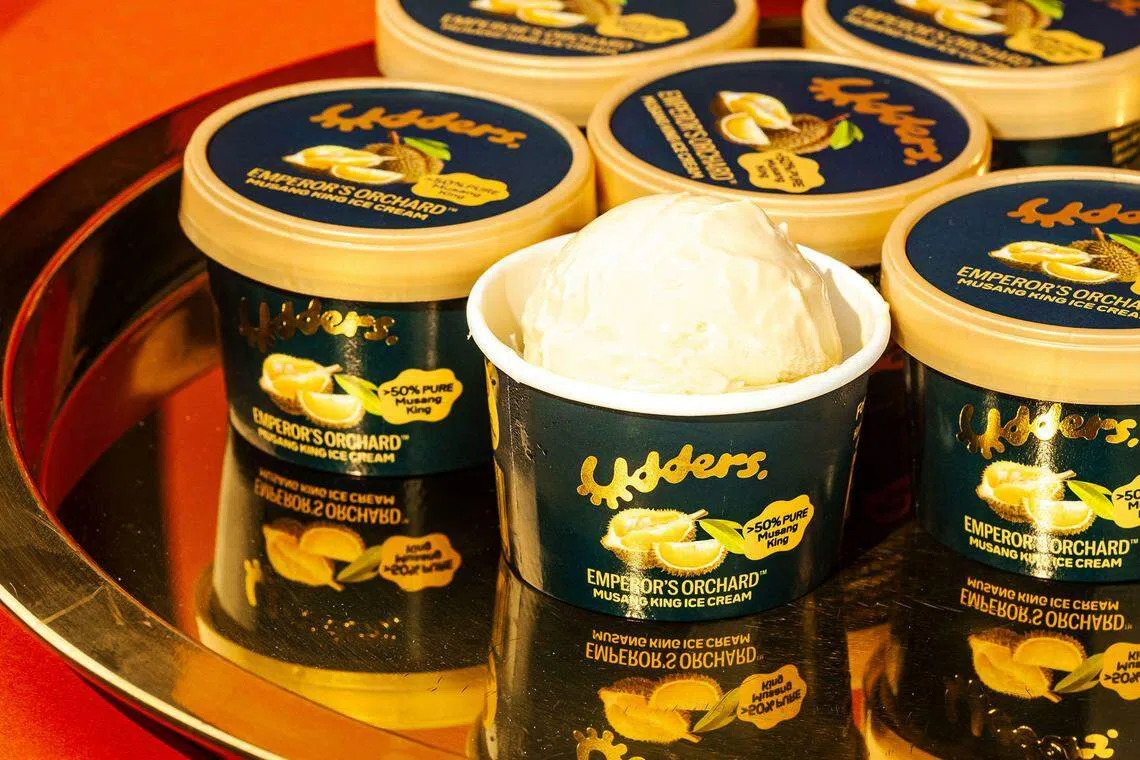
The ice cream maker took a different tack for its foray into China last November. Partnering a China-based importer, it homed in on what Wong dubbed the “super-premium” durian segment.
Its bestseller in Singapore, Emperor Mao – named for the Mao Shan Wang durians from which it is made – is the only flavour exported to China. Known as Emperor’s Orchard there, this durian flavour can be found in the freezers of 47 Sam’s Club “warehouse clubs” in 25 cities there.
Sam’s Club, a subsidiary of US retail giant Walmart, operates on a membership-based retail model, providing products to its members in bulk and at discounted rates in warehouse-like outlets.
Wong said: “The Chinese are still having a love affair with durian. The super-premium Mao Shan Wang ice cream space wasn’t really occupied by anyone yet, and we felt we could fill that gap in China.”
Mao Shan Wang, also known as Musang King, is a prized – and pricey – variety of the thorny fruit, which Udders sources from the town of Raub in Malaysia’s Pahang state.
Not only is the fruit expensive, labour costs are higher than for other Udders products, as the mixture has to be mixed by hand. Udders manufactures all its ice creams in Singapore.
“We use more than 50 per cent durian flesh in every serving of ice cream,” Wong said. “If you run that through the machine, it will pulverise everything into a very even, homogeneous mix, but it loses that fibrous texture.”
By March this year, the company will have exported 12 container-loads of its durian ice cream to China, Wong said. With China being in the grip of winter now, she expects sales to accelerate in mid-year, when it gets warmer.
F&B in South-east Asia
In contrast, Udders entered South-east Asia by opening F&B outlets first, instead of just distributing its products in supermarkets.
That is because consumers there tend to be more price conscious, making it difficult for Udders’ comparatively pricier offerings to compete with local ice cream brands at face value.
“We need to open outlets first to build the brand and provide a more well-rounded customer experience,” said Wong.
“This is so that they know what the brand is all about, rather than just putting our product on the shelf. Nobody would know what it is,” she said.
The overseas F&B outlets operate on a franchise model, through which local entrepreneurs in each market pay a franchise fee and monthly royalties to Udders.
In return, the company provides its made-in-Singapore ice cream and training for key employees, and takes care of marketing and branding.
“The franchise model does reduce a lot of risk for us in navigating the local ecosystems overseas,” said Wong. Most of the capital expenditure incurred in setting up the outlets is borne by the franchisees.
The company has nine outlets overseas: two each in Jakarta and Manila, and five in Malaysia.
Jakarta was the company’s first overseas foray in 2019, before Covid-19 ground the company’s international expansion plans to a halt.
“We couldn’t travel there to train the local staff, (and to) check on the quality of the ice cream,” Wong said.
Post-pandemic, the company aims to at least double its store count in Indonesia, the Philippines and Malaysia this year.
Udders expects to grow its revenue by 20 per cent in 2024, though Wong declined to provide current sales figures. Ice cream production is forecast to grow by 20 to 30 per cent this year, up from some 350 tonnes in 2023.
TRENDING NOW

Easy to rent out, hard to sell: Are buyers losing interest in Singapore’s one-bedroom condos?

GovTech retrenches another 38 staff in second round of layoffs

Stocks to watch: Seatrium, CapitaLand Investment, Keppel DC Reit, Suntec Reit, CLCT, TSH Resources

World’s largest offshore wind platform by Seatrium consortium on track to be completed by 2028

