Work more, earn less: F&B owners brace for double whammy of dining-in ban

Singapore
FATIGUE is the prevailing sentiment among food and beverage (F&B) establishments, with Singapore's dining-in ban set to take effect from Thursday. Players who spoke to The Business Times are preparing for a tough month ahead, and want more rental and wage support.
"It's very tiring, we just feel very tired," said Anthony Low, owner of the Xin Sheng Gor Hiang stall at Boon Lay Place Market and Food Village.
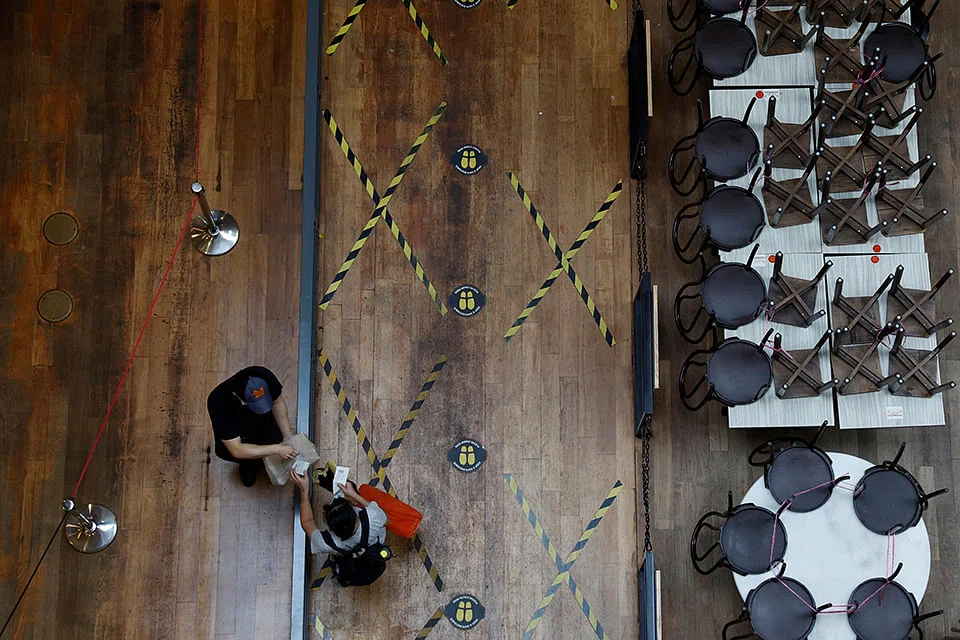
"When the (dining-in) limit changed from two to five people, we took off tags from the tables and chairs, but now we need to put them back; we need to step up everything again. This is a lot of groundwork, but we have no choice, because we know the situation is bad."
For one month from July 22, dining-in for all F&B establishments will be prohibited. This marks a reversion to restrictions under Phase 2 (Heightened Alert).
The ban is a blow to some hawkers who had closed their stalls previously and recently reopened, said Mr Low, who also chairs the hawker division of the Federation of Merchants Association, Singapore (FMAS). They are now considering closing again, as their dishes are not suitable for food delivery.
The restaurant industry is similarly hit hard. Without dining-in, restaurants immediately lose out on the 10 per cent service charge they can otherwise earn, noted Samuel Yik, managing director of Dian Xiao Er.
"It's really a challenge for businesses to break even; only the volume can counteract the loss in our profit margin. We are busier but we earn less," said Mr Yik.
To ramp up volume this year, Dian Xiao Er rolled out more deals such as half-price for a cod fish set that normally costs over S$180. This has received strong support from customers, especially the work-from-home crowd, said Mr Yik.
The challenge, however, is that customers tend to eat less when ordering, as opposed to dining-in, which leads to lower order values. Food delivery apps also charge commissions of about 27 per cent, Mr Yik said.
While the apps' commissions are steep, F&B owners have few other options, said Eileen Li, director of Ming Hing Food, which operates robot fried rice chain Bowl & Bowl.
"Customers don't have to pay a big amount for delivery, but business owners have to bear the costs... But even though the commission is high and our margin is little, it's still better than zero," she said.
With the challenging month ahead, the Restaurant Association of Singapore is calling on the government to mandate rental rebates from landlords. Since the circuit breaker ended, F&B businesses have been operating on a seating capacity of 40 per cent on average, said a statement signed by RAS members including its president, Andrew Kwan.
"We note the record earnings announced by various Reits in recent months, which is not surprising as landlord rental income is spinning freely and hardly remitted. On behalf of F&B tenants, we call on the government to mandate landlords to meaningfully assist in these times of extreme hardship," the statement said.
The RAS also called for rental rebates from landlords to be provided in proportion to the drop in revenues, and to exclude revenue from deliveries.
The association said that it is "unconscionable" for landlords to insist on full rentals when tenants can't operate freely.
Cedric Tang, director of Ka-Soh Restaurant, agreed that mandated rental rebates will be helpful.
More government support for labour costs would also be welcome.
It has been a tough year, noted Mr Tang, after he had to shutter his family's heritage business, Swee Kee Eating House, in May.
"We are definitely very tired, it's difficult to keep up with all the new rules.
"We are hoping that the situation won't be like in May. We are increasing marketing and trying to advertise our delivery services as much as possible."
Beyond the business challenges, F&B owners also hope for more certainty with Singapore's long-term Covid-19 strategy.
"I've seen F&B businesses closing down. The most important thing will be for the government to consider how to control the spread.
F&B is the most directly affected now, but in the long run, a lot of industries are going to be affected indirectly," said Ms Li.
Citing the irresponsible actions of KTV operators that led to a cluster, she added: "I just hope every single business owner will behave."
READ MORE: